Stop Alignment Drift: Cross-Team Clarity, Rhythm, Ownership
What leaders miss about alignment drift
Alignment doesn’t collapse with one bad meeting. It erodes through small compromises. A vague objective here. An extra project there. A dependency nobody clarified. Before long, every team is 10 degrees off. Small angles become big misses. The cure is not more town halls. The cure is an operating system that hard-wires clarity, cadence and ownership into daily work.
Here’s the brutal truth. If your organisation can’t answer three questions on any Monday morning, you’re already drifting:
- What outcomes matter most this cycle, and how will we measure them?
- Who owns each outcome and what decisions sit where?
- When, exactly, will we look up, look back, and look forward together to adapt?
If those answers aren’t immediate and consistent across teams, drift has started.
Why alignment drifts across teams
Let’s name the culprits so we can kill them.
- Goals are fuzzy or output-based, not outcome-based. Work becomes busy, not effective.
- Decision rights are unclear. People escalate by default and slow the whole system.
- Cadence is inconsistent. You plan yearly, talk weekly, and change randomly.
- Ownership is diluted. Many contributors, no single accountable person per deliverable.
- Interfaces between teams are vague. Hand-offs get stuck in the cracks.
- Explore and exploit work compete for the same attention and resources.
- Challenge is unsafe. Teams won’t speak up fast enough to correct the course.
Each of these has a straightforward countermeasure if you install the right operating rhythm and governance.
The operating system to stop alignment drift
Principle 1: One compelling narrative, made tangible
Strategy must be precise enough to steer weekly work. Do that by setting a small number of Objectives with 3–5 measurable Key Results. Then design Initiatives that directly advance those KRs. Treat OKRs as a build-system for strategic change, not as performance appraisals or personal goals. Avoid cascaded command-and-control. Invite teams to propose their contribution to the OKRs. And above all, install an OKR system, not set-and-forget goals, so the whole organisation reviews, reinforces and adapts rhythmically. That is how you protect alignment and focus at scale .
Principle 2: Ruthless rhythms that prevent drift
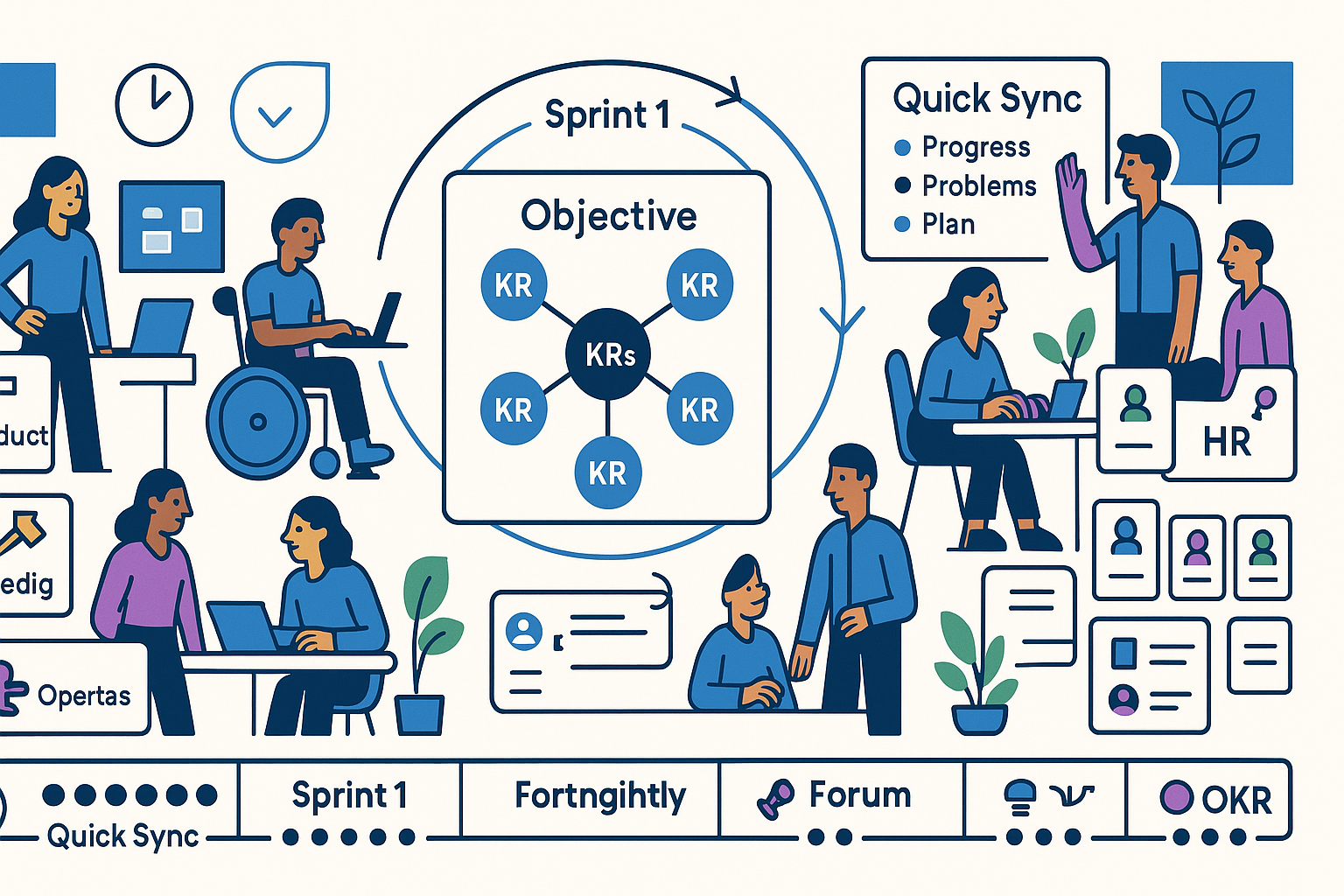
Every team needs a shared beat. Use short Sprints, never longer than two weeks, and daily Quick Syncs to surface progress, problems and next steps. Frequent check-ins are the antidote to mission drift and lost focus. Don’t shift goalposts mid-Sprint. Review together at the end, learn, then adjust the next cycle . Align the whole organisation with a Looking Up, Looking Back, Looking Forward cadence across squads to keep perspective and momentum synchronised . At the portfolio level, define your productivity rhythms clearly. Decide what work gets done and by whom, then schedule when you will review and decide. Strategic and tactical loops must be explicit, or drift will creep in unnoticed .
Principle 3: Single-point ownership and clear decision rights
Nothing drifts faster than a deliverable with shared ownership. Assign exactly one accountable owner for every Initiative, Epic, Story and Deliverable. Teams may contribute, but one name owns each item. Define deliverables as nouns, not verbs, so it’s obvious what will exist by the review. This increases accountability and gives teams freedom on the how. Pair this with documented decision rights and Leader’s Intent for every priority so decisions stick at the edge and don’t boomerang upwards. Convert tasks to outputs. Run short Sprints with daily Quick Syncs to make progress visible and inspectable .
Principle 4: Make interfaces explicit, not heroic
Silos don’t cause drift. Undefined interfaces do. Mandate mapping clarifies purpose, jurisdiction, authority and decision rights. Use it to align vertical and horizontal accountabilities so components are complementary and non-conflicting. When mandates are clear, teams collaborate by design rather than by heroics. Where the degree of work-process interdependency is high and functional conflict exists, integrate or create explicit compensating mechanisms. Otherwise, separate interfaces cleanly to minimise coordination cost. This is how you stop work falling between teams and keep flow tight .
Principle 5: Outcomes over activities, end-to-end
Translate strategy into a single end-to-end backlog: OKRs → Initiatives → Epics → Stories → Deliverables → Tasks. Agree levels and time horizons so each layer can be reviewed at the right cadence. Explicitly describe value, who receives it, and how you will know it’s done. Capture everything on the backlog and prioritise by impact, effort, learning, and progress. Use Quick Syncs to keep work flowing and problems visible. This gives you a common language across teams and prevents the classic trap of competing project lists and invisible work .
Principle 6: Separate explore from exploit so focus survives
Alignment collapses when discovery work competes with delivery work in the same lane. Use OKRs for exploit work that builds the current business. Use AKIs, Aspirations and Key Insights, for explore work that searches for new value. Keep these pipelines distinct, reviewed on their own merits, and resourced deliberately. This prevents strategy tourism and protects both innovation and execution .
Principle 7: Build the conditions to challenge early and often
Drift thrives where people bite their tongues. Psychological safety isn’t comfort, it is the permission to raise tough issues without consequence. Use blameless debriefs, calibrate support and challenge, and model curiosity. That is how truths surface early enough to course-correct without drama .
Five alignment moves your leaders must standardise
- Publish Leader’s Intent for every priority. State the purpose, key tasks, and desired end-state. Push decisions to the edge with clear decision rights and a single owner per decision. Then inspect outputs, not process. This builds speed without losing control .
- Run the Looking Up/Back/Forward cadence. Every squad answers three questions in a fixed rhythm: big picture context, what we achieved since last review, what we will achieve next. It keeps local work tethered to enterprise goals .
- Use two-week Sprints and daily Quick Syncs. Progress, problems, plan. Short, sharp, visible. Mid-Sprint goalpost changes are extremely rare. Review at the end and adapt the next cycle. This prevents mission drift in real time .
- Define deliverables as nouns. “A tested onboarding flow v2,” not “improve onboarding.” One owner per deliverable. Inspect at the Sprint review. This simple language shift tightens accountability system-wide .
- Create cross-team forums with clear accountabilities. Use them to resolve conflicts fast, clarify dependencies, and maintain a single narrative across squads. Combine this with a small set of lead measures and a rhythm of review to sustain alignment under pressure .
Your anti-drift meeting architecture
- Weekly: Team Quick Syncs. 15 minutes. Progress, Problems, Plan. No storytelling, just clarity. Log blockers and decision requests. Escalation paths are clear and pre-agreed .
- Fortnightly: Sprint Review and Planning. Inspect deliverables, decide what to stop, start, continue. Define next Sprints with nouns. Do not change goals mid-Sprint unless the world changed. Review together and invite improvement ideas .
- Monthly: Cross-team Alignment Forum. Looking Up/Back/Forward across squads. Resolve interdependencies and re-sequence work. Publish decisions and update the single backlog .
- Quarterly: OKR Review and Reset. Evaluate outcomes, prune zombie work, and reset KRs with a bias to fewer, clearer, higher-impact targets. Reinforce the OKR system, not just the artefacts .
Hard-wire accountability without bureaucracy
Open accountability increases performance and lowers meeting bloat when people can see peer progress and contribution. Make outcomes and owner names visible. Keep the scoreboard small and lead-focused. This raises the cost of drift, publicly, and reduces the need for heavier controls .
Design interfaces that stop hand-off friction
Most cross-team failures are design failures. Use Mandate Mapping to define domain, purpose, decision rights and authority. Aim for complementary, non-conflicting mandates with minimal overlaps and underlaps. Where interdependency is high, integrate or establish compensating mechanisms consciously, not ad hoc. This is what minimises coordination cost and preserves speed as you scale .
Make strategy useful on the frontline
Strategy without translation causes drift. Use an agile productivity stack with explicit layers from OKRs down to Tasks, each with an agreed time horizon and owner. Everyone should know which level they are operating at and when it is reviewed. That shared architecture turns strategy into weekly traction and gives you a single language for alignment .
Implementation plan: 90 days to alignment you can feel
Days 0–30: Clean the signal
- Publish the enterprise Objectives and 3–5 measurable KRs. Kill or park work that doesn’t move a KR.
- Stand up Quick Syncs in every team. Define Sprint length.
- Identify owners for all active Initiatives, Epics and Deliverables. Document decision rights for the top ten decisions that stall progress .
Days 31–60: Build the interfaces
- Map mandates for core teams and set cross-team forums.
- Install the Looking Up/Back/Forward cadence across squads.
- Convert deliverables to nouns. Publish Leader’s Intent for each priority. Start monthly alignment forums that publish decisions to the single backlog .
Days 61–90: Raise the bar
- Separate explore and exploit pipelines. Add AKIs for discovery and OKRs for delivery.
- Introduce blameless debriefs and simple safety checks to surface issues early.
- Trim metrics to a few lead measures. Enforce the no mid-Sprint goalpost move rule. Tighten review-to-reset loops across all levels .
See the whole system: the 6Ps alignment map
- Purpose: Is the why clear and connected to daily work?
- People: Do leaders have the skills and safety to challenge and decide?
- Proposition: Are we crystal clear on value and trade-offs?
- Process: Are mandates, interfaces and review rhythms defined?
- Productivity: Do we have a small set of lead measures and a visible backlog with single owners?
- Potential: Is explore work distinct from exploit with its own cadence and criteria?
Metrics that keep drift out
- Three to five lead measures per team, not vanity lags.
- Percentage of deliverables reviewed on time per Sprint.
- Number of mid-Sprint goal changes. Target near zero.
- Dependency cycle time across teams from raise to resolve.
- Percentage of work aligned to active KRs by effort.
Anti-patterns to kill this month
- Cascading OKRs as tasks for everyone. Invite contribution, don’t impose. Set an OKR system, not a poster. This reduces sandbagging and silos .
- Multiple owners per deliverable. It is a design error. Single owner only, inspect outputs, not process .
- One-size-fits-all cadences. Align rhythms, yes. But keep Sprint discipline local and strict. Frequent check-ins prevent drift better than big meetings ever will .
- Undefined mandates between squads. Clarify purpose, authority, and decision rights. Choose integrate or separate explicitly. Don’t leave it to chance .
- Mixing explore and exploit. Use OKRs to build the business you have. Use AKIs to find the business you’ll need. Keep them separate or you’ll deliver neither .
Final word
Alignment is not a motivational speech. It is a set of design choices you make visible and repeatable. Install a single narrative. Enforce a ruthless rhythm. Assign real ownership. Design the interfaces. Separate explore from exploit. Create the safety to challenge early. Do these with discipline and drift stops. Momentum returns. Results follow.
Next Steps
Want to learn more? Check out these articles:
Decision Rigour: Make Fewer, Faster, Better Calls That Stick
Balance Authority and Autonomy: A Blueprint for Speed and Trust
Raise the Leadership Signal-to-Noise Ratio [Leader's Guide]
To find out how PerformanceNinja could help you, book a free strategy call or take a look at our Performance Intelligence Leadership Development Programme.