
Decision Rigour: Make Fewer, Faster, Better Calls That Stick
If you’re honest, your organisation doesn’t suffer from a lack of brains
It suffers from a lack of decision rigour. Work stalls not because people are lazy, but because choices are fuzzy, rights are unclear, and decisions don’t stay decided. You know the pain: meetings that end without a commit, escalations that arrive too late, bureaucracy creeping into everything. If that stings, good. Let’s fix it.
What is decision rigour?
Decision rigour is a repeatable system for making high‑quality decisions quickly, with clear ownership, clean communication, and tight follow‑through. It is not more meetings. It is not theatre. It is an operating standard that reduces noise, speeds flow, and locks in learning so your next call is even better than your last.
At PerformanceNinja, we define an Operating System as the set of processes and structure that dictates how decisions are made, how work is executed, and how objectives are achieved. Decision rigour is the beating heart of that system, not a side process you bolt on later .
The uncomfortable truth leaders must face
Four predictable failure modes explain most decision chaos:
- Decision fog: Nobody knows who decides what. Hand‑offs blur. Authority and accountability are misaligned, creating either resentment or reckless calls when the two diverge .
- Decision theatre: You have long discussions, short clarity, and no explicit right to decide. People leave meetings with impressions, not commits. Work drifts.
- Decision drift: Even when a decision is made, it isn’t captured, communicated, or linked to execution cadences and OKRs. Tasks slip because the decision’s consequences were never concretised in the weekly rhythm .
- Decision whiplash: Decisions get reopened based on opinions, not new data. The same questions resurface because no one established conditions to revisit or a process to learn from outcomes. You repeat debates instead of running debriefs and extracting learning .
Rigour resets this. It names the decision type, clarifies rights, sets the cadence, defines inputs, documents the call, broadcasts the commit, and runs the learning loop. Every time.
The Decision Rigour System: seven non‑negotiables
You don’t need 500 pages. You need a simple, disciplined kit that everyone can use.
1) Classify the decision before discussing it
Stop arguing without agreeing what kind of decision you are making. Two distinctions matter most:
- Explore vs Exploit: Are we making a decision to search and learn (high uncertainty) or to optimise and scale (low uncertainty)? Don’t mix them. Explore uses experiments. Exploit uses standards and throughput targets .
- Strategic vs Operational: Is the choice setting direction or executing it? Strategic calls demand broader context and slower revocation. Operational calls demand speed and reversible framing.
This step alone kills 30% of meeting waste because people stop using exploit logic to kill explore options, and stop using explore drift to avoid exploit commitments.
2) Make decision rights explicit every time
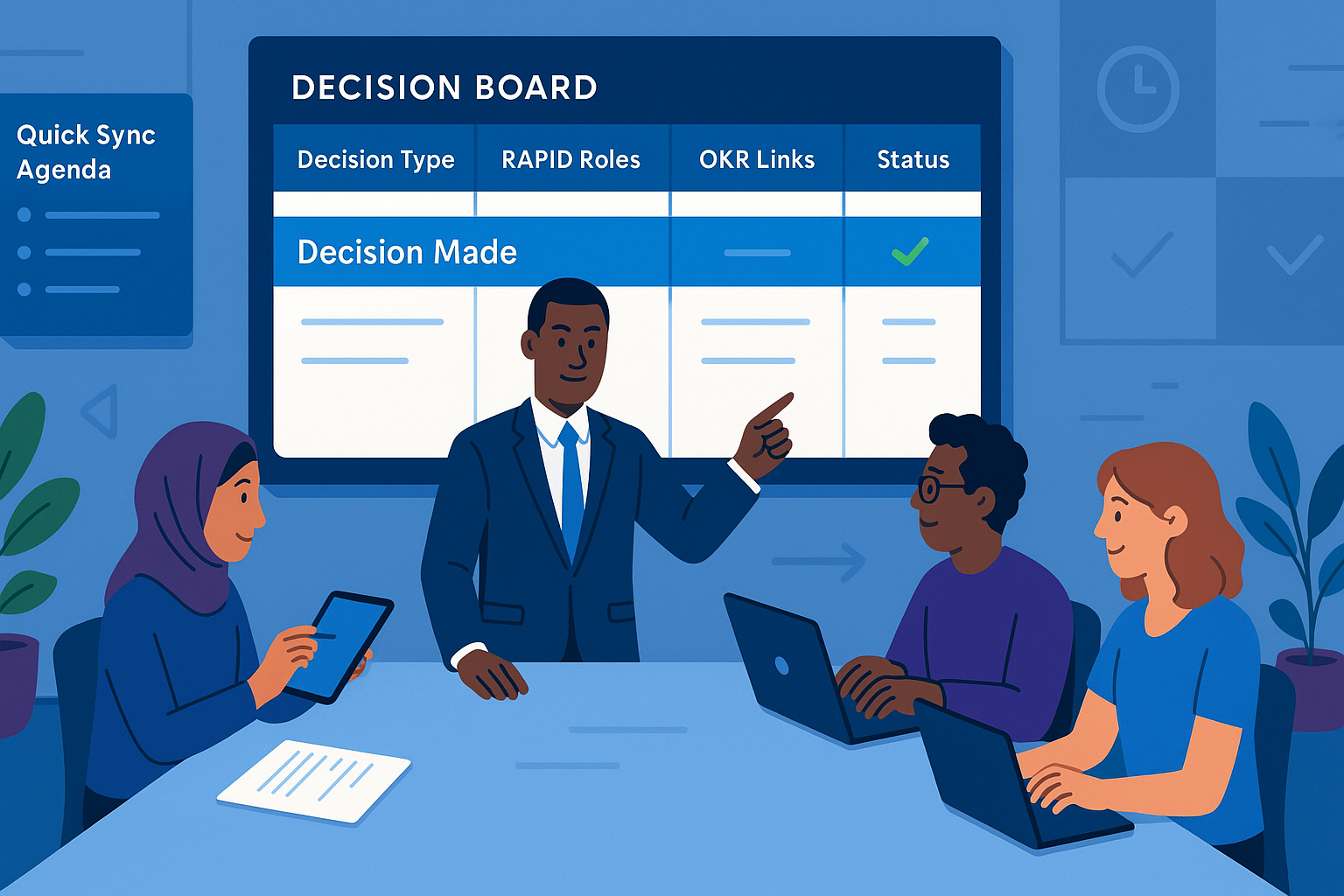
Use a lightweight, visible schema. RAPID works well because it distinguishes who Recommends, who must Agree, who Performs, who provides Input, and who Decides. Assign names in writing before debate. No name, no discussion .
Then align authority and accountability. If someone is accountable for execution but lacks the decision right, expect resentment and sandbagging. If they have the decision right but not the accountability, expect recklessness and shortcuts. Balance the two or pay for it in rework .
3) Set cadences and channels that force clarity
Rigour is rhythm. Use two loops and stick to them:
- Strategic loop: Quarterly OKRs that make direction explicit. State the objective and 3–5 key results. If a decision doesn’t move a key result, prune it. Publish goals, boundaries, and linkages so context is obvious and decisions align across teams .
- Tactical loop: Weekly or twice‑weekly Quick Syncs. Convert decisions into deliverables, owners, and dates. End every meeting with commit statements and a visible log of decisions made. If it’s not captured, it didn’t happen .
These loops reduce over‑escalation, keep windows open, and stop status theatre. They also reinforce Leader’s Intent so teams can move without waiting for permission .
4) Demand data, not volume
You don’t need endless packs. You need the right inputs. Ask for:
- One‑page brief: decision, options, recommendation, risks, trade‑offs, proposed metrics.
- Relevant data modes: descriptive to say what happened, diagnostic to say why, predictive to forecast, prescriptive to suggest what to do. If you have data, let’s look at data. If you don’t, be clear you’re using judgement and why. It’s better to be explicit than to pretend .
- Clear visuals: prioritise what matters, reduce clutter, provide context across time and categories. Start with the user of the decision, not the analyst’s convenience .
- Pre‑mortem for big bets: what could fail, and how do we reduce likelihood or impact now? Red‑team critical assumptions before committing .
5) Use Leader’s Intent to speed safe autonomy
Leaders must broadcast intent so teams can act without over‑escalation: I intend to achieve X, within these boundaries, using these linkages. Bias to action, empower ownership, and coach for safety. Publish decision rights and boundaries, then get out of the way .
6) Apply fair process so decisions stick
Execution quality depends on perceived fairness, not just correctness. Give people engagement in shaping options, explain the reasoning behind the final call, and set clear expectations for execution. Engagement, explanation, expectation. It’s not consensus. It’s disciplined legitimacy .
7) Close the loop with debriefs and failure analysis
Every material decision should produce learning. Run blameless debriefs. Ask Start/Stop/Continue, leverage data, capture next moves, and assign owners with dates. For misses, use the 5 Whys and document root causes. Build a visible decision database. If you didn’t learn, you just paid tuition and skipped class .
The hard costs of poor decision rigour
Look at your week. How many meetings exist because you didn’t get the decision right the first time? Late escalations. Reopened debates. Parallel work in opposite directions. This is why execution slips, culture dilutes, and bureaucracy creeps in. It isn’t people. It’s systems. High‑performing organisations operate as a team of teams with empowered execution, shared context, and disciplined decision protocols. Centralised control fails in complexity; empowered execution with rigour wins it .
A 30‑day playbook to raise decision rigour
You don’t fix this with posters. You fix it with moves. Here’s what to do in the next month.
Week 1: Diagnose and set standards
- Publish a one‑page Decision Standard: classification, RAPID roles, required inputs, communication, logging, and debrief expectations. Make it the default for all material decisions starting now .
- Inventory your Top 10 open decisions. Classify each as Explore or Exploit, Strategic or Operational. Name a Decider and a Recommender for each today .
- Set up a Decision Log in your work system. Every decision captured with date, owner, rationale, conditions to revisit, and links to tasks. If it isn’t in the log, it isn’t a decision.
Week 2: Align cadences and context
- Refresh your OKRs to make trade‑offs explicit. Cut any work that doesn’t move a key result. Publish goals, boundaries, and linkages so teams stop guessing .
- Introduce two Quick Syncs per week. End each with commit statements and a recap of decisions made and decisions needed. Make follow‑through visible and social, not private and silent. Open accountability to teams increases performance, especially for the laggards .
Week 3: Upgrade inputs and rights
- Mandate the one‑page decision brief for any call above a small threshold. No brief, no decision discussion. Data first, noise last .
- Rebalance authority and accountability on three critical workflows. Remove situations where people are blamed for outcomes they cannot decide, or decide without owning outcomes .
Week 4: Lock in learning
- Run debriefs for two recent major decisions. Capture learning, identify system fixes, and update the Decision Standard accordingly. Keep it blameless and evidence‑based .
- Train managers to state Leader’s Intent in writing for the next sprint. Explicit context increases speed and reduces over‑escalation .
Decision scorecard: what great looks like
Measure decision performance like you measure sales. Track it. Improve it.
- Time to decision: clock from problem defined to decision made. Target: reduce by 30% within two quarters.
- Time to commit: clock from decision to first deliverable shipped. Target: within one sprint for operational calls.
- Reopen rate: percentage of decisions reopened without new data. Target: under 10%.
- Decision clarity: percentage of decisions in the log with named RAPID roles, rationale, revisit conditions, and linked tasks. Target: 95% completeness .
- Debrief rate: percentage of material decisions debriefed within two weeks of outcome. Target: 90% .
- Alignment rate: percentage of decisions explicitly linked to an OKR. Target: 100% for strategic and cross‑team decisions .
How decision rigour maps to the PerformanceNinja 6Ps
Rigour is not an island. It is the backbone across your system.
- Purpose: Clear goals, boundaries, and linkages give decisions a compass. Without them, decisions fragment and culture dilutes. Publish them and enforce them to align choices upstream and down .
- People: Train managers to use Leader’s Intent, to run fair process, and to debrief. This builds psychological safety and decisive execution, not niceness without outcomes .
- Proposition: Distinguish Explore from Exploit. Protect experiments from exploit governance. Protect exploit throughput from explore distraction. Your portfolio needs both, governed differently .
- Process: Build decision protocols into your Operating System. Decision‑making protocols, communication channels, workflows, reporting structures, and performance metrics all connect. Treat decision rigour as a core process, not a bolt‑on .
- Productivity: Run strategic and tactical rhythms. Convert decisions into deliverables, owners, dates, and visible weekly review. This is where speed comes from .
- Potential: Use pre‑mortems, red‑teams, and debriefs to turn decisions into compounding advantage. Resilient organisations don’t just bounce back. They accelerate into the new reality because their decision loops compound faster than the market’s shocks .
Tactical templates you can lift today
- Decision brief template: One page. Decision, context, options, recommended option with trade‑offs, metrics, risks, RAPID roles, conditions to revisit.
- Decision log fields: ID, title, date, decider, recommender, contributors, decision type, rationale, conditions to revisit, linked OKR, linked deliverables, status, learning notes.
- Meeting close script: “Before we end, read back the decisions we made. Who owns each, by when, and what deliverable will we see at the next sync?” If you cannot answer, the decision isn’t real.
- Debrief script: “What did we intend? What happened? What will we start, stop, continue? What one system change will prevent this miss next time?” Log it or lose it .
Implementation plan (high‑level)
- Set the standard: Publish the Decision Standard and train managers to use it.
- Wire the rhythms: Lock in the OKR and Quick Sync cadence. Protect the time.
- Instrument the loop: Implement the decision log and dashboards. Track the scorecard.
- Coach the behaviours: Reinforce Leader’s Intent, fair process, and debriefs. Model it.
- Prune the noise: Sunset legacy forums that don’t end in commits. Consolidate decision points into your new rhythms.
The expectation reset
Decision rigour is a leadership choice, not a software purchase. It will feel blunt at first. Good. That bluntness is clarity. Your job is not to have all the answers. Your job is to build the system that gets to better answers faster, again and again. When your managers can state their intent clearly, assign decision rights quickly, demand the right inputs, close meetings with commits, and learn out loud, speed increases, culture strengthens, and results stick.
One final provocation: audit your calendar. How many sessions this week exist because a previous decision lacked rigour? Cancel the theatre. Install the system. Decide once. Decide well. Then move.
Next Steps
Want to learn more? Check out these articles:
Balance Authority and Autonomy: A Blueprint for Speed and Trust
Raise the Leadership Signal-to-Noise Ratio [Leader's Guide]
Decide Faster Without More Meetings: The Leader’s Playbook
To find out how PerformanceNinja could help you, book a free strategy call or take a look at our Performance Intelligence Leadership Development Programme.