
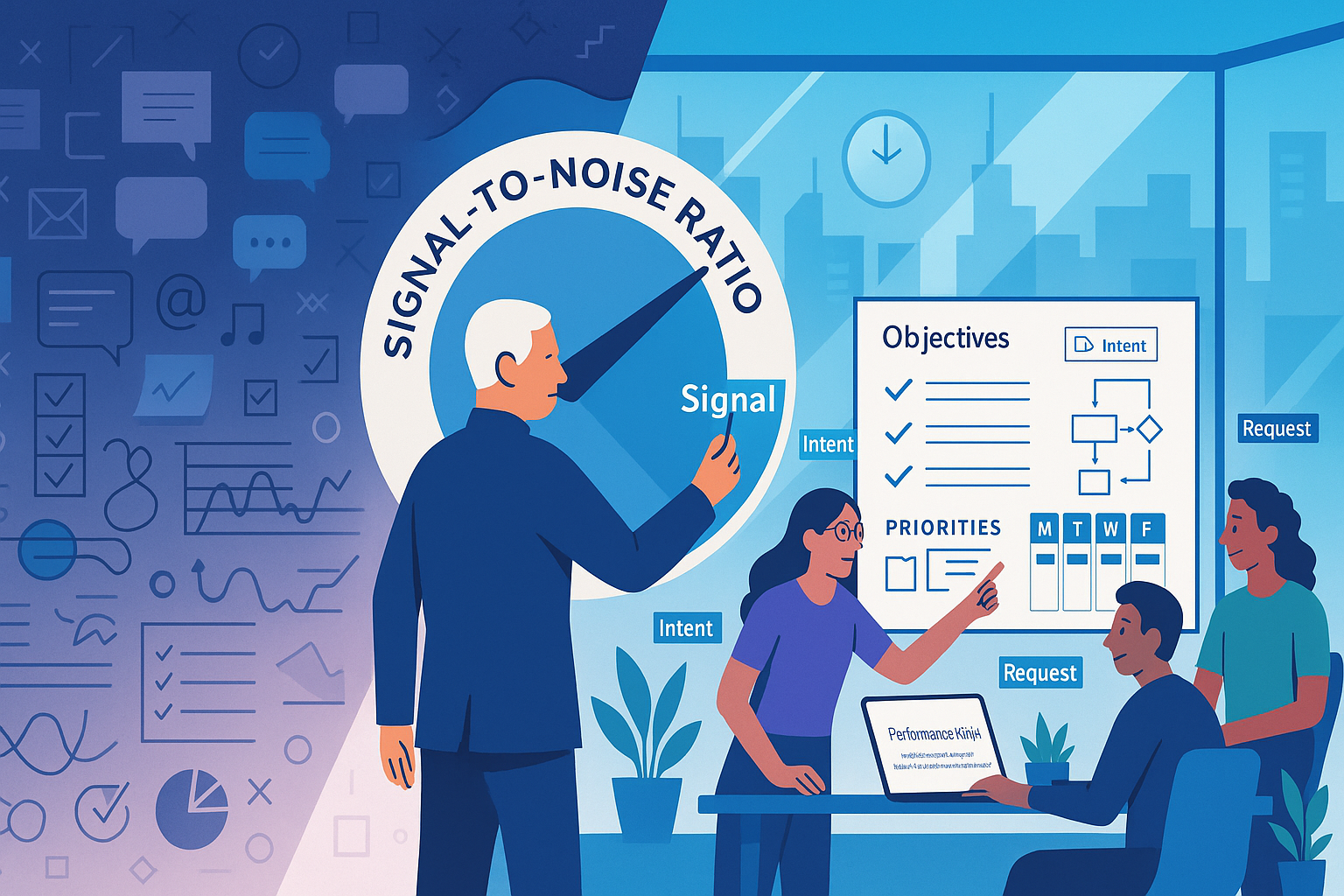
Raise the Leadership Signal-to-Noise Ratio [Leader's Guide]
If you walk into your week feeling busy but blurry, your leadership signal is drowning in noise. Pings multiply, meetings sprawl, dashboards compete, and somewhere between the strategy offsite and the Wednesday all-hands, the message degrades. People work hard. Few work on the right things. That is not a work-rate problem. It is a signal-to-noise problem.
The brutal truth. Your primary job is to transmit intent at high fidelity so people can act decisively without you. Anything that distorts, dilutes or delays that intent is organisational noise. Cut the noise and your organisation compounds. Leave it alone and it compounds too, in the wrong direction.
This guide will show you how to raise your leadership signal-to-noise ratio fast. You will get practical tools, a 90-day plan, and the operational disciplines that separate noisy leaders from precise ones.
What do we mean by signal and noise?
Signal is the small set of clear, stable messages that drive action. Noise is everything that distracts, confuses or fragments that action.
Leadership signal, in practice, is:
- Leader’s intent. The non-negotiable outcomes and operating rules that guide trade-offs.
- Priorities. A ruthless short list of what matters now and what can wait.
- Decision rights. Who decides, who advises, who is informed. No ambiguity.
- Standards. How we do the work, to what quality, by when.
- Cadence. The rhythm that aligns weekly work with strategic outcomes.
Noise shows up as:
- Vague direction. Ten objectives, fifty initiatives, and no sequence.
- Meeting fog. Updates with no decisions. Recurring sessions with no agendas.
- Metric overload. Thirty dashboards. No vital few.
- Policy creep. Rules added after every incident. Principles forgotten.
- Tool thrash. Six channels, no protocols. Everyone shouts. No one hears.
If your team cannot repeat your top three outcomes and how to make trade-offs by Tuesday morning, your signal is weak.
Symptoms that your signal-to-noise ratio is low
These symptoms are common. None are trivial. Each one taxes speed and morale.
- You cannot get everyone working on the right things at the right time. Priorities exist only as slides, not as weekly commitments.
- Execution slips because there is no system to follow up with tasks. Work scatters across chats, emails and boards.
- Culture dilutes as you scale. New joiners learn folklore, not first principles.
- Cross-team work feels hard. Interfaces between departments are unclear and clients feel the seams.
- Bureaucracy creeps in. Reviews multiply. Decisions stall. Energy drops.
- You struggle to find truth-tellers. Signals filter as they rise. People polish, then present.
- Change becomes slower. More elements to consider, no clear pattern to follow.
- You need roles you are not ready to hire for. Structure lags strategy.
- Innovation either distracts from core delivery or withers on the vine. No pipeline discipline.
- People problems multiply. Friction grows where clarity is missing. Former stars struggle as new leaders.
- The business model works on paper but will not scale cleanly. Too much special-case handling.
Noise is not accidental. It is the default outcome of growth without design.
Use the 6Ps lens to locate signal loss
At PerformanceNinja, we use a 6Ps lens to find and fix noise. Keep it high level and practical.
- Purpose. If your why, how and what are vague, teams invent their own versions. Fix by writing a single page Leader’s Intent with outcomes, boundaries and decision rules.
- People. If capability mismatches exist, you get rework. Fix by levelling roles, building coaching capacity, and teaching leaders to decide, not defer.
- Proposition. If strategy is muddled, product choices splinter. Fix by sequencing bets and stating what you will not do.
- Process. If systems are bloated or undefined, work slows. Fix by mapping flows and removing approvals that add time but no quality.
- Productivity. If alignment rhythms are absent, teams drift. Fix by building a weekly operating rhythm from outcomes to commitments.
- Potential. If innovation is unmanaged, it either hijacks the core or dies in a lab. Fix by limiting work-in-progress and staging gates.
This is not theory. It is a practical way to see where the signal decays.
Raise the SNR: A tactical playbook
This is a precise, field-tested set of actions. Apply in order. Do not skip.
- Write a one-page Leader’s Intent
- Outcomes for the next 90 days. Three only, outcome phrased, with measures.
- Non-negotiables. Principles that guide trade-offs, for example default to client impact over internal preference.
- Decision rights. One line per domain. Who decides, who advises, who is informed.
- Constraints. Budgets, timelines, compliance boundaries.
- Operating rhythm. How we set, review and learn each week.
- Cap priorities and stage them
- Company: maximum three strategic outcomes for the quarter.
- Function: maximum three that align to the company outcomes.
- Team: maximum three that align to the function outcomes.
- Stage them. Not everything starts in week one. Sequence matters.
- Install an information triage protocol
- Subject line tags in email and chat: [Decision], [Intent], [Request by DD/MM], [Risk], [FYI].
- Responses match the tag. Decisions get a clear decision, not a discussion.
- Route long-form updates to a weekly async digest. Reserve synchronous time for debate or commitment.
- Map decision rights in one page
- For your top ten decision domains, write a simple table: Domain, Decider, Advisers, Escalation path, SLA for decision.
- Teach managers to decide at their level. Escalate with options and a recommendation.
- Build a weekly operating rhythm that aligns work to outcomes
- Monday 30 minutes executive sync. Confirm the week’s three must-win outcomes. Convert them into named deliverables with owners and due dates.
- Wednesday 20 minutes focus check. Remove blockers. Re-sequence, do not add.
- Friday 30 minutes learning review. What moved, what did not, what we learned. One process improvement captured per team.
- Clean up meetings with rules and rituals
- No agenda, no meeting. Publish decisions and pre-read 24 hours before.
- Start with the decision to be made or the commitment to be confirmed.
- Use two-pizza size. No more than seven people unless it is a broadcast.
- Timebox. End early by default. Recap decisions and owners in the final two minutes.
- Put your metrics on a strict diet
- Define five vital metrics. Three outcomes, one leading indicator, one quality or risk indicator.
- Set explicit thresholds. Green, amber, red. Decide actions linked to states before you see the numbers.
- Kill vanity dashboards. If no weekly decision changes because of a metric, archive it.
- Clarify interfaces between teams
- Write a service catalogue. For each team, state what you do, how to request it, service levels, and who to escalate to.
- Publish API-like agreements between teams. Own the seams and client experience improves.
- Establish a clear escalation path
- Level 1. Resolve inside team within 24 hours.
- Level 2. Escalate cross-function with options within 48 hours.
- Level 3. Executive decision within 72 hours. Document the decision and the rule it sets.
- Prune policies and replace with principles plus checklists
- Delete one redundant policy per week. Replace with a clear principle and a short checklist.
- Maintain a change log. Every new rule has an expiry review date.
- Protect the innovation pipeline without distracting the core
- Create a three-lane portfolio. Core, Adjacent, New.
- Limit work-in-progress in each lane. Stage gates with explicit exit criteria.
- Assign dedicated capacity. Do not borrow from core delivery without authorisation.
- Build truth-telling rituals
- Run pre-mortems for critical projects. Ask what failed, then prevent it.
- Assign a rotating red team to challenge big decisions.
- Create anonymous clarity pulse checks. Ask monthly if people can state the top outcomes and decision rules. Fix gaps within a week.
Do these twelve and you will feel the noise drop by week two. By week six, speed and morale rise. By week twelve, you have a repeatable system.
Communication architecture that cuts noise
Random channels create random outcomes. Build a communication architecture where messages have types, routes and rules.
- Broadcasts. Company-wide updates. Use a weekly digest. Tag with [Intent] or [Update]. Keep to five bullets. Link to details.
- Decisions. Use a single repository. Each entry has context, options considered, decision, owner, date, and the rule it sets. Tag with [Decision].
- Requests. Use [Request by DD/MM]. Include outcome, owner, definition of done. If the due date is firm, say why. If flexible, offer a window.
- Risks. Tag with [Risk]. State the trigger, impact, probability, and the pre-agreed response.
- FYI. Tag with [FYI]. Limit. If an FYI drives no action in 14 days, delete.
Write with the four-sentence rule:
- One sentence for context.
- One for the desired outcome.
- One for constraints.
- One for the next step and owner.
Clarity is not word count. It is signal density.
Lead like a transmitter: behaviours that raise signal
Tools support. Your behaviour sets the tone. Model precision or you breed noise.
- Say no more often. Every new priority demotes an old one. Say which.
- Repeat yourself strategically. State the top three outcomes every week. People remember what you emphasise, not what you once said.
- Hold office hours. Give your organisation a predictable slot to raise issues. Redirect ad hoc noise into structured time.
- Publish decisions within 24 hours. If you decide in a meeting, capture it and the rule it sets.
- Default to principles over preferences. Fewer rules, stronger judgement.
- Reward clarity. Promote those who simplify complexity without dumbing it down.
Diagnose and measure your signal-to-noise ratio
If you cannot measure it, you cannot manage it. Build a small, sharp set of SNR indicators.
- Signal density. Percentage of communications that are tagged [Decision], [Intent] or [Request] out of total internal messages.
- Time to clarity. Hours from question to a documented decision or next step.
- Rework rate. Percentage of deliverables sent back due to unclear requirements.
- Meeting salvage rate. Percentage of meetings that produce a documented decision or commitment.
- Clarity NPS. Monthly one-question pulse. Can you state our top three outcomes and how to make trade-offs this quarter? Score and trend.
- Escalation SLA success. Percentage of escalations closed within target times.
Track weekly for eight weeks. You will see patterns fast.
A short vignette: from broadcast to precision
A European SaaS company had smart people and flat growth. The CEO’s updates were inspirational but inconsistent. Teams started everything, finished little. Cross-functional work was painful. Clients felt the seams.
They installed a one-page Leader’s Intent, a three-outcomes cap, a weekly rhythm, and a decision repository. They tagged communications, put metrics on a diet, and wrote clear interfaces between Sales, Product and Delivery. Within six weeks, time to clarity dropped by half. The pipeline became predictable. They deleted 18 recurring meetings. Morale went up because people finally knew what winning looked like.
The work did not get easier. It got clearer. That was enough.
A practical 90-day plan
Keep it high level, visible and unambiguous.
- Days 1 to 10. Draft Leader’s Intent. Socialise with your top team. Finalise the three outcomes and decision rights. Publish. Kill five meetings and three dashboards.
- Days 11 to 30. Install the weekly operating rhythm. Set up tags and the decision repository. Define five vital metrics with thresholds and actions.
- Days 31 to 60. Map interfaces. Write service catalogues. Launch escalation SLAs. Run your first pre-mortem and red team review. Delete two policies. Add one principle.
- Days 61 to 90. Limit innovation WIP. Stage gates live. Run two clarity pulse checks. Fine-tune the rhythm and remove what still adds noise. Celebrate your first SNR wins.
Hold the line. Do not add back what you removed without a clear reason.
Common traps and how to avoid them
Noise returns if you ignore these traps.
- Too many priorities. Cap them. Stage them. The sequence is the strategy.
- Vague ownership. Every outcome has a single owner with a face and a name.
- Decision avoidance. Do not outsource up. Decide at the right level with a clear escalation path.
- Tool proliferation. Standardise. Fewer tools with stronger protocols.
- Policy overgrowth. Replace rules with principles and checklists. Review expiry dates.
- Meeting relapse. Protect the operating rhythm. No status updates outside the digest.
- Ignoring the seams. Write service catalogues. Own the interfaces.
Final word: leadership is a transmission game
You do not lead by broadcasting more. You lead by transmitting better. The organisation reflects your clarity. Raise the signal. Reduce the noise. Then watch your people move with speed, alignment and pride.
If you feel stretched, start small. One page of intent. Three outcomes. A weekly rhythm that turns strategy into next week’s work. That is enough to shift momentum and reclaim your job as the chief transmitter of signal in your business.
Next Steps
Want to learn more? Check out these articles:
Decide Faster Without More Meetings: The Leader’s Playbook
Protect Culture Integrity as You Scale: A Leader’s Playbook
Blameless Debriefs That Fix Work Now [Leader's Field Playbook]
To find out how PerformanceNinja could help you, book a free strategy call or take a look at our Performance Intelligence Leadership Development Programme.