
Decide Faster Without More Meetings: The Leader’s Playbook
The brutal truth about your slow decisions
Your team is not slow because people are lazy or stupid. It is slow because your operating system is incoherent. Specifically:
- Decision rights are unclear, so issues bounce between meetings waiting for “permission”.
- Tasks are written as activity, not output, so no one knows what to ship next.
- Updates masquerade as decisions, so time evaporates in status theatre.
- Escalation is the default, not the exception, so leaders become bottlenecks.
Every one of these is solvable with deliberate design. The goal is empowered execution with shared consciousness, not centralised control with endless check-ins. When you push decisions to the edge with clear intent and guardrails, you get higher quality answers faster . Open accountability to the team reduces meeting time and increases performance when you can actually see who owns what and what was delivered .
The operating system for speed without more meetings
Speed comes from clarity, not chatter. Build these nine elements. Do them in order. Keep them light and rigorous.
1) Publish Leader’s Intent and decision rights
Ambiguity kills speed. Replace it with explicit intent and ownership.
- Leader’s Intent: For every priority, state the outcome to achieve, the why, and the key constraints. If people know what winning looks like and the limits, they will not need to meet to ask basic questions .
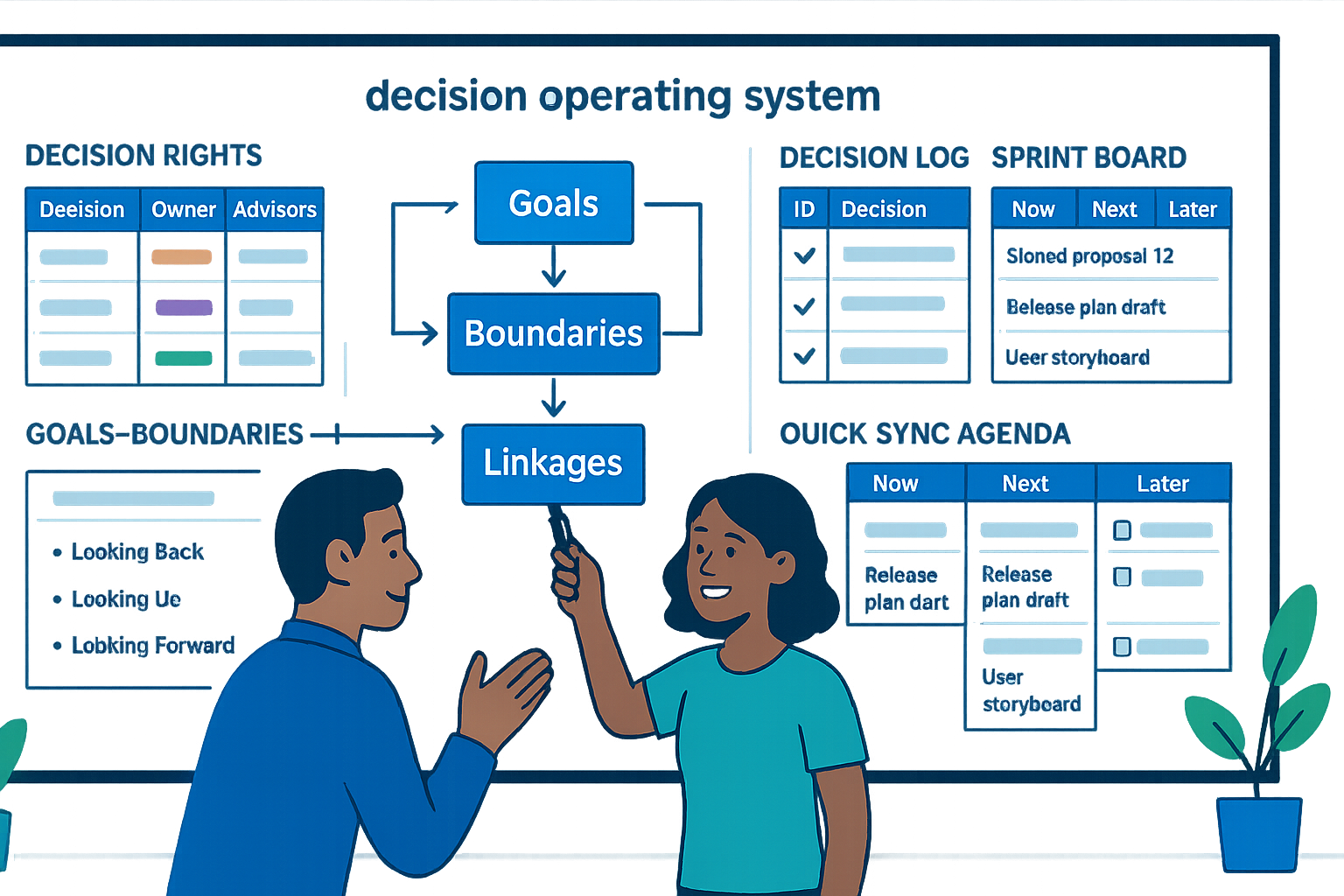
- Decision Rights: Name a single owner for every material decision. Document who decides, who advises, who is simply informed. Do not delegate to a committee. One owner, accountable end to end .
- Default-to-Action: If the owner has Leader’s Intent and is inside boundaries, they decide. Escalate only on boundary breaches or irrecoverable risk .
When you do this well, people stop waiting, windows stop closing, and escalation drops. That is not theory. Assign a single owner, clarify decision rights, and you remove the most common stall points .
2) Set Goals, Boundaries, and Linkages
Fast decisions need three forms of clarity:
- Goals: What does success look like. Expressed positively. Measurable.
- Boundaries: What must not be done. Expressed as constraints that empower creativity inside them.
- Linkages: Who else is affected and how to work with them to avoid collisions.
Codify these at team level and publish them so everyone optimises for the same end without constant coordination. This model turns supervision into empowerment and makes speed safe .
3) Convert tasks to deliverables
Speed requires visible outputs. Convert activity into tangible deliverables.
- Write deliverables as nouns, not verbs. “A signed pricing proposal v3” not “align with sales”. Nouns force clarity and enable inspection .
- Single owner per deliverable. Teams collaborate, but one person is on the hook for the thing to exist by an agreed date .
- Show, do not tell. At the next review, you must be able to show the artefact, not report activity .
When outputs are explicit, most “alignment” meetings vanish because the work becomes inspectable by simply looking at what exists.
4) Replace standing meetings with Quick Syncs
Do not add meetings. Tighten cadence. Use short Quick Syncs to spike tempo without bloating calendars.
- Ten minutes. Daily or three times weekly. Standing, cameras on if remote.
- Three questions only: Looking Back, Looking Up, Looking Forward. What was achieved since last time. What matters now in the big picture. What will be delivered before the next sync .
- No problem solving. Agree owners and take issues offline. Protect the speed ritual .
Short sprints plus frequent Quick Syncs keep momentum high without defaulting to another hour-long meeting block .
5) Use decision memos, logs, and SLAs
Asynchronous decisions beat calendar ping-pong. Standardise the format and the clock.
- Decision memo: One page. Context. Options considered. Chosen path. Risks. Owner. Date. Ask for fast critique using a shared Communication Code so people know you want rigorous challenge, not platitudes .
- Decision log: A simple register that records what was decided, by whom, evidence links, and date. Make it searchable. Leaders should see decisions, not chase them .
- SLAs by decision type: Set response times. For example, operating decisions within 24 hours. Cross-team interface decisions within 72 hours. Strategy-shaping decisions within 7 days, after fair process is applied .
Fair process matters. Involve people, explain the logic, set expectations. You get higher buy-in with fewer meetings when the path to the decision is transparent .
6) Run one backlog, separate Explore from Exploit
Speed slows when experiments fight with operations on the same track. Separate modes, one view.
- Explore: Hypothesis-driven experiments with explicit learning goals.
- Exploit: Commitments that drive today’s outcomes.
- One backlog: A single visible queue segmented by mode so trade-offs are explicit and meetings are not needed to rediscover priorities every week .
Use a tight Rapid Design Loop to learn quickly in Explore, then graduate proven ideas into Exploit with clear outputs and owners .
7) Push decisions to the edge with a simple escalation ladder
Most decisions should be made by the person closest to the information. Create an explicit ladder:
- Edge decision: The owner decides within stated boundaries using data at hand. Inform stakeholders via the decision log.
- Peer consult: If the decision affects another team’s linkage, consult that owner asynchronously. Proceed unless a boundary conflict is raised.
- Leader arbitration: Escalate only if boundaries are breached or the impact is systemic. Leaders decide fast or reset boundaries. Then return decisions to the edge .
This is how a team of teams sustains agility without bureaucracy. You do not centralise thinking. You amplify it at the edge and keep leaders focused on setting intent and guardrails .
8) Use open accountability to kill committee creep
Publish who owns what and what was delivered. Visibility reduces the need to talk about progress because progress is visible, and it measurably raises performance while cutting meeting load .
9) Operate in short, protected sprints
Two-week sprints with visible inspection create a drumbeat. Plan just enough to reach the next outcome, avoid mid-sprint changes, and let the team deliver. This cadence prevents waste and shrinks decision latency between milestones .
Where leaders usually go wrong
- Confusing trust with assumption. “I trusted them” often means “I assumed the expectations were clear”. Make expectations explicit and two-way to enable real empowerment .
- Delegating to groups. Groups advise. People decide. Assign single owners for decisions and deliverables .
- Centralising decisions that should live at the edge. It feels safe and looks tidy. It kills speed. Push decisions out and give people Leader’s Intent and boundaries .
- Replacing operating discipline with more meetings. Meetings are not a system. Your productivity rhythms and decision protocols are the system .
- Conflating updates with decisions. Use the decision log so updates are self-serve and meetings can focus on judgement calls .
Tactical templates you can use today
Decision memo (one page)
- Context: Problem, constraints, relevant data.
- Options: Real alternatives, not straw men. Risks per option.
- Decision: Chosen path and why. Owner. Date.
- Impact: Who is affected. Linkages and boundaries touched.
- Next step: The first deliverable as a noun with a date.
Decision SLAs by type
- Run-rate decisions: 24 hours. Edge owner decides, informs.
- Interface decisions: 72 hours. Owner consults linkage owner, decides.
- Strategy-shaping decisions: 7 days. Use fair process, then decide .
Quick Sync agenda
- Looking Back: What did we ship since last time.
- Looking Up: Any boundary or linkage risk to surface.
- Looking Forward: The next deliverables and owners before next sync .
Decision rights table
- Decision: Name clearly.
- Owner: One person.
- Advisors: Named roles only.
- Informed: Named roles only.
- Boundary: What limits apply.
Escalation ladder
- Level 1: Edge decision with log entry.
- Level 2: Peer consult within SLA.
- Level 3: Leader arbitration only if boundary is hit .
30-day implementation plan
Week 1: Establish clarity
- Select two decision domains that frequently stall. For each, publish Leader’s Intent and boundary conditions .
- Map the top ten decisions in each domain. Assign one owner per decision. Fill your decision rights table .
Week 2: Install the cadence
- Replace one standing meeting with a 10-minute Quick Sync. Enforce the agenda and no problem solving rule .
- Introduce the one-page decision memo and a shared decision log. Teach the Communication Code so critique is explicit and fast .
Week 3: Convert work to inspectable outputs
- Rewrite your in-flight tasks as deliverables. Nouns, not verbs. One owner each. Two-week deadline per deliverable .
- Run Explore vs Exploit as separate swimlanes in a single backlog so trade-offs are visible and faster to decide .
Week 4: Calibrate and lock
- Set decision SLAs. Publish them. Track adherence in the log and fix the top two bottlenecks.
- Hold a 30-minute blameless debrief on what accelerated and what dragged. Adjust boundaries, linkages, or owners accordingly. Then move on .
Metrics that actually matter
- Decision cycle time: From proposal to decision by type. Target reductions week over week.
- Reversal rate: Percentage of decisions reversed within 30 days. High reversals indicate unclear intent or boundaries.
- SLA adherence: Percent of decisions made within type SLA.
- Meeting volume: Count of standing meetings eliminated and replaced by Quick Syncs.
- Backlog ageing: Items waiting on decisions for more than one sprint.
- Psychological safety: Whether it is safe to challenge and raise risks. Without it, speed becomes recklessness. Test and improve it deliberately .
The 6Ps lens: where this lives
Decision speed is not a perk. It is part of your operating system. Through the PerformanceNinja lens, you are tuning Process and Productivity while ensuring People have the conditions to use judgement. Purpose anchors what matters. Proposition benefits because value reaches users sooner. Potential is protected by separating Explore from Exploit and learning fast without distraction .
Common objections and firm responses
- “We need more voices in the room.” Involve people through fair process, not bloated meetings. Engagement, explanation, expectation. Then decide and move .
- “What if someone makes the wrong call.” Boundaries and linkages limit blast radius. Leaders set intent, not every decision. Push decisions to the edge and you will often get the 90 percent solution today, not the 70 percent tomorrow .
- “We tried sprints before.” You likely sprinted tasks, not deliverables, and you changed priorities mid-sprint. Protect the cadence and inspect outputs, not activity .
Close the decision gap now
Speed without more meetings is not a fantasy. It is the product of intent, ownership, cadence, and visible outputs. Start with two domains, set clear decision rights, and install Quick Syncs. Publish your decision log and SLAs. Convert activity into nouns. In four weeks you will feel the drag fall away.
The alternative is to keep stacking meetings and hoping culture fixes itself. It will not. Design it. Demand it. Then defend it every day.
Next Steps
Want to learn more? Check out these articles:
Protect Culture Integrity as You Scale: A Leader’s Playbook
Blameless Debriefs That Fix Work Now [Leader's Field Playbook]
Post-merger Culture Codification: Protect Value In 100 Days
To find out how PerformanceNinja could help you, book a free strategy call or take a look at our Performance Intelligence Leadership Development Programme.