
Post-merger Culture Codification: Protect Value In 100 Days
Why codification beats culture by osmosis
Culture by osmosis was always lazy. Post-merger, it is lethal. Two tribes, two sets of myths, two histories of what worked. If you do not codify how work happens, the loudest legacy wins, not the best. Codification is the act of writing the rules people can actually use. Not values on a wall, but decisions in motion.
Codification is not a branding exercise. It is an engineering job. You define behaviours, guardrails and mechanisms. You install them in the flow of work. You measure whether they live. Then you enforce them without flinching.
The brutal truths leaders must face
Accept these or pay for them twice.
- Day 1 to Day 100 is the value kill zone. Indecision becomes the culture.
- If leaders contradict the Codex once, everyone else will contradict it daily.
- People watch promotions, not posters. Your talent moves will broadcast the real culture.
- Integration theatre is expensive. Only mechanisms change behaviour.
- Middle managers decide the merger. Equip them or lose the frontline.
- Cultural debt compounds faster than technical debt. Delay multiplies rework.
- You do not need consensus. You need clarity, consequences and cadence.
What to codify in the first 100 days
Use the PerformanceNinja 6Ps to frame the whole, then go deep where it counts. You are designing a simple culture operating system that connects purpose to practice.
Purpose: A single, hard-edged narrative
- State the mission in one sentence that frontline teams can repeat.
- Name the customer you will obsess over, not all of them.
- Define the three strategic bets the combined company will fund.
- Write what you will stop doing. Publish it. Mean it.
People: Behaviours, standards and talent moves
- Codify five non-negotiable behaviours in plain English. One page. Zero fluff.
- Translate each behaviour into 2 to 3 observable actions per role.
- Redesign performance reviews within 30 days to include behaviours with teeth.
- Make three visible talent moves that reward the new behaviours. Do it early.
Proposition: The customer promise and choices
- Clarify the combined value proposition in one page. What you solve, for whom, how you win.
- Set product and service standards that reflect the promise. Speed, quality, reliability, price.
- Publish how trade-offs will be handled when standards collide. Customer, cost, compliance.
Process: Interfaces, decision rights and rituals
- Map the top ten cross-team interfaces that drive 80 percent of value.
- Assign a DRI for each interface. Document inputs, outputs, SLAs, escalation paths.
- Define decision rights for strategic, financial and operational calls. Who proposes, who decides, who is consulted, who is informed.
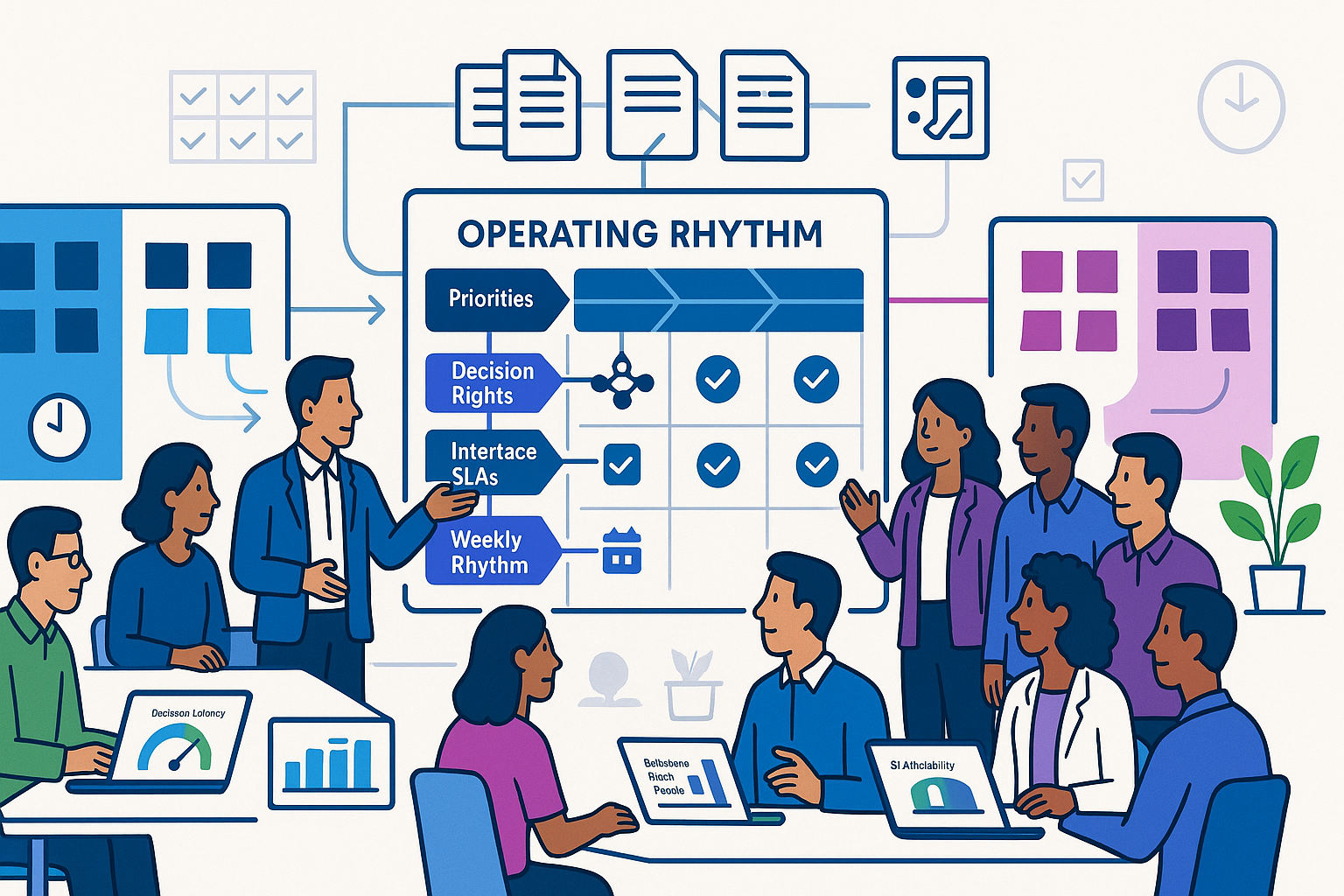
- Establish a unified operating rhythm. Weekly, monthly, quarterly beats that everyone follows.
Productivity: Alignment and execution cadence
- Align goals to outcomes, not activity. Use three company-wide outcomes for the next 6 months.
- Set a single weekly execution rhythm. Priorities, dependencies, decisions, risks.
- Install a visible blocker board for cross-team issues. Age SLA with forced escalation at 72 hours.
- Measure throughput and quality weekly. Publish the dashboard openly.
Potential: Innovation without distraction
- Protect one or two innovation streams with clear stage gates.
- Cap investment by stage. Kill quickly if evidence is weak.
- Link innovation metrics to business outcomes, not vanity prototypes.
Build the Culture Codex people will actually use
Your Codex is a concise, living artefact. It is not a slide deck. It is the manual for how we work here now.
The Culture Codex structure
- Our intent: mission, customer, three strategic bets, what we stop.
- Non-negotiable behaviours: five behaviours with observable actions per role.
- Decision rights: the who and how for the big ten decisions.
- Interfaces: the top ten team interfaces, inputs, outputs, SLAs and escalations.
- Operating rhythm: the weekly, monthly and quarterly meetings with purpose, inputs and outputs.
- Talent rules: how we promote, pay, hire and exit based on behaviours and outcomes.
- Symbols and standards: naming conventions, communication norms, tools, templates, brand usage.
Keep it under 12 pages. Write in bullets. Version control it. Make it the first tab in everyone’s browser.
Writing the Codex fast and well
- Appoint a single accountable owner. Two deputies. A cross-functional drafting team of six.
- Run three design sprints of two weeks each. Draft, test in live meetings, refine.
- Validate with frontline pilots, not executive speculation. Fix what fails in real use.
- Publish v1.0 by Day 30. Issue v1.1 at Day 60. Lock v1.2 at Day 90.
Mechanisms, not posters: embed culture in the work
Mechanisms are the habits, tools and meetings that force the intended behaviour every week. If you do not build them, the old culture will return.
The minimum viable mechanism set
- Leader’s Intent memo. Every initiative starts with a one-page statement of purpose, desired end state, constraints and decision rights.
- Weekly priorities and dependencies review. 30 minutes per team. Start with outcomes, finish with decisions.
- Decision log. A lightweight record of major calls, owners and dates. Make it searchable.
- Interface contracts. Two-page agreements between teams for each critical interface.
- Escalation play. A simple pathway that moves a blocker from owner to sponsor within 72 hours.
- After-action reviews. 45 minutes, within 72 hours of a milestone. Facts, insights, actions, owners.
- Promotion panel. Cross-functional, behaviour-weighted, with evidence from peers and reports.
Measure what you mean
Culture that cannot be measured becomes folklore. Install leading and lagging indicators. Review them in the same place you review revenue.
Leading indicators
- Cadence adherence. Percentage of teams running the weekly review on time.
- Behaviour proof points. Number of documented examples of each non-negotiable per week.
- Decision latency. Median time from proposal to decision on top ten decisions.
- Interface reliability. SLA compliance for the top ten interfaces.
- Talent signals. Ratio of promotions, exits and hires aligned to the Codex behaviours.
Lagging indicators
- Time to value on cross-team initiatives.
- Customer NPS or equivalent, by segment.
- Margin movement on the core proposition.
- Voluntary regretted attrition in critical roles.
Publish the dashboard. Talk about it. Act on it. The moment you stop, the culture stops.
Leadership non-negotiables for the post-merger moment
If you are in the top team, you are the weather. Model the Codex or move aside.
- One narrative. No freelancing. Every leader uses the same language.
- Visible trade-offs. Say no in public. Explain why using the Codex, not politics.
- Truth over harmony. Surface conflicts early. Resolve them decisively.
- Evidence over nostalgia. Legacy success stories are inputs, not instructions.
- Consequences. Reward and remove based on behaviours and outcomes, not tenure.
A 100-day implementation blueprint
Speed without order is chaos. Order without speed is bureaucracy. Use both.
Days 0 to 14: Pre-close to Day 1
- Appoint the Codex owner and drafting team. Clarify authority and timeline.
- Run a culture collision scan across both organisations. Identify friction lines on speed, quality, risk, autonomy, collaboration, customer focus.
- Draft the one-sentence mission and customer focus. Agree the three strategic bets and the stop list.
- List the top ten team interfaces and top ten repeat decisions.
- Identify three Day 1 symbolic acts that prove the new culture.
Days 15 to 30: Draft and pilot
- Write Codex v0.8. Behaviours, decision rights, interfaces and operating rhythm.
- Pilot the weekly priorities review in two critical teams. Fix friction.
- Create interface contracts for the top three interfaces. Test escalations.
- Publish promotion and hiring rules to managers. Train panel members.
- Announce three visible talent moves aligned with behaviours.
Days 31 to 60: Embed and enforce
- Release Codex v1.0. CFO and COO sponsor the operating rhythm.
- Roll out the decision log and escalation play. Track decision latency and escalation age.
- Convert two legacy rituals you will keep, and kill two you will not.
- Launch the dashboard with leading indicators. Review weekly at the executive table.
- Conduct after-action reviews on early integration wins and misses.
Days 61 to 100: Lock and scale
- Release Codex v1.1, then v1.2. Freeze changes for 60 days.
- Extend interface contracts to all top ten interfaces. Enforce SLAs.
- Shift performance reviews to include behaviours with weight.
- Publish the first culture report. Wins, gaps, next experiments.
- Audit promotions, exits and hires for alignment. Correct deviations publicly.
Symbols that land, fast
People read symbols like spreadsheets. Use them intentionally.
- Keep one legacy ritual that fits the future. Kill a cherished one that does not. Explain why.
- Standardise email signatures, document templates and naming conventions within 30 days.
- Move two senior leaders’ seats to sit with cross-functional teams for 90 days.
- Consolidate tool stacks quickly. Two tools. One becomes the standard. The other goes.
- Rename teams to fit the new mission. Words shape identity.
- Celebrate one customer win earned by the new way of working, not the old.
Common failure modes and how to avoid them
Do not repeat patterns that have sunk better deals than yours.
- Vague values with no behaviours. Fix by writing observable actions per role.
- Endless consensus seeking. Fix by setting decision rights and deadlines.
- Integration by committee. Fix by appointing a single accountable Codex owner.
- Poster campaigns without mechanisms. Fix by building the weekly operating rhythm.
- Silent contradictions at the top. Fix by coaching and consequences within the executive team.
- Protecting pet projects. Fix by enforcing the stop list and reassigning resources.
- Over-engineering. Fix by shipping v1.0 fast and iterating in the work.
FAQ for decisive leaders
- How detailed should the Codex be. Detailed enough that a new manager can run their week without guessing.
- How do we handle legacy pockets that resist. Publish the expectations, provide coaching, set a deadline, then make a change.
- What if two behaviours conflict in practice. Choose based on the customer promise and strategic bets. Document the trade-off.
- How long until it feels normal. About two quarters of strict, public follow-through.
The point of all this
Mergers fail culturally because leaders get romantic about integration and squeamish about enforcement. Codification is not about slogans. It is about making the right way the easy way, every week. You engineered a deal. Now engineer the culture that pays for it.
If you remember nothing else, remember this. Write it down. Put it to work. Measure it. Enforce it. That is how you protect value in a merger. And that is how you help people do the best work of their careers in a new, stronger company.
Next Steps
Want to learn more? Check out these articles:
Scaling Leadership in Complex Organisations: A Field Guide
Revisiting Culture in 2026: Speed, Clarity, and Ownership
Escalation Paths That Work: Faster Decisions, Fewer Fires
To find out how PerformanceNinja could help you, book a free strategy call or take a look at our Performance Intelligence Leadership Development Programme.