
Scaling Leadership in Complex Organisations: A Field Guide
If you feel your calendar expanding faster than your influence, you’re not alone. Complex organisations don’t fail because leaders lose IQ. They fail because leadership doesn’t scale. Decision speed drops. Culture dilutes. Innovation stalls. Bureaucracy creeps. The brutal truth is this: complexity scales exponentially, while most leadership systems remain linear. The good news is that leadership can scale, and when it does, results compound.
This field guide shows you how to multiply leadership across your organisation without multiplying meetings, headcount or noise. It is direct, tactical and built for senior leaders who want clarity, speed and control without strangling initiative.
The brutal truth: complexity scales faster than headcount
The environment you operate in is volatile, uncertain, complex and ambiguous. As organisations grow, complexity compounds and the leadership paradigm must shift from command-and-control to connectivity and accountability. McKinsey’s leadership shifts are clear on this point: move from directing hierarchies to catalysing empowered networks, from control to rapid learning, and from scarce competition to value cocreation. That shift is the foundation of scalable leadership in complexity .
At some point a business leader must become an organisation leader if growth is to continue. The operating model must evolve from pre-bureaucratic founder-centric execution, through standardised and hierarchical control, to a post-bureaucratic agile network. Many leaders stall because they try to scale what worked in stage one into stage three. It doesn’t translate .
What it means to scale leadership
Scaling leadership is not adding layers. It is multiplying judgement. Practically, that means:
- Shared context: Everyone understands the mission, constraints and interfaces so they make good decisions locally.
- Clear decision rights: People know who decides, who performs, who gives input, and what to escalate.
- Operating rhythm: The organisation runs on a predictable cadence from strategy to weekly work.
- Empowered execution: Authority and accountability are balanced, with Leader’s Intent replacing permission-seeking.
These elements sit inside your organisational operating system. Decisions, workflows, communication channels, metrics and structures must be designed, not assumed. If you don’t design them, entropy will. A crisp definition of the operating system makes this visible and buildable .
Symptoms you are not scaling leadership
- You don’t need a survey to see it. Look for:
- Decisions bunching at the top. Bottlenecks form around a few names.
- Teams working hard on the wrong things. Priorities change weekly, but the scoreboard does not.
- Culture dilution. Values posters are strong; lived behaviours are weak.
- Collaboration friction. Work crosses team boundaries and dies there.
- Innovation that either distracts the core or gets starved by it.
- Former star contributors failing as first-line managers.
- Meetings up. Velocity down.
Leadership that scales: a practical blueprint
1) Build shared consciousness, then push authority to the edge
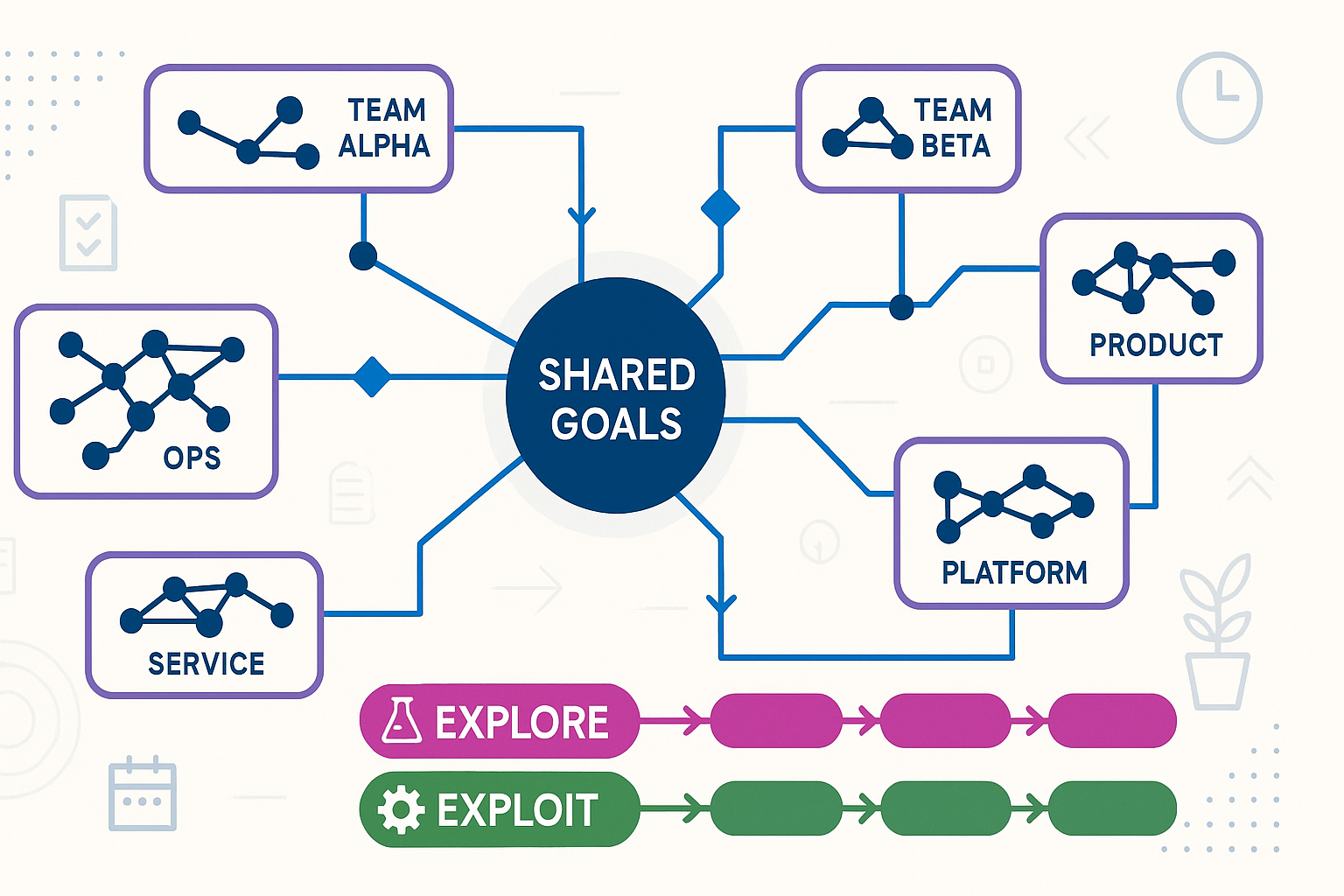
In complex systems, planning yields diminishing returns. Shared consciousness plus empowered execution wins. Think Team of Teams: information flows broadly, trust and purpose are built deliberately, and teams act fast inside clear boundaries. This is not theory. It is how high-performing networks operate under pressure .
Do this next week:
- Publish Leader’s Intent for every priority: “I intend to achieve X, within these boundaries, by Y date.” Require teams to state their intent and checks before acting. It builds bias to action and disciplined autonomy .
- Codify Goals, Boundaries and Linkages for each team. Goals give focus and accountability. Boundaries unlock creativity. Linkages prevent local optimisation at system cost .
- Run 15-minute cross-team Quick Syncs three times a week to surface interdependencies, blockers and decisions.
2) Clarify decision rights and escalation paths
Ambiguity kills velocity. Define who Decides, who Recommends, who Provides Input, who Performs. Make authority explicit and match it with accountability. Too much authority without accountability creates recklessness. Too much accountability without authority breeds resentment. The balance is the core of scalable empowerment .
Do this next week:
- Add a decision-rights line to every initiative: D, A, R, I clearly named.
- Create a living Decision Log. One page. What was decided, by whom, why, and when.
- Set a 24-hour SLA on escalations. Decisions wait for data, not for diaries.
3) Design for flow, not control
Structure must follow work, not personalities. Start with activity, then group, then role capabilities, then individuals. Test designs using clear criteria like alignment to strategy, accountability and flexibility. Avoid redundant hierarchy. Managers must add value at every level. Span-of-control is not a rule-of-thumb number. It is a function of similarity of work, coordination needs, competence levels and other context factors. Design explicitly, not by folklore .
Do this next month:
- Map value flows end-to-end. Redesign team interfaces where work stalls.
- Run the Activity → Grouping → Capability → Individual sequence to avoid creating bespoke roles that don’t scale .
- Pilot small reductions in layers. Compress where managers are pass-throughs.
4) Install a ruthless execution rhythm
Strategy that does not hit a calendar is a wish. Build an execution rhythm that ties intent to outcomes weekly. Use OKRs to set direction, then drive work through Initiatives, Epics, Stories and Sprint Deliverables. Keep the altitude levels distinct and the cadence visible. Agility at scale requires coordination rituals that look up, look forward and look back across teams .
Do this next fortnight:
- Set one to three company-level Objectives with three to five Key Results each. Publish them and stop projects that do not move the KRs.
- Establish a weekly Leadership Rhythm: Monday priorities and dependencies, mid-week risk and learning, Friday outcomes and resets.
- Implement WIP limits on Initiatives. If everything is top priority, nothing is.
5) Upgrade your managers: from super-doers to system builders
Managers who succeed as individual contributors often fail when their job becomes multiplying others. They need two upgrades. First, emotional intelligence, because it drives trust, challenge and performance. Second, management craft. The evidence is consistent: EQ is a strong predictor of performance and revenue outperformance, and great managers materially improve team results. Treat management as a discipline, not a reward for tenure .
Do this this quarter:
- Explicitly calibrate support and challenge in every 1:1 and team meeting. Use a communication code to solicit critique, reduce defensiveness and raise the level of debate .
- Develop leaders using a multiply model: Inform, Train, Coach and Apprentice. One-off workshops don’t scale capability. Apprenticeship does .
- Clarify leadership levels. Who leads people, teams, functions and the enterprise, and what time horizons they own. Don’t demand three-year thinking from someone accountable for three months .
6) Run dual speed: protect today while building tomorrow
You must exploit the current business while exploring the next. Manage two portfolios with distinct rhythms, metrics and governance. Exploration is about learning per unit time, not short-term ROI. Exploitation is about delivering KR movement with reliability. Mixing them in one backlog guarantees conflict. Separate them, then integrate at the board level .
Do this next month:
- Maintain two visible backlogs: Explore and Exploit. Cap Explore capacity to 10 to 20 percent.
- Tie Explore projects to strategic themes and stage-gates. Fund learning milestones, not vanity prototypes.
- Track learning velocity for Explore and KR movement for Exploit.
7) Reduce bureaucracy without losing control
Bureaucracy grows when leaders mistake more rules for more control. Replace rule proliferation with clarity. Use culture and context to set the frame, then operate with the minimum level of specificity required for performance. Too little clarity drives turf wars. Too much detail kills initiative. Get Goals, Boundaries and Linkages right, and use Leader’s Intent to move faster with less supervision .
Do this now:
- Replace ten-page policies with one-page principles where possible.
- Publish a living “How We Decide Here” guide. Make authority and accountability visible.
- Use post-event debriefs to fix systems, not blame people. Simplify after every sprint.
8) Build resilience into the system
Your operating model must absorb shocks without heroics. Build resilience through scanning and anticipating, not slogans. Cross-train to avoid single points of failure. Run pre-mortems and red-team big calls. Debrief relentlessly. Resilience is a set of micro-habits that compound, not a poster on the wall .
Do this this quarter:
- Add a pre-mortem to every major initiative. List failure modes, mitigations and owners.
- Cross-train for critical roles. Document rules-of-thumb where formal SOPs are heavy.
- Publish a risk register with likelihood, impact and mitigations. Review monthly.
Where the 6Ps fit: the big picture
Scaling leadership touches every element of your system. Use the 6Ps to ensure balance at the macro level:
- Purpose: Refresh vision, mission and values so they guide trade-offs. Make them decision-useful, not decorative .
- People: Build leadership as a capability at every level. EQ, coaching and apprenticeship are not optional in complexity .
- Proposition: Clarify strategy and value disciplines. Use a Rapid Design Loop to validate new ideas fast and kill the weak ones faster .
- Process: Design the operating system. Decision protocols, communication channels, workflows and structures that fit your context .
- Productivity: Install the execution rhythm. OKRs, cadences and definition levels that drive outcomes, not output theatre .
- Potential: Govern innovation as a portfolio. Separate Explore from Exploit and integrate at leadership level .
Implementation plan: 90 days to move the needle
You don’t need a revolution. You need a system. Here is a high-level plan:
- Weeks 1 to 2: Diagnose the operating system. Map decision flows, cadences, interfaces. Agree top three friction points. Publish interim Leader’s Intent for the quarter .
- Weeks 3 to 4: Set one to three Objectives and three to five KRs. Publish Goals, Boundaries and Linkages per team. Stop or pause work that does not move KRs .
- Weeks 5 to 8: Define decision rights for all active initiatives. Stand up the leadership rhythm and Quick Syncs. Pilot one interface redesign between two teams .
- Weeks 9 to 12: Lift manager capability with targeted coaching, support/challenge calibration, and apprenticeship moves. Stand up the Explore backlog with gated funding .
Metrics that matter
Measure whether leadership is scaling, not just whether work is finishing. Track:
- Decision cycle time: From intent to decision for material calls. Should fall as rights and rhythms solidify .
- Escalations per week: Initially rise as ambiguity surfaces, then fall as clarity sticks.
- OKR health: % of KRs on track at mid-point and end-point. Review weekly to avoid “set and forget” .
- Throughput and WIP: Fewer, bigger bets completed beats many, half-done projects.
- Manager quality signals: Feedback requests per meeting, number of blameless debriefs, frequency of skip-levels. These correlate with EQ in practice .
- Explore learning velocity: Validated learnings per month. Kill rates for weak ideas. Portfolio balance between Explore and Exploit .
Common traps and how to avoid them
- Setting and forgetting OKRs: Build a weekly review cadence. If KRs don’t guide the week, they don’t exist .
- Imposed cascades: Invite teams to propose their contribution to company OKRs. Ownership beats compliance every time .
- Structure obsession: Don’t start with boxes. Start with work. Test designs against clear criteria and avoid adding layers that add no value .
- Decision fog: Without explicit rights, you get shadow vetoes. Publish D, A, R, I for every initiative and log decisions in plain sight .
- Culture theatre: Replace value posters with Goals, Boundaries and Linkages. Pair with Leader’s Intent to create real autonomy with accountability .
Final word: choose to scale leadership, not meetings
You can hire more people, add more layers and run more meetings, then wonder why you feel more in control yet move slower than ever. Or you can scale leadership. Build shared consciousness. Clarify decision rights. Run a ruthless rhythm. Upgrade managers. Separate Explore and Exploit. Reduce bureaucracy with clarity. Bake resilience into your operating model.
In complexity, speed is a system property, not a personal trait. Craft the system and your leaders at every level will do the rest.
Next Steps
Want to learn more? Check out these articles:
Escalation Paths That Work: Faster Decisions, Fewer Fires
Clear Interfaces Between Teams: Build Speed, Cut Waste
Operating Model Clarity: Turn Strategy Into Results Quickly
To find out how PerformanceNinja could help you, book a free strategy call or take a look at our Performance Intelligence Leadership Development Programme.