
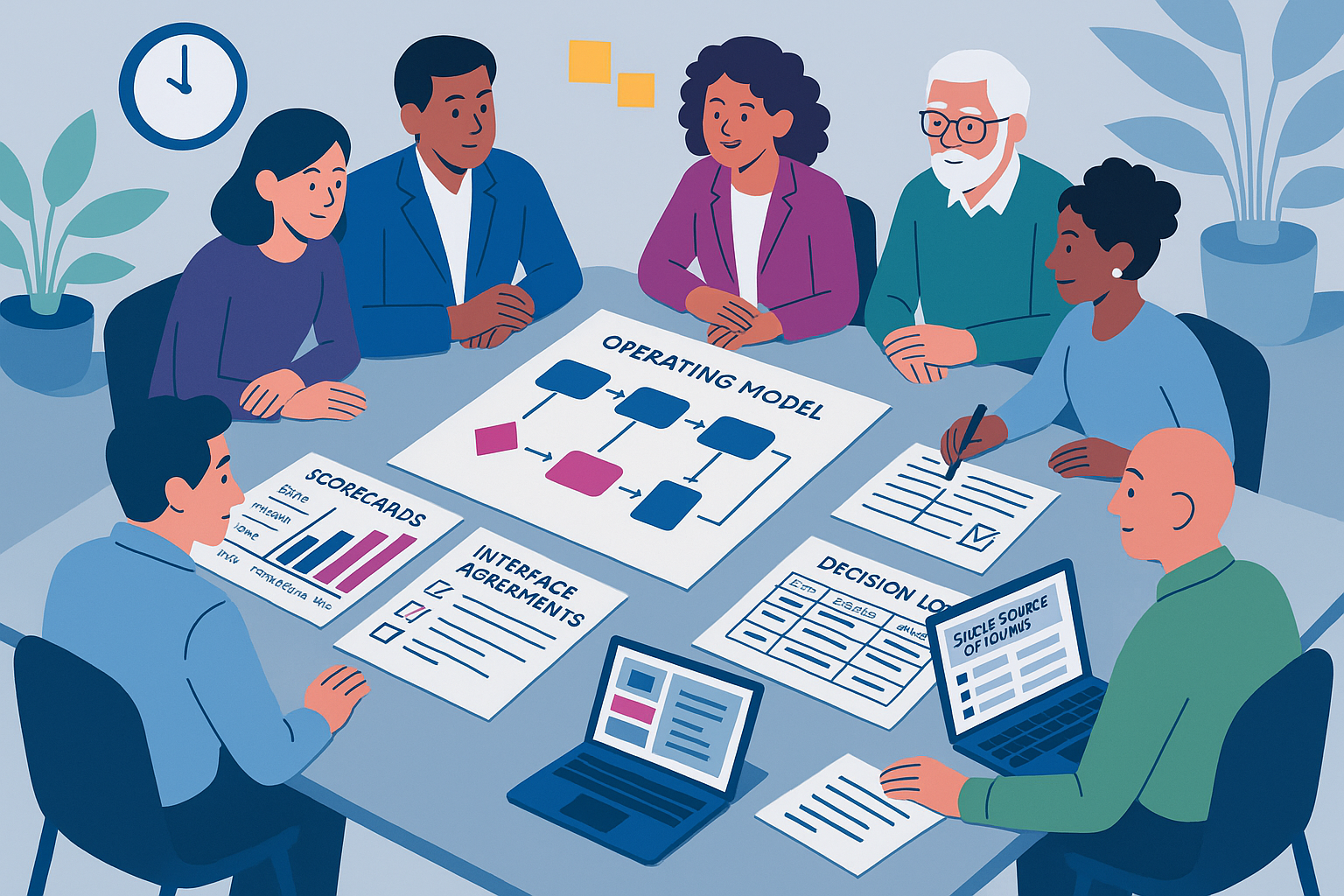
Operating Model Clarity: Turn Strategy Into Results Quickly
You can feel it. Strategy sounds sharp in the boardroom, then Monday arrives and reality turns fuzzy
Priorities collide. Work slows. Decisions ping‑pong. Good people burn time doing the wrong work, for the right reasons, with the wrong assumptions. That is not a talent problem. It is operating model fog. And it is costing you speed, margin and trust.
Operating model clarity is not a poster or a PowerPoint. It is the practical, everyday answer to four questions. Who decides. Who does. How work flows. How we know it worked. When leaders get this right, execution stops fighting itself. Waste falls. Momentum returns.
This is a field guide for senior leaders who want results without bureaucracy. You will get a sharp definition, brutal diagnostic tests, a blueprint you can implement, and the weekly rituals that keep clarity alive when the pressure hits.
What operating model clarity actually means
Operating model clarity is the explicit design of how your organisation creates value, end to end, and the agreements that make that design real in daily work. It is where strategy meets Tuesday afternoon.
Five components define clarity:
- Purpose and proposition. Why you exist and the value you promise customers. This is the north star for choices.
- Value flow. The minimum viable path from opportunity to cash, and who does what along it.
- Decision rights. Who decides, who contributes, and how to escalate when facts change.
- Operating cadence. The meetings that matter, the metrics that signal truth, and the artefacts that lock decisions.
- Enablers. Skills, tools, data and guardrails that let teams move fast without asking for permission.
If any one of these is vague, you pay a hidden tax in delay, rework and politics. If all five are explicit, your strategy compounds.
The brutal truth: signs you are operating in a fog
You probably recognise the symptoms. They are not random. They are system outputs.
- Good plans, inconsistent follow‑through. Weekly priorities change quietly, so work diffuses.
- Repeated escalations. Decisions bounce upwards because no one trusts they own the call.
- Meeting bloat. Time spent reconciling different truths, not advancing one plan.
- Cross‑team friction. Handoffs create surprises. Ownership is fuzzy at the interfaces.
- Slow learning. Issues recur because no one captures and enforces the fix.
- Heroics required. Delivery relies on overtime and favours rather than design and rhythm.
If three or more are present, you do not have a people problem. You have an operating model clarity problem.
Clarity by design: the operating model blueprint
High performers make clarity tangible. Use the following blueprint to design or reset yours. Keep it on one page. Build depth only where the work demands it.
Anchor on purpose and proposition
Strategy without a sharp why drifts. Tie your operating model to the PerformanceNinja 6Ps big picture. Purpose and Proposition are the first constraints. They define what you will not do, which is where speed comes from. Write one sentence for each:
- Purpose. We exist to [do what] for [who] so they can [outcome].
- Proposition. We win by [unique advantage], serving [segment], through [model].
If leaders cannot recite these precisely, your operating model will wobble.
Map the value flow in 60 minutes
You do not need a thousand‑box process map. You need a value stream that fits on a whiteboard and answers five practical questions.
- Trigger. What event starts the flow.
- Steps. The minimum set of stages to deliver value.
- Owners. A single accountable owner for each stage.
- Policies. The rules that govern handoffs, approvals and quality.
- Signals. The measures that tell us if this stage is healthy.
Example stages for a product company. Sense demand, Prioritise opportunities, Design solution, Build, Launch, Run, Improve. Give each stage one verb, one owner, one metric, one entry and exit criterion. If two teams co‑own a stage, no one owns it. Decide.
Decision rights that move at the speed of trust
The fastest organisations are not those with the smartest people. They are the ones where everyone knows exactly which calls they own, and which they must not make.
Use a simple DARE matrix to hard‑wire this:
- Decide. Final authority and accountability for the outcome.
- Advise. Must be consulted before a decision. Brings facts and risks.
- Recommend. Proposes a course of action with rationale and data.
- Execute. Implements the decision, owns delivery quality and feedback.
Create a one‑page DARE for your top 20 recurring decisions. Examples. Prioritise the quarterly roadmap. Approve pricing changes. Commit to a major client deadline. Change a production standard. Assign a DARE owner for each decision and define the default escalation rule. If a decision stalls for more than two working days, the next level up decides within 24 hours.
Roles, teams and interfaces
Structure follows value, not the other way around. Define the few roles that must exist for the value flow to work, then arrange teams to reduce handoffs and batch sizes.
- One‑page role charters. Purpose, outcomes, decision rights, interfaces, skills, anti‑goals. The anti‑goals are the tasks this role will not do.
- Interfaces first. Document the two or three most critical interfaces and their working agreements. Example. Product to Sales. Weekly 30‑minute backlog and deal review with a shared decision log and a single source of truth.
- Span only what you can support. If a manager cannot hold a meaningful weekly one‑to‑one with each direct, the span is too wide or the work is too complex.
Operating cadence and standard commitments
Meetings are tools. Use only those that cut uncertainty. Design them against decisions, not habit.
- Weekly leadership rhythm. 60 minutes. Review outcomes versus plan, unblock cross‑team work, ratify two to three decisions from the log. No status theatre. Data up front, decisions recorded.
- Value stream review. Fortnightly, 90 minutes. End to end. Identify bottlenecks, fix root causes, update policies.
- Quarterly strategy to execution. Four hours. Refresh intent, set three to five outcomes, allocate capacity, kill or continue bets.
- Standard commitments. Every recurring meeting has an input, output, owner and timebox. Every decision lands in a shared log within 24 hours.
Measures and feedback
Measure what proves the system works, not what flatters it. Use a small stack that links purpose to team behaviour.
- North Star. One metric that represents value delivered to customers.
- Flow. Lead time, throughput, work in progress. The physics of delivery.
- Quality. Escapes to customers, first pass yield, rework rate.
- Health. Engagement signal, attrition risk, absence of heroics.
Build a one‑page scorecard that updates weekly. Replace opinion‑heavy meetings with fact‑based conversations.
Tooling and knowledge
Tools are multipliers for clarity when used with intent.
- Single source of truth. One system of record for work, decisions and measures. If you have three, you have none.
- Decision log. Date, owner, context, options, choice, expected impact, review date. This protects you from amnesia and circular debates.
- Playbooks. Short, task‑level guides for the ten hardest recurring activities. When work is hard, write it down.
How to expose the gaps fast: the nine clarity tests
Use these tests in your next leadership meeting. If a test fails, write the gap and fix it this week.
- Leader’s intent test. Can each leader state the 90‑day outcomes without notes.
- Ownership test. For the top five decisions, can we name the Decider and Executor instantly.
- Interface test. For our three highest‑friction handoffs, do we have published working agreements.
- Cadence test. Can we cancel two meetings this week because the scorecard tells us the truth faster.
- Customer test. Can every team member map their work to the value flow in under five minutes.
- Escalation test. Do we have a 24‑hour rule for unresolved decisions.
- Policy test. Are entry and exit criteria for each value stage written and visible.
- Data test. Do we trust our North Star and flow metrics enough to bet money on them.
- Learning test. Do we review one decision from the log every week to refine our heuristics.
Implementation plan: a 90‑day clarity sprint
You do not need a transformation. You need a sprint that proves speed without chaos. Keep it tight, visible and leader‑led.
Weeks 1 to 2. Align on intent and scope
- Clarify the three to five 90‑day outcomes. Write them in plain language with success measures.
- Draft the value flow on one page. Name stage owners. Set a weekly scorecard and a single source of truth.
- Create a draft DARE matrix for the top 10 decisions. Publish it and invite feedback.
Weeks 3 to 4. Lock the basics
- Finalise role charters for the five roles that matter most. Add anti‑goals.
- Define interface agreements for two high‑friction handoffs. Pilot for two weeks.
- Launch the weekly leadership rhythm and the decision log. Kill two low‑value meetings.
Weeks 5 to 8. Remove bottlenecks
- Run fortnightly value stream reviews. Identify and fix two systemic constraints.
- Standardise policies for stage entry and exit. Train teams in 30‑minute micro‑sessions.
- Build three playbooks for hard work where errors repeat.
Weeks 9 to 12. Institutionalise learning
- Review decision log patterns. Upgrade two heuristics. Adjust DARE where confusion remains.
- Tune metrics. Replace any vanity measures with flow or quality signals.
- Publish the one‑page operating model to all staff. Leaders explain the why and the how in team sessions.
By day 90, you will have a living operating model. Not perfect. Good enough to run faster with fewer surprises.
Daily and weekly rituals that keep clarity alive
Rituals convert design into behaviour. Keep them light, repeatable and ruthless.
- Five‑minute daily stand‑ups in teams that execute. Yesterday, today, stuck. Update the single source of truth during the meeting.
- Weekly business review. Outcomes, flow, quality. Decisions recorded and assigned.
- Decision of the week. Pick one decision from the log to review. Capture a lesson and a rule of thumb.
- Change freeze windows. Two short windows per week where only emergency priority changes are allowed. Protects flow from thrash.
Pitfalls and how to avoid them
Most operating model efforts fail for predictable reasons. Avoid them early.
- Designing in the abstract. If you cannot tie a choice to a specific value flow constraint, you are decorating, not designing.
- Mistaking tools for clarity. New software without decision rights creates faster confusion.
- Over‑specification. Documenting everything slows learning. Document the few things that keep breaking.
- Silent dissent. If leaders cannot disagree openly in the weekly forum, politics will find a back door.
- Leaders above the system. If leaders bypass the cadence with side deals, the model collapses.
Simple tools you can deploy tomorrow
Adopt these three, and watch the noise drop within two weeks.
- One‑page operating model. Purpose, proposition, value flow, DARE for top decisions, cadence, scorecard. Print it. Review it weekly.
- Decision log template. One shared sheet. Adopt the 24‑hour rule. Every decision gets a review date and a named owner.
- Interface working agreement. For any two teams that fight often. Define meeting, metrics, handoff policies and conflict rules on a single page.
The big picture: connect the 6Ps for sustained speed
Operating model clarity is not a process project. It is how the whole system works.
- Purpose focuses choices. If it is vague, everything is negotiable and nothing is fast.
- People carry the model. Skills, behaviours and role clarity turn rules into reflexes.
- Proposition directs the value flow. Different propositions demand different decision rights and cadences.
- Process is the visible part, but it must be minimal viable process, not maximal bureaucracy.
- Productivity is the discipline. The scorecard, rituals and decision log prevent drift.
- Potential is your option engine. A clear operating model lets you run an innovation pipeline without cannibalising the core.
When these six align, speed becomes normal and resilience improves under stress.
Leader checklist: five moves to start this week
If you do nothing else, do these and do them now.
- Write and share the one‑sentence purpose and proposition. Demand precision.
- Map the value flow with your team in 60 minutes. Assign owners and metrics.
- Publish the DARE matrix for your top decisions. Enforce it in the next meeting.
- Launch the weekly leadership rhythm. Bring a one‑page scorecard. Cancel one meeting.
- Start the decision log. Review one decision every week. Upgrade your rules.
Clarity is a choice. You do not buy it. You build it. When you do, strategy stops leaking, people stop guessing and results arrive on time. That is the work of leadership. Do it with intent and do it now.
Next Steps
Want to learn more? Check out these articles:
Reduce Bureaucracy While Scaling: Leader’s Guide to Speed
Align Goals to Weekly Work: Build an Execution Rhythm
Quick Sync Agenda: Drive Outcomes, Cut Meeting Waste Fast
To find out how PerformanceNinja could help you, book a free strategy call or take a look at our Performance Intelligence Leadership Development Programme.