
Reduce Bureaucracy While Scaling: Leader’s Guide to Speed
Stop bureaucracy from stealing your scale
If your company moves slower now than when you had half the headcount, you have a bureaucracy problem. Not a people problem. Not a market problem. A leadership problem. Left alone, bureaucracy compounds. It shows up as decision drag, approval theatre, and policies invented to solve one exception that quietly strangle everyone else. Customers feel the seams. Teams feel the grind. Growth stalls.
This is your guide to strip out the waste while you scale up the impact. It is blunt, practical, and built for leaders who want speed without losing control.
Why this matters now: organisational complexity grows non‑linearly with size. What felt like healthy structure at 150 people can become a throttle at 300. The answer is not less structure. It is the right structure. The difference is clarity and cadence, not heroics and hope. The best organisations shift from pre‑bureaucratic to post‑bureaucratic operating models by creating empowered networks that still meet governance needs. They move from command and control to shared consciousness and empowered execution, without surrendering accountability. That shift is now table stakes in a volatile, uncertain, complex and ambiguous world .
The brutal truth about bureaucracy and scale
Bureaucracy is a symptom of unclear goals, fuzzy decision rights, and risk managed through blanket policies. When ambiguity rises, issues escalate to the point of clarity. Leaders become the bottleneck. Friction replaces flow. Boundaries reduce risk, but they also reduce innovation if added blindly, which is why every new rule must be weighed as a cost as well as a benefit .
Look at your organisation through three lenses:
- Goals. Are priorities, outcomes and measures explicit, visible and finite? Or are you managing by vibe and velocity?
- Boundaries. Do teams know the guardrails clearly enough to move fast inside them? Or are you managing exceptions with policies that live forever?
- Linkages. Do cross‑team handoffs, forums, and delivery interlocks exist and work? Or is collaboration ad hoc and based on who shouts loudest?
When these three are weak, decision latency climbs, meetings multiply, and ownership becomes a group sport with no scoreboard. That is bureaucracy.
Telltale signs your bureaucracy is creeping in
- Decision latency is measured in weeks. Decisions bounce up the hierarchy because there is no single owner and no documented decision rights. Over‑escalation and status theatre follow .
- “Let’s form a committee” is a reflex. Change killers multiply. The gravitational pull is towards more talk, more process, more delay .
- Policies expand faster than value. Each exception generates a rule that never dies. Boundaries accumulate, innovation shrinks .
- Accountability is about inputs, not outputs. People report activity, not results. Meetings track effort, not delivery .
- Silo friction rises. Handoffs fail. Initiatives sprawl. You are managing by escalation instead of design, because linkages are underdefined .
A simple principle to cut bureaucracy fast
Subtract, then simplify, then codify, then scale. Start by deleting steps that do not add value. If you are not adding a few back, you have not deleted enough. Only optimise what should exist. Then accelerate and, finally, automate. This sequence, popularised by leaders who ship at pace, is a proven antidote to process creep .
The big picture: reduce bureaucracy with the 6Ps
The PerformanceNinja 6Ps framework is useful for seeing the whole system. Use it to target causes, not symptoms. Do not overcomplicate it. Anchor your moves in these six areas to free speed while protecting control .
Purpose: Align on outcomes that matter
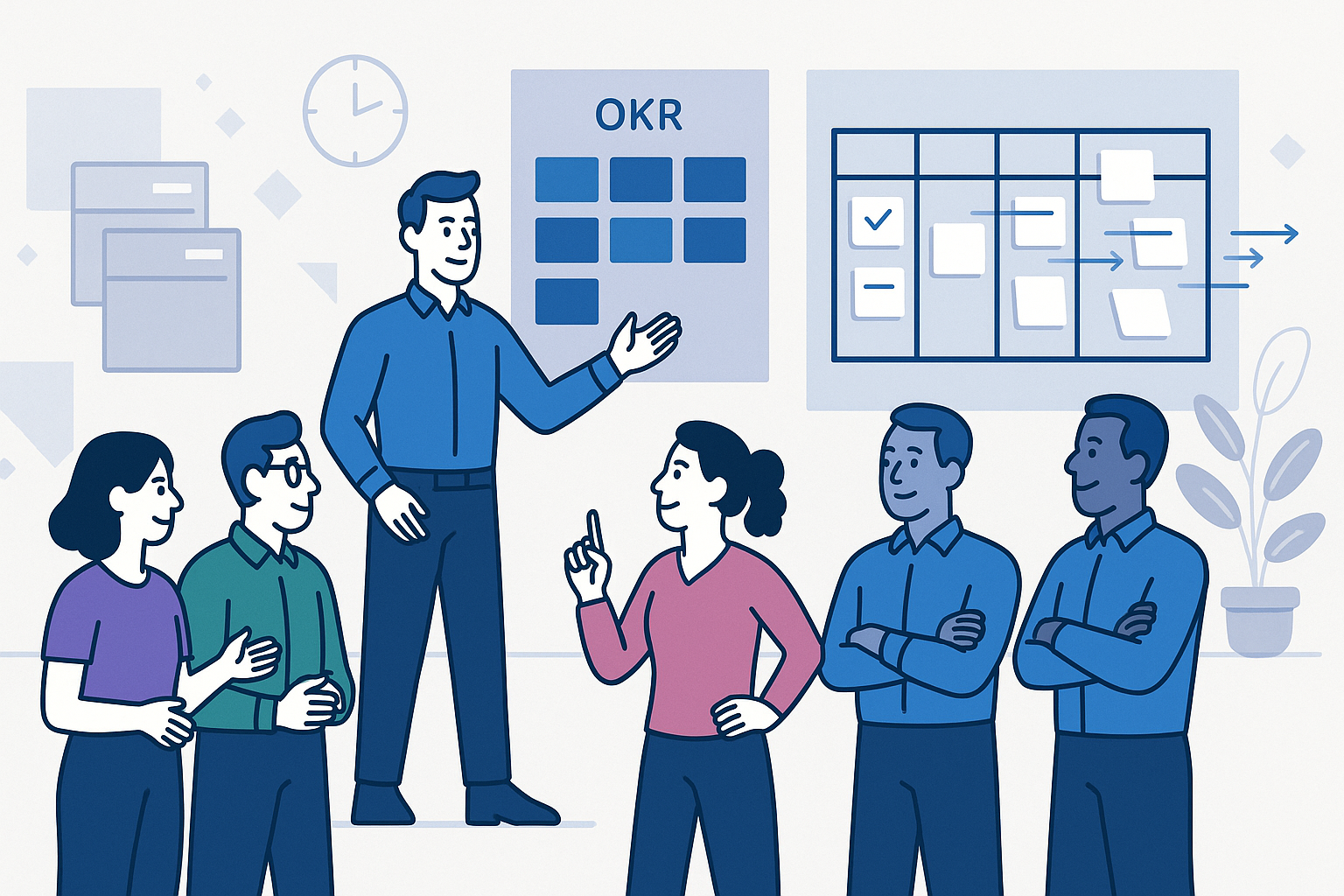
If everything is important, nothing is. Publish three things clearly: Objectives, Key Results, and Leader’s Intent. Use OKRs to narrow the field to what moves the needle. Pair them with a short Leader’s Intent statement for each priority: what we aim to achieve, the key constraints, and how we will know we have won. This gives teams freedom inside boundaries, which is the only sustainable way to scale speed. OKRs also create transparency, alignment and agility across the organisation when used properly .
Make goals visible at every level, and tie them to review rhythms your teams can keep. Build a simple stack: company OKRs, team initiatives, epics and deliverables. Then connect strategy to execution with a cadence that looks both up and forward. This is where bureaucracy goes to die, because priorities remain explicit and trade‑offs are made weekly, not annually .
People: Clarify roles, grow leaders, protect safety
Bureaucracy flourishes when people do not know what they own, or when they fear speaking up. Fix both. Document decision rights. Assign a single owner for each priority. Use an explicit decision model and basic RACI where needed. Do not confuse empowerment with abdication. Balance authority with accountability to avoid recklessness and resentment. You are building adults, not passengers .
Right‑size spans of control. Flatten where managers do not add value, but keep spans realistic based on complexity, interdependency, and team maturity. A flat structure without the right spans simply moves the burden to meetings and escalation. Get the span factors right and you reduce coordination cost without losing coherence .
Build psychological safety so challenge flows to the work, not the people. Model curiosity. Ask for critique. End meetings with clear commitments. Healthy challenge reduces future process because people fix issues early and in the open .
Proposition: Focus where value is created
Bureaucracy grows in the shadows of stale portfolios. Stop funding everything. Use a rapid design loop to validate what to keep, cut or scale. Ask if each initiative is desirable, feasible, viable, rational and legal. If it is not, stop kidding yourself. Kill it or park it. That frees resources and removes the need for heavy coordination across dead work .
Process: Design your operating system on purpose
Every scaling firm needs an organisational operating system. It is the set of processes and structures that define how decisions are made, how work is executed, and how objectives are achieved. Without this, every team invents its own rules and bureaucracy fills the vacuum. Define decision protocols, communication channels, workflows, reporting, goal setting, resource allocation, performance metrics, and feedback loops. Make it custom to your strategy. Mission execution must match mission readiness .
Productivity: Move work with cadence, not chaos
Shift the accountability focus from process to deliverables for non‑compliance work. Define outputs with nouns, not verbs. Then run short sprints and quick syncs to inspect deliverables and adjust. Frequent check‑ins prevent drift, while keeping change between sprints reduces churn. Do fewer things at once, finish more, and ship faster. Bureaucracy hates momentum .
Make your rhythm explicit. Use weekly and fortnightly cycles. Review progress, plan next outcomes, and surface risks. Align this tactical beat with the strategic OKR cycle so nothing important hides. A simple cadence destroys the need for ad hoc coordination, status meetings, and endless decks. It replaces them with facts, flow and focus .
Potential: Separate explore and exploit to protect both
The quickest route to heavy governance is unmanaged innovation that endangers today’s revenue. Solve this by explicitly separating Explore from Exploit. Protect exploration time, but put it on a different cadence, with different rules and budgets. Manage Explore through learning metrics and stage gates. Manage Exploit through OKRs and throughput. That keeps novelty from breaking the factory and stops the factory from suffocating novelty .
The anti‑bureaucracy operating system: 12 decisive moves
- Map decision rights and assign single owners
For each top priority, record who recommends, who decides, who performs, who gives input and who is informed. Then publish it. Ambiguity is friction. A named owner per outcome is non‑negotiable . - Run a two‑tier planning cadence
Strategic: OKRs every 6 to 12 months. Tactical: sprints 1 to 2 weeks. Use Looking Up, Looking Back, Looking Forward to keep teams connected to the big picture without daily slide decks . - Define deliverables, not tasks
For non‑compliance work, specify the output required. Let teams choose the method. This increases accountability and creative ownership, while slashing process micromanagement . - Replace status meetings with Quick Syncs
Daily or twice weekly 15‑minute syncs. Everyone states what was delivered, what is next, where they are blocked. End with clear commitments. No theatre. No summaries. Just progress . - Install a policy hygiene cycle
Sunset policies automatically unless renewed. Require a “three times then system” rule: only write or keep a policy for repeated, material issues. Remember the trade‑off. Every boundary reduces risk and also reduces innovation . - Use mandate, delegate, automate, template
Whenever a decision repeats, ask if a high‑level mandate removes future decisions. If not, delegate. If still heavy, automate or template. This is how you shave coordination cost every week, not once a year . - Design linkages explicitly
Map handoffs, forums, and communication rhythms across teams. Define where joint work happens and how. Put it on the calendar. If a linkage is not designed, it collapses into email storms and escalation ladders . - Right‑size spans of control and kill redundant hierarchy
Use the span of control factors to calibrate management load. Test your design against clear accountabilities and the redundant hierarchy test. If a manager does not add value, fix the design or remove the layer . - Track a few operational lead measures
Measure decision latency, cycle time, WIP, throughput, and on‑time deliverables. Keep it simple. Use a single source of truth. Then review weekly. Data beats opinions and removes room for political process . - Build open accountability
Make goals, owners and commitments visible to the team of teams. Transparency increases performance and reduces the need for status control. People step up when everyone can see the scoreboard . - Normalize blameless debriefs and failure analysis
After key events, debrief with Start, Stop, Continue and the 5 Whys. Keep it safe and impersonal. Capture actions with owners and dates. This prevents your system from hardening into more rules after every mistake . - Protect Explore vs Exploit lanes
Keep Explore work on separate boards, metrics and budgets. Use stage gates to graduate winners into Exploit. That way your core stays stable and your innovation stays alive .
Common traps and how to avoid them
- Policing instead of designing. Adding more rules is a delayed way of saying you have not designed goals, boundaries and linkages. Build the operating system. Do not outsource leadership to policy. A clear OOS defines how decisions are made, work is executed and objectives are achieved, tailored to your context .
- Personalising too soon. Restructure around individuals and you lock in today’s problems. Sequence your thinking: activity, grouping, capability, then individual. Personalise last to avoid politics and brittle designs .
- Off‑the‑peg solutions. Best practice without adaptation becomes bureaucracy by template. Every OOS must be custom designed so mission execution matches mission readiness and your specific constraints .
- Vague mandates. When nobody knows the purpose, authority and decision rights for a domain, everything escalates. Use mandate mapping to increase clarity, focus and coherence across domains .
- Change theatre. People resist change for real reasons. Apply the change equation: dissatisfaction with the status quo, vision of the future, and practical next steps must exceed resistance. Otherwise, your change drives meetings, not outcomes .
A 30‑day implementation plan
Week 1: Delete and decide
- Run a one‑hour “Stop the Stupid” workshop. List meetings, reports, and approvals to cut. Delete or timebox three immediately. Apply “subtract then simplify” before anything else .
- Baseline decision latency and cycle time. Start capturing in one place. Facts beat stories .
- Publish Leader’s Intent for the three top priorities and draft OKRs. Keep it on one page .
Week 2: Clarify and cadence
- Map decision rights for the top priorities. Name a single owner for each. Document RAPID or RACI where the stakes are high .
- Launch Quick Syncs and 1–2 week sprints for delivery teams. Define deliverables with nouns, not verbs .
- Stand up cross‑team forums for two critical linkages. Agree handoffs and operating rhythms .
Week 3: Systemise and simplify
- Codify the minimum viable operating system. Write one page per element: decision protocols, communication rhythms, planning cadence, performance dashboard. Keep it custom and light .
- Review spans of control on paper. Fix the obvious outliers. Remove one redundant layer if the test fails .
- Introduce blameless debriefs after key events. Capture actions and owners in the same system as your OKRs and deliverables .
Week 4: Protect the portfolio and lock the gains
- Segregate Explore from Exploit. Create a simple stage gate for experiments. Review them separately from BAU. Kill or double down quickly .
- Install a policy sunset. Any policy not renewed with a stated owner and measured benefit expires automatically. Boundaries are power tools. Use sparingly and precisely .
- Run a retrospective on the 30 days. Start, Stop, Continue. Decide the next three simplifications to remove 10 percent more friction .
What great looks like
Post‑bureaucratic organisations operate as agile networks with clear accountabilities, a cadence that matches their context, and a culture of open accountability. They are designed for adaptability, not theatre. They keep governance tight and process light. They combine shared consciousness with empowered execution, and they outperform over time because they make decisions where the information lives, not where the hierarchy sits .
Big picture alignment, always
As you implement, keep scanning the 6Ps. Purpose clarifies the why and what. People bring the skills and behaviours. Proposition focuses your value. Process builds the scaffolding. Productivity drives the weekly choices. Potential keeps tomorrow alive without breaking today. Keep them aligned and your operating system will stay light, fast and resilient as you scale .
One final challenge
Remove three processes this month. Assign single owners to your top three outcomes. Separate Explore from Exploit for the next quarter. Then watch how much speed returns when bureaucracy stops being your default response to growth.
Next Steps
Want to learn more? Check out these articles:
Align Goals to Weekly Work: Build an Execution Rhythm
Quick Sync Agenda: Drive Outcomes, Cut Meeting Waste Fast
Organisational Operating System Design [Practical Blueprint]
To find out how PerformanceNinja could help you, book a free strategy call or take a look at our Performance Intelligence Leadership Development Programme.