
Align Goals to Weekly Work: Build an Execution Rhythm
If strategy keeps dying in your calendar by Tuesday afternoon, this is for you
You set goals. Your team nods. Then reality arrives: meetings multiply, priorities collide, fires blaze, and the week disappears. Repeat enough times and strategy becomes theatre. Shareholder letters promise transformation. Team chats deliver status updates. Actual progress? Patchy.
Here is the brutal truth. Most organisations fail to turn goals into weekly work because they have no operating rhythm. Hope fills the gap. So does bureaucracy. You do not need more enthusiasm. You need a hard-edged, engineered system that converts strategy into what people do every week.
This article shows you how to align goals to weekly work with a practical, repeatable cadence. It is tough. It is simple. It will make you unpopular with noise-makers and invaluable to customers. Read on if you are ready to do less drift, more delivery.
The brutal truth: strategy dies on Tuesday afternoon
Missing output is rarely a talent problem. It is almost always a decision and design problem. Teams get stuck because:
- Goals are abstract, but calendars are concrete. The calendar wins.
- Status dominates. Outcomes are an afterthought.
- Decision rights are foggy. Work slows while people seek permission.
- Capacity is fictional. Everything is “top priority”. Nothing ships on time.
- Governance is performative. Reviews ask “How’s it going?” instead of “What moved?”
Fixing this starts with an operating rhythm. Rhythm beats heroics. You do not need more hours. You need fewer, better choices repeated weekly.
What alignment really means week to week
Alignment is not agreement. It is defined, measurable progress on the few outcomes that matter, made visible and managed every week. Three principles lead:
Outcomes, not activity
People do not wake up to “strategic alignment”. They wake up to tasks. Your job is to connect those tasks to outcomes customers feel and financials reflect. Define outcomes as shifts in user behaviour, risk posture, cost, or revenue. If you cannot observe it, it is not an outcome.
Constraints and capacity
Stop planning as if you have infinite people and zero interruptions. Treat capacity as a hard constraint. Limit work in progress. Flow improves when you focus on fewer streams and finish more often. This is basic queue theory in action. Little’s Law is not optional. It is physics applied to your backlog.
Operating rhythm beats heroics
A weekly cadence that creates focus, makes trade-offs, and exposes reality is superior to last-minute pushes. Small, disciplined course corrections beat quarterly pivots and annual post-mortems.
The weekly operating rhythm that aligns goals to work
This rhythm has three artefacts, four rituals, and five guardrails. Keep it tight. Keep it visible.
The three artefacts
- Strategy on a page. One page, four lines: Vision, 3-year outcomes, 12-month objectives, 90-day bets. No fluff.
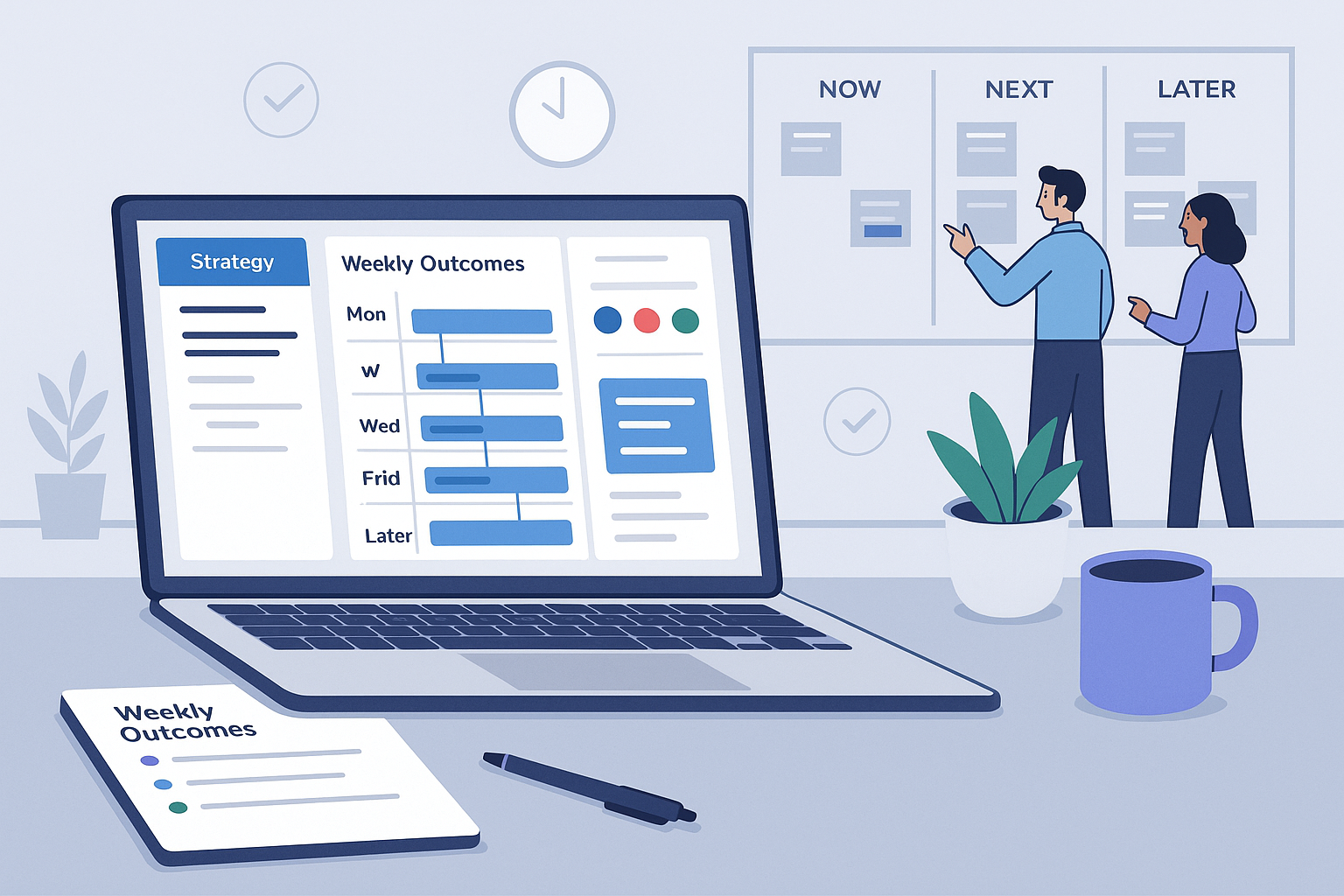
- Weekly outcomes board. Now, Next, Later columns with specific, measurable outcomes and the work that delivers each one. Outcome first, then tasks.
- Scorecard. A one-screen view with a handful of leading indicators and trailing results. Green, amber, red. No decimals, no vanity metrics.
The four rituals
- Weekly commit. Monday. 45 minutes. Each team commits to 1–3 outcomes for the week and the work that makes them non-negotiable. If it is not on the board, it is not happening.
- Midweek adapt. Wednesday. 20 minutes. Surface blockers early, swap scope if needed, protect focus.
- Demo and decide. Friday. 45 minutes. Show what moved. Decide what stops, continues, or changes next week. Demos beat decks.
- Monthly reset. 90 minutes in week four. Roll up learning, refresh 90-day bets, retire zombie work.
The five guardrails
- WIP limit. Cap concurrent initiatives per team. Fewer streams, faster flow.
- Decision rights. Explicit RACI-like rules for who decides what. Reduce ambiguity and escalation time.
- Time blocks. Focus bands on calendars for deep work tied to weekly outcomes.
- No stealth work. Nothing enters midweek without deprioritising something else. Always show the trade-off.
- Visible dependencies. Owners for every dependency, with dates. No orphaned risks.
Convert annual goals into weekly outcomes
Executives often throw objectives at teams and hope they translate. Do the conversion work. Use this cascade.
The Goal-to-Week cascade
- Annual objective. Example: Increase enterprise retention from 90% to 94%.
- 90-day bet. Example: Reduce time-to-value for new enterprise customers from 30 to 14 days.
- Monthly objective. Example: Ship guided set-up for top three integrations.
- Weekly outcomes. Example: 1) 20 enterprise users complete guided set-up with NPS ≥ 50, 2) Cut onboarding call length from 60 to 35 minutes in two pilot accounts.
- Work. Example: Build integration selector, write 3 in-product checklists, record 2-minute tutorial, revise call script, run A/B on CTA placement.
Notice the pattern. Each step tightens scope, keeps the outcome measurable, and ensures the weekly work is unambiguously linked to a result that matters.
Engineer your calendar, or it will engineer you
Strategy dies in the calendar. You must design the week.
Focus bands
Block two or three daily focus bands per team for outcome-driving work. Treat them like client meetings. Non-negotiable. Examples:
- Product/engineering. 09:00–11:00 and 14:00–15:30, Tue–Thu.
- Sales. 10:00–12:00 prospecting focus, Mon–Thu.
- Ops. 13:00–15:00 process improvement focus, Tue–Fri.
Use protected blocks to execute the weekly outcomes. Do not schedule recurring status meetings in these bands. Status belongs to your scorecard and Friday demos.
Meeting hygiene rules
- Every meeting must have a decision or deliverable. Otherwise cancel it.
- 25 or 50 minutes by default. Give people transition time.
- No multi-team alignment meetings without a written pre-read and clear decision rights.
- Replace “update” meetings with asynchronous updates. Use the Friday demo for alignment.
Apply WIP limits using Little’s Law
The more you start, the longer everything takes. Limit the number of parallel initiatives. A practical rule:
- Team of 5–7: two initiatives max.
- Team of 8–12: three initiatives max.
You will ship more, sooner. Cycle time falls. Throughput rises. Morale improves because people finish work and see the impact.
Measure what matters weekly
If you do not measure weekly, you will argue monthly. Choose metrics that reveal whether your week is working.
Four metrics to run your week
- Outcome attainment. Did we hit the week’s outcomes? Yes or no. No weasel words.
- Throughput. Number of outcome-aligned deliverables completed per week. Keep it stable by limiting WIP.
- Flow efficiency. Ratio of active time to waiting time across key work streams. Expose blockers.
- Forecast reliability. Percentage of weekly commitments met. If it is below 70% for three weeks, reduce scope or fix dependencies.
Use these metrics to learn, not to punish. The purpose is to strengthen the system, not score people.
Decision rights: who moves what, when
Misalignment thrives in vagueness. Give people the authority to move fast within clear boundaries.
Leader’s intent
State the why, the what, and the boundaries. Then get out of the way. Example:
- Intent. Increase trial-to-paid conversion by improving first 5 minutes.
- Target. Lift conversion from 22% to 28% by end of Q2.
- Boundaries. No new ad spend. Maintain accessibility standards. Coordinate with Support on scripts.
With intent, people decide locally. Without it, they escalate everything. That is how weeks disappear.
Escalation lanes
Define three lanes so issues travel fast:
- Lane 1. Team-level. Resolve within 24 hours. No leader required.
- Lane 2. Cross-team. Resolve in 48 hours with named owners.
- Lane 3. Executive. Resolve in 72 hours at the weekly exec stand-up.
Write this down. Put it where work happens. Consistency is power.
Edge cases: cross-functional, innovation, and service teams
Different work types need tailored rules.
- Cross-functional initiatives. Appoint a single accountable owner. Use a shared weekly outcomes board across teams. Break down by value slice, not by department task.
- Innovation bets. Separate from the core. Fixed time budget per week. Outcome is validated learning with explicit kill or scale criteria.
- Service and BAU-heavy teams. Use capacity buffers. Lock focus bands for improvement work or the urgent will strangle the important.
Implementation plan: a 30-day sprint
Do not launch a programme. Install a rhythm. Here is a simple boot-up.
- Week 1: Clarify and pick. Write strategy on a page. Select two 90-day bets. Pick the first weekly outcomes per team. Set focus bands.
- Week 2: Run the cadence. Monday commit, Wednesday adapt, Friday demo. Populate the scorecard. Enforce WIP limits.
- Week 3: Tighten decisions. Publish decision rights. Turn two update meetings into asynchronous updates. Tackle your worst dependency.
- Week 4: Review and reset. Track the four metrics. Drop one initiative. Raise the quality bar on weekly outcomes. Plan the next 30 days.
Resist the urge to add more. Depth beats breadth.
Common traps and how to avoid them
- Vague outcomes. If your weekly outcomes are not measurable, you will drift. Demand observable change every week.
- Too much work. If you are missing commitments, cut scope by 30% and reduce WIP. Do it now.
- Meetings leak into focus bands. Protect them like revenue. Because they are.
- Hidden dependencies. Name an owner and a date for each dependency. No name means it is not real.
- Vanity metrics. If a metric does not drive a decision, remove it.
The PerformanceNinja 6Ps lens: make it systemic
Use the 6Ps to check for hidden friction so your weekly rhythm sticks.
- Purpose. Does each weekly outcome ladder directly to strategy on a page? If not, it is noise.
- People. Do managers know how to set outcomes and run the cadence? Coach them.
- Proposition. Are we prioritising the few value drivers that move customers and revenue this quarter?
- Process. Do your tools and workflows support the rhythm, or fight it? Simplify.
- Productivity. Are WIP limits, focus bands, and metrics installed and visible?
- Potential. Are innovation bets ring-fenced with time and decision criteria?
If one P is weak, the rhythm will wobble. Fix it before scaling.
A short example: turning retention goals into weekly work
A B2B SaaS scale-up had a churn problem with mid-market clients. The annual goal was clear: improve net revenue retention from 105% to 115%. Each quarter leadership asked for sharper customer health and better onboarding. But weekly life was chaos.
We installed the rhythm. Two 90-day bets: cut onboarding time-to-value and reduce time-to-first-insight in the product.
Weekly outcomes looked like this:
- Week 1. 15 new admins complete guided set-up with an NPS of 50+. Reduce average onboarding call to 45 minutes in two pilot accounts.
- Week 2. 20 admins complete set-up. 50% click-through to first dashboard within 3 minutes. Publish Support script v2 and train CSMs.
- Week 3. 25 admins complete set-up. 60% click-through. Run A/B on in-app prompt with two messages.
Work mapped directly: shipped integration selector, checklists, and two-minute video; updated call scripts; created a dashboard shortcut; ran A/B tests. The team hit weekly outcomes four weeks in a row. Time-to-value dropped from 28 days to 13 days in 60 days. NRR lifted to 113% in the next quarter. No heroics. Just rhythm.
Leader’s checklist: make this week count
- Write your strategy on a page. One page. Today.
- Choose two 90-day bets. Kill the rest for now.
- Set WIP limits. Fewer streams. Faster flow.
- Define weekly outcomes before tasks. Outcome first, then work.
- Block focus bands. Treat them as revenue.
- Install the four rituals. Commit Monday. Adapt Wednesday. Demo Friday. Reset monthly.
- Publish decision rights and escalation lanes. Reduce needless permission-seeking.
- Track four metrics weekly. Attainment, throughput, flow efficiency, forecast reliability.
If you do this, you will stop confusing motion with progress. You will align goals to weekly work by design, not by accident.
Final word: make the week the unit of execution
Strategy should not be a quarterly drama. It should be a weekly practice. The week is the unit of execution. Build a rhythm where goals become outcomes, outcomes become work, and work becomes value. Do this consistently and the culture will shift from activity to impact. That is how leaders master the art of organisational leadership.
Next Steps
Want to learn more? Check out these articles:
Quick Sync Agenda: Drive Outcomes, Cut Meeting Waste Fast
Organisational Operating System Design [Practical Blueprint]
Culture Without Bureaucracy: A Blueprint for Agile Teams
To find out how PerformanceNinja could help you, book a free strategy call or take a look at our Performance Intelligence Leadership Development Programme.