
Revisiting Culture in 2026: Speed, Clarity, and Ownership
If you pulled down every values poster in the office tomorrow and deleted the #culture Slack channel, would your execution slow by even a day? If the answer is no, you do not have a culture. You have slogans. In 2026, culture is the operating system for speed. It is the difference between a team that adapts in hours and one that convenes a task force in weeks. The uncomfortable truth is this: culture drift is the default, bureaucracy creep is relentless, and well-meaning leaders are often the ones slowing the team down.
This article is a hard reset. We will strip culture back to first principles, expose where your organisation is leaking energy, then give you a no-nonsense way to rebuild speed, trust, and ownership without theatre or fluff. Expect bluntness. Expect tactics you can run by Monday.
The brutal truth about culture in 2026
Culture is how things happen in general. Not how you say they happen. Not the aspirational slide. It is the real cadence, the real decisions, the real trade-offs. And it is distinct from context, which is what is relevant right now. Leaders who confuse culture and context either standardise themselves into paralysis or improvise themselves into chaos. Your job is to design both with intent, then keep them in balance. The lens is simple: ensure your vision, systems, rituals, goals, structures, tools, and stories are coherent and mutually reinforcing to drive outcomes in the real market you face today. If this sounds like culture-by-design rather than culture-by-slogan, it is. Treat it as such .
If you recognise yourself here, you are not alone:
- It is hard to get everyone working on the right things at the right time. Misaligned priorities cause drag. Execution rhythms are episodic, not engineered.
- DNA is diluted as you scale. Remote, hybrid, and rapid hiring stretch the original norms until they snap. Collaboration across teams is clunky. The client feels the seams.
- Bureaucracy creeps in. A form here. A steering meeting there. Soon the organisation is paying an interest rate on every decision.
- Managers who were excellent individual contributors are now accountable for teams and systems. They are under-skilled for the new job and over-protective of the old one.
- You cannot change things by decree anymore. Complexity demands clarity of decision rights, not louder instructions.
The market context multiplies the difficulty. You are operating in a VUCA world. Volatility, uncertainty, complexity, and ambiguity are structural, not cyclical. You do not fix them. You build for them .
Culture is not vibes. It is design.
You can measure and engineer culture. Use tools that reveal what actually drives behaviour:
- The Cultural Web helps you surface the real paradigm, stories, symbols, power structures, routines, and controls people live by. It is fast, practical, and brutal in the best way .
- The Competing Values Framework shows the tensions your culture must manage and the trade-offs you are implicitly making: control vs flexibility, internal cohesion vs external market focus. There is no perfect quadrant. There is only deliberate balance for your strategy and stage .
Define culture precisely: simple, testable, executable
Precise definitions beat inspirational adjectives. Start here:
- Culture: how things happen in general. Codify it in a small set of operating norms and rituals that are observable and inspectable in your calendar, your tools, and your meetings. If it is not visible in the way you plan, decide, deliver, and learn, it does not exist.
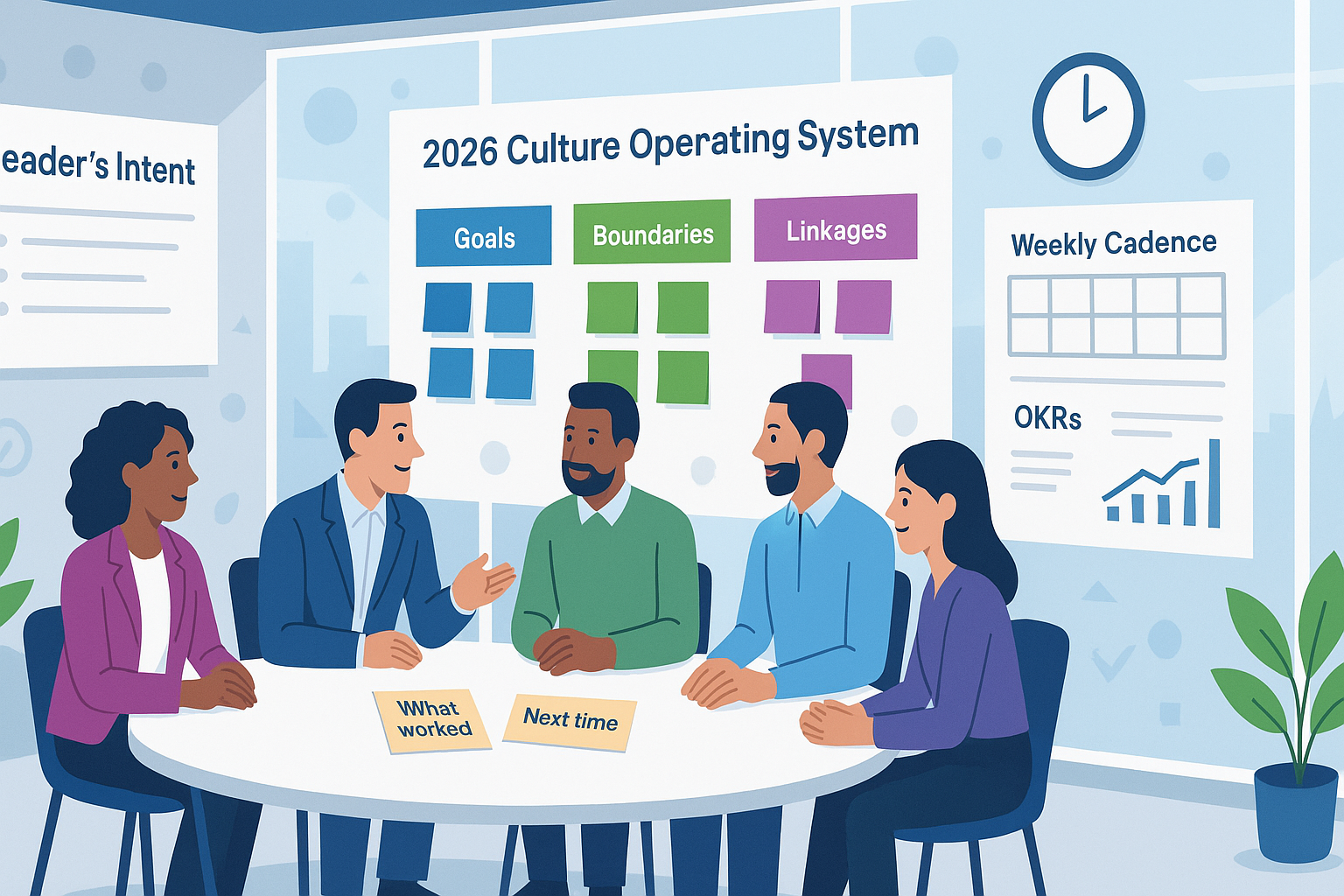
- Context: what is relevant right now. Express it in Leader’s Intent, OKRs, and near-term priorities. Then remove anything that conflicts. Simplicity is speed .
To translate intent into execution, install the Goals, Boundaries, Linkages pattern at every level. It is the most underused lever in growth companies:
- Goals: state what good looks like in positive, outcome terms.
- Boundaries: state the constraints in negative terms to unleash creativity inside safe limits.
- Linkages: state the interfaces and responsibilities across teams to eliminate friction and turf wars. Clarity reduces leader overwhelm, accelerates decisions, and improves collaboration .
What high-performing culture looks like in 2026
Speed without chaos: decision rights and operating rhythm
Fast organisations are not reckless. They are engineered. They combine distributed decision-making with crystal-clear intent and cadence:
- Leader’s Intent: replace requests with “I intend to…” plus the checks you have made. Push authority to the edge with balanced accountability. This teaches judgement and raises the standard of thought before action. It is the opposite of micromanagement and the antidote to passivity .
- Operating Rhythm: standardise a weekly and monthly cadence that looks up, back, and forward. Inspect deliverables. Prioritise ruthlessly. Connect squads via cross-team forums. Think tactically week-to-week and strategically quarter-to-quarter so sprint teams do not drown in noise or chase shadows .
- OKRs as alignment, not bureaucracy: use 3 to 5 Objectives with 3 to 5 Key Results per Objective to focus, not to suffocate. The point is alignment, transparency, and engagement. If OKRs feel like admin, you are writing tasks, not outcomes .
Trust with standards: psychological safety plus accountability
This is not a warm and fuzzy add-on. Psychological safety is the precondition for speed and learning. People must be able to surface risks, ask for help, and challenge plans without fear. But safety is not softness. It sits with clear performance standards and fast feedback. Measure it with simple questions. Run blameless debriefs as a ritual. You will raise the rate of learning and lower the cost of mistakes .
Ownership at every altitude: business within a business
In a 2026 culture that works, managers and teams think like internal entrepreneurs. They own outcomes, treat colleagues as clients and suppliers, and balance authority with accountability. You get focus, better interfaces, and fewer handoffs that go nowhere. It is practical. It is teachable. And it scales without one hero at the centre of every decision .
Adaptable DNA: choose your cultural mix
The strongest cultures are adaptable, not dogmatic. Blend your cultural emphasis based on strategy and lifecycle. A heavy market orientation might be right for a commercial turnaround. A clan-leaning emphasis helps integrate a newly remote or cross-border team. An adhocracy bias fuels innovation in early-stage bets. Rebalance deliberately as seasons change, do not let the pendulum swing randomly .
Networked, not just hierarchical
You still need structure and accountability, but the execution engine in 2026 looks like empowered networks, not fragile chains of command. Build shared consciousness and empowered execution, with outcome-based goals, clear decision rights, and transparent information. This shift is well documented and repeatable when leaders redesign their operating model with courage and clarity .
30-day action plan to reset culture, fast
You do not need a year-long values programme. You need four weeks of decisive action.
- Set Leader’s Intent and remove noise
Write a one-page Leader’s Intent for the next quarter: what we will achieve, how we will measure it, what we will not do. Share it in writing. Inspect every standing meeting and report against it. Cut anything that does not serve the intent. You will get instant lift in focus and morale. Use simple OKRs for alignment, not theatre . - Codify five non-negotiable behaviours
Pick five behaviours that define how work gets done here. Tie each to a specific ritual. For example, “We seek the root cause before reacting” paired with a 15-minute 5-Whys slot in every incident review. Publish them as a one-pager. Train managers to model and coach them. You are designing culture intentionally, not hoping for osmosis . - Install Goals, Boundaries, Linkages at team level
In a 90-minute session with each team, set 3 to 5 goals, define the boundaries they must respect, and map linkages to adjacent teams. Capture decisions about who is accountable, who is consulted, and who is informed. This single move reduces friction more than another all-hands ever will . - Build a weekly operating rhythm
Run a short weekly review cadence that looks back on deliverables, looks up to intent and OKRs, and looks forward to next-week commitments. Get cross-team leaders in a 30-minute forum to surface dependencies and commit to handoffs. The cadence matters more than the slides . - Hard-wire psychological safety with standards
Ask the safety questions in your next team survey and bring results into the open. Run one blameless debrief per team per fortnight, focused on learning, not blame. Close with specific actions, owners, and deadlines. Safety with standards improves execution speed without excuses . - Teach intent-based leadership in the line
Replace status requests with “I intend to…” updates that include the checks made. Push decisions to the edge with clear boundaries. Coach managers to ask more questions and give fewer orders. You will get better decisions and stronger talent, quickly . - Decide on your cultural balance for this season
Use the Competing Values lens in an exec offsite. Choose the 60:30:10 mix your strategy needs right now. Then pick two rituals that visibly support that bias. For example, to boost market orientation, run weekly win/loss learning and customer-story sessions. To shift to more adhocracy, reserve protected exploration time and log learning in a shared system .
90-day blueprint: lock in the gains
Keep the plan tight and high-level. Depth beats breadth.
- Clarify strategy-to-structure link: Confirm your operating model supports your strategic priorities and stage. If not, fix decision rights and interfaces first, org chart second. Do not scapegoat structure or copy what someone else did. Fit matters, and re-orgs fail when you skip diagnosis and buy-in .
- Codify the operating system: Document your Goals, Boundaries, Linkages; your weekly and quarterly rhythms; your decision rights and escalation paths; your handful of rituals. Put them where work happens. This is your culture OS.
- Train managers as culture carriers: Upgrade frontline managers in coaching, feedback, decision-making, and cross-team collaboration. Great managers are multiplicative for performance. Treat this as a core capability, not an HR nice-to-have .
- Run the change equation explicitly: Raise dissatisfaction with the status quo using real waste and delay metrics, paint a credible vision, and commit to practical next steps that overcome resistance. Make the change math visible so people can believe it and do it .
Metrics: culture you can inspect, not just feel
Measure what proves culture is working. A few, non-gameable, leading indicators beat a dashboard zoo.
- Decision velocity and quality: median cycle time from issue raised to decision logged; percent of decisions with a single accountable owner; percent resolved at the right level first time. Use your decision-rights framework to analyse misses .
- Operating rhythm health: percent of teams running the weekly look up/back/forward cadence; on-time handoffs across teams; number of unresolved cross-team dependencies older than one week .
- Psychological safety and standards: track two questions that matter most to speed and learning, such as “It is safe to take a risk on this team” and “Members of this team are able to bring up problems and tough issues.” Pair them with defect rates and rework time to keep standards in view .
- Ownership signals: percent of managers submitting “I intend to…” updates; number of boundary-respecting decisions made without escalation; internal customer NPS across team interfaces, reflecting the business-within-a-business mindset .
- Alignment and focus: number of active OKRs per team and per individual; the ratio of outcome KRs to output tasks; completion rate of key initiatives linked to OKRs. If outputs dominate, you are gaming the system, not changing behaviour .
Common traps to avoid
- Declaring values without installing rituals. If it is not in the calendar, it is not in the culture.
- Copying another company’s playbook without adaptation. Best practice is context-dependent. Off-the-peg fixes misfire.
- Blaming structure for every pain. Often the real blockers are unclear decision rights, weak interfaces, and absent rhythms.
- Running a re-org without diagnosis, design criteria, and a true implementation plan. That is how 61% of re-organisations fail to achieve outcomes. Take a holistic view and test your design against strategy, people, and flexibility criteria .
- Pretending change is easy. It is not. Make the change equation explicit and real, then walk people through it with credibility and care .
Zooming out: culture as a system, not a slogan
Culture does not sit in HR. It sits across your entire operating model. Use the 6Ps to check systemic cohesion:
- Purpose: vision, mission, and principles that truly guide decisions, not decorate walls.
- People: skills, behaviours, and leadership capability that carry the culture daily.
- Proposition: strategy and value choices that your culture must enable.
- Process: systems, rhythms, and interfaces that embed your norms.
- Productivity: ways of deciding, aligning, and inspecting the work week by week.
- Potential: how you explore and exploit. Protect learning time, log insights, and operationalise innovation so it does not cannibalise focus .
Culture is the most powerful lever you have in 2026, but only if you treat it like an engineering problem. Design it. Install it. Inspect it. Adapt it. Do this and you will ship faster, decide cleaner, collaborate better, and keep your soul intact while you scale.
Implementation plan: brief and high-level
- Week 1: Leader’s Intent; cut noise; publish five behaviours; set the weekly cadence.
- Weeks 2–3: Goals, Boundaries, Linkages per team; decision rights and escalation paths; first round of blameless debriefs.
- Week 4: Exec offsite to set cultural balance via Competing Values; confirm operating model fit; publish culture OS.
- Weeks 5–12: Train managers; run the change equation; track five leading metrics; adjust rituals as signals demand.
This is not about perfection. It is about compound improvements that stay. Make culture your speed advantage.
Next Steps
Want to learn more? Check out these articles:
Culture Without Bureaucracy: A Blueprint for Agile Teams
Keep Culture Strong as You Scale: A Guide for Leaders
Transforming Company Culture: Strategies for Improving Employee Engagement
To find out how PerformanceNinja could help you, book a free strategy call or take a look at our Performance Intelligence Leadership Development Programme.