
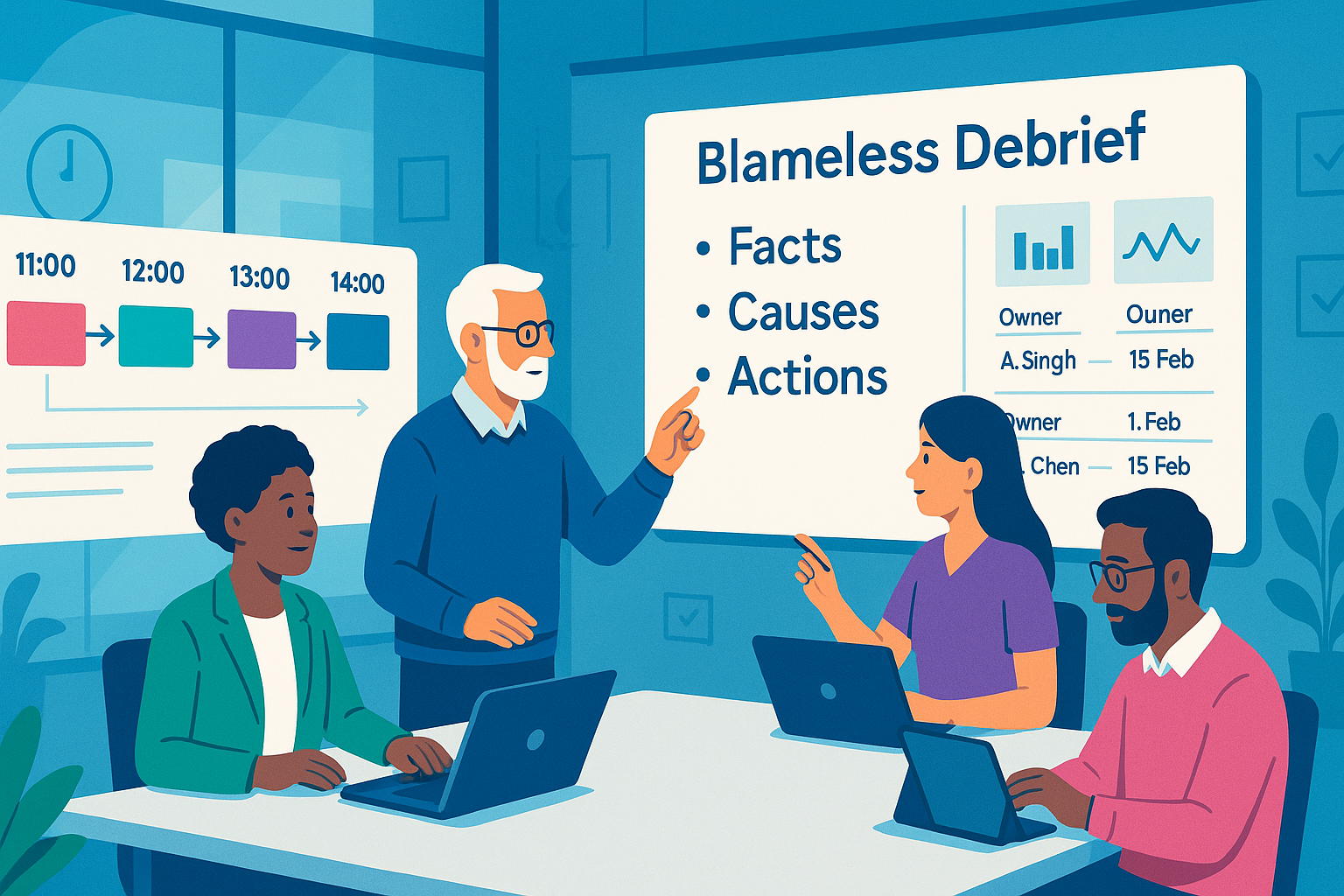
Blameless Debriefs That Fix Work Now [Leader's Field Playbook]
Introduction: You are not short of talent. You are short of truth
If the last time something broke you asked “who did this?” rather than “what made this possible?”, you just taxed your own organisation. Blame is an accelerant for fear. Fear kills speed, learning, and ownership. A blameless debrief is how you stop the rot and build a system that gets smarter after every hit.
This is not a soft idea. It is operational discipline. Elite teams use it because it works. The US Army’s After Action Review is brutally honest and relentlessly focused on learning. Google’s Site Reliability Engineering playbook treats postmortems as blameless by design to prevent repeat incidents. Amy Edmondson’s research on psychological safety shows teams speak up and correct faster when they are not punished for raising problems. You want speed. Speed lives where learning is safe and truth is normal.
The brutal truth: blame kills speed
Blame fires a shot across the bow of candour. People hide risk, under-report small issues, and invent safe stories. You end up running the business on fiction. Every delay, defect and rework cycle is a tax you chose.
High-performance organisations accept this truth:
- Failure is data. If you delete it with blame, you delete your learning loop.
- Humans are the last step in a chain. Systems shape behaviour. Fix the system and you change the outcomes.
- You move speed to the left by moving fear out of the room.
What a blameless debrief is (and is not)
A blameless debrief is a short, structured review held soon after an event. The goal is to extract facts, find system causes, and agree actions that prevent recurrence or reduce impact. No witch-hunts. No performance reviews. No theatre. Just facts, cause, action.
It is not:
- A therapy session. Feelings matter, but the focus is evidence and decisions.
- A legal defence meeting. Do not litigate the past. Understand it.
- A status update. It is a learning and improvement ritual.
- A place to hide. If you repeatedly ignore standards or actions, that is a separate performance issue. Just culture separates learning from accountability, and handles both.
The 30-minute blameless debrief: agenda and scripts
Leaders love speed, but they waste it with unstructured review meetings. Here is a 30-minute format that works. Keep it. Repeat it. Make it muscle memory.
Before the debrief: set the conditions
- Timing: within 48 hours while memory is fresh.
- Participants: the incident lead, those close to the work, the decision-maker, a neutral facilitator, and a scribe.
- Materials: a single-page timeline, key metrics, screenshots or logs. Keep to the facts.
- Rules (state them out loud):
- No blame. We examine systems and decisions in context.
- Speak plainly. Use facts and timestamps.
- Focus on what, how, and why. Not who.
- Close with specific owners, deadlines, and follow-up.
During: run the agenda
- 0 to 3 minutes: Purpose and rules
Script: “We are here to learn, not to blame. Our goal is to understand how our system produced this outcome and agree three to five concrete actions that protect us next time.” - 3 to 10 minutes: Timeline walkthrough
Script: “Walk us through the timeline in 60 seconds. Then we will clarify key moments.”
Ask:- What happened, when, and where?
- What signals did we see or miss?
- Which decisions were made, on what information?
- 10 to 18 minutes: Contributing factors
Use a simple prompt: “What made the right thing hard and the wrong thing easy?”
Probe categories:- Information: visibility, alerts, dashboards, SOPs, runbooks.
- Process: handoffs, approvals, queues, role clarity.
- Tools: reliability, latency, usability, access.
- People context: staffing, skills, fatigue, incentives.
- Environment: priorities, deadlines, customer pressure, change volume.
- 18 to 25 minutes: Actions that change the system
Script: “If this happened tomorrow, what one change would most reduce impact or probability?”
Choose three to five actions, not twelve. Each action must have an owner, a deadline, a definition of done, and an expected risk reduction. - 25 to 30 minutes: Confirm, appreciate, publish
Summarise actions, owners, dates, and follow-up. Thank people for candour. State where the write-up goes and when the follow-up review will run.
After: land the learning
- Publish a one-page write-up within 72 hours.
- Log actions in the same system you use to manage work.
- Run a 10-minute follow-up in the weekly leadership rhythm to confirm closure and impact.
Roles and responsibilities that keep it tight
You do not need a circus. You need clear roles.
- Executive sponsor: protects the blameless principle and enforces action closure. Removes blockers and noise.
- Facilitator: neutral, trained in incident analysis, keeps time and tone. Enforces rules. Cuts monologues.
- Incident lead: closest to the event. Presents the timeline, context, and constraints.
- Scribe: captures facts, factors, and actions in real time. Publishes the one-pager.
- Domain experts: answer precise questions. No speeches. No posturing.
- Decision-maker: accepts the actions, allocates resources, and approves trade-offs.
Make it measurable: the metrics that matter
If you do not measure, you are practising theatre. Track these:
- Time to debrief: incident end to debrief start. Target 48 hours or less.
- Action closure rate: percentage of debrief actions closed on time. Target 90 percent.
- Repeat incident rate: recurrence of similar events within 90 days. Target downwards trend.
- Time to detect and time to restore: trend over time. Aim for consistent reduction.
- Learning velocity: number of debriefs completed and published per month. Target a sustainable cadence.
- Impact reduction: for the same class of incident, measure drop in customer impact or internal cost.
Patterns to look for: fix systems, not people
Humans adapt to the system you built. Study patterns. Fix constraints.
- Silent dashboards: alerts that bark but do not bite. No routing, no ownership. Fix routing, thresholds, on-call clarity.
- Hand-off friction: work dies between teams. Define clean interfaces and service levels. Create a single owner per hand-off.
- Decision fog: unclear authority. Use decision rights matrices and visible escalation paths.
- Hero dependency: only two people can fix it. Cross-train. Build runbooks. Rotate on-call. Remove special snowflakes.
- Incentives at war: speed measured here, quality punished there. Align goals and metrics so teams pull the same way.
- Procedural dead ends: three approvals for simple changes. Replace blanket approvals with risk-based gates.
Common traps that destroy blameless debriefs
You can wreck this fast. Avoid the traps.
- Faux blamelessness: “We are blameless, but why did Jane not follow the checklist?” That is blame. Ask what made the checklist invisible, unusable, or misaligned with reality.
- Fishing expeditions: open-ended debates with no timebox. Use the 30-minute format and cut to actions.
- Action stuffing: twelve generic tasks nobody owns. Choose fewer, sharper actions.
- Confidentiality theatre: burying the write-up so only three people see it. Publish by default. Use redaction only when legally required.
- Conflating learning with discipline: if you see negligence, handle it privately through performance management. Do not poison the learning ritual.
- Over-automation: tools without culture. Software helps, but the human rule set drives truth.
Where blameless debriefs fit in your operating system
Debriefs are one ritual in a larger operating system. Link them to other rhythms so learning changes work next week, not next quarter.
- Weekly leadership rhythm: review open debrief actions and unblock. Ten minutes. No slides.
- Quarterly risk review: cluster incidents, choose themes, invest in systemic fixes.
- Roadmap governance: factor debrief insights into prioritisation. Security, reliability, and customer-impact actions must have a clear lane.
- Talent development: identify skill gaps revealed by incidents. Train, pair, or hire.
- Culture pulse: track psychological safety indicators. If candour drops, the system is under threat.
The 7-sentence debrief write-up template
Keep it short. Clarity wins.
- What happened in one sentence.
- Customer or business impact in one sentence.
- The timeline in three to five bullet points.
- Contributing factors in three to five bullet points.
- What we learned in two to three bullet points.
- Actions with owners and deadlines in three to five bullet points.
- Expected risk reduction in one sentence.
Scripted opening lines for leaders
Words set tone. Use these.
- “Thank you for leaning in fast. We are here to learn, not to blame.”
- “Assume competence. We will study context and constraints.”
- “State facts. If it is not on the timeline, it is opinion.”
- “One conversation at a time. We will finish with actions we believe in.”
How to handle heated moments without losing the room
Incidents are charged. Keep discipline.
- When voices rise: pause, restate the purpose, and return to the timeline.
- When someone blames a person: redirect to system factors. Ask, “What made that the most reasonable choice at the time?”
- When context is missing: timebox a quick data pull. If unavailable, note the gap as an action.
- When you hit uncertainty: write down the unknowns. Convert to tests or monitoring improvements.
Choosing actions that move the needle
Not all actions are equal. Choose actions that change how work works.
- Eliminate a class of error: add an automated check that prevents bad inputs.
- Reduce blast radius: add circuit breakers, feature flags, or progressive rollouts.
- Improve visibility: fix alerting, add health checks, improve logging, simplify dashboards.
- Clarify ownership: assign a clear single owner for a system or hand-off.
- Shorten recovery: build a tested rollback or restore capability.
- Tighten standards: update a runbook with the exact threshold and response steps.
- Skill uplift: deliver a focused drill or pairing exercise on the weak point.
The 30-day rollout plan
You do not need a two-year change programme. You need 30 disciplined days.
Week 1: Build the rule set and artefacts
- Draft the 30-minute agenda and the 7-sentence template.
- Train five facilitators. Use a one-hour practice with a past incident.
- Set the rule: all material incidents get a debrief within 48 hours.
Week 2: Run three pilot debriefs
- Pick two recent incidents and one success case. Run the format.
- Publish the write-ups. Share where everyone can read them.
- Track time to debrief and action closure commitments.
Week 3: Wire learning into the weekly rhythm
- Add “debrief actions” to the leadership meeting. Ten minutes. No exceptions.
- Resolve one cross-team ownership gap revealed by the pilots.
- Start the debrief log: date, event, actions, closure, impact.
Week 4: Scale with discipline
- Train ten more facilitators using real cases.
- Review repeat incident patterns. Choose a theme and fund a fix.
- Publish a one-page “how we learn” guide. Reinforce blameless rules and why they exist.
Executive FAQs
Is blameless the same as no accountability?
No. Just culture separates learning from discipline. The debrief asks how the system set up the outcome. If someone repeatedly violates clear standards, manage that separately.
What if legal or compliance is involved?
Invite them early. Clarify what must be redacted. You can be transparent and compliant. Do not make “legal” a fig leaf for secrecy.
Will this slow us down?
It speeds you up. You convert incidents into durable improvements. You cut repeats. You get faster at detection and recovery. The meeting takes 30 minutes. The payoff compounds.
What if people do not speak?
Model it. Senior leaders go first with their own misjudgements. Then ask specific, neutral questions. Protect the rule set and praise candour in public.
How do we keep it from becoming a blame session?
Use a neutral facilitator. State the rules at the start. Cut blame language. Refocus on context, constraints, and timeline facts.
The PerformanceNinja 6Ps lens: why this works at scale
Use blameless debriefs to tighten your operating system across the 6Ps.
- Purpose: codify why you run debriefs. You learn to protect customers and speed.
- People: build psychological safety with operational edge. Train facilitators and incident leads.
- Proposition: improve reliability and trust in your product by removing repeat failure modes.
- Process: standardise the 30-minute format and the 7-sentence write-up.
- Productivity: track action closure, reduce repeat incidents, and focus investment where risk falls fastest.
- Potential: mine debriefs for innovation. Constraints reveal opportunities for new features and automation.
Maintaining quality over time
Good habits decay. Protect the ritual.
- Quarterly calibration: facilitators review three write-ups and refresh standards.
- Rotate facilitation: prevent blind spots and groupthink.
- Celebrate system fixes: spotlight actions that removed whole classes of risk.
- Keep the bar: if actions slip, stop other work and close them. Signal what matters.
Coaching notes for leaders in the room
You cast a long shadow. Your behaviour sets the norm.
- Never ask “who is at fault?” Ask “what did the system make likely?”
- Get curious about constraints: missing data, unclear ownership, time pressure.
- Share your own error stories. You signal that truth is safe.
- Fund the fix. Do not leave actions unfunded and unloved.
- Close the loop in public. Report back on impact. You build trust when learning changes reality.
Two real-world examples you can copy tomorrow
- Release outage, 28 minutes of downtime
Timeline shows a deploy script skipped a health check on one service. Alert arrived but routed to an unmonitored channel. Engineers improvised a rollback.
Actions:- Add a blocking health check to the deploy script.
- Route alerts to the on-call rota with a clear escalation path.
- Add a 15-minute rollback drill to the weekly practice.
- Customer onboarding backlog spike
Timeline shows three hand-offs between sales, legal, and ops with unclear ownership. Each team chased different SLAs. Work stalled in queues.
Actions:- Define a single owner for onboarding flow.
- Merge three forms into one. Clarify required fields and validation.
- Implement a daily flow review until backlog clears.
Your first debrief script for the next incident
Print this. Use it.
- “We are here to learn, not to blame. We will study facts and context.”
- “Timeline in 60 seconds. Then clarifying questions.”
- “What made the right thing hard and the wrong thing easy?”
- “Choose three to five actions with owners and deadlines.”
- “We publish a one-pager in 72 hours. Follow-up next week.”
Why this matters now
As your organisation scales, truth dilutes. Everyone is busy. Few are honest. Blameless debriefs force the honest conversation that turns chaos into an operating advantage. Your competitors will keep running whodunnits. You will run a system that compounds learning and compounds speed. That is how you win.
Implementation plan
- Define the ritual: 30-minute agenda, rules, template, roles. One day.
- Train facilitators: one-hour practice using a past event. One day.
- Run pilots: three debriefs, publish write-ups, review closure. One week.
- Wire the loop: add debrief actions to weekly leadership rhythm. Immediate.
- Scale and protect: train more facilitators, track metrics, hold the standard. Ongoing.
Close
Truth is a choice. Make it a habit. Run blameless debriefs with rigour, not rhetoric. You will learn faster, reduce repeat pain, and build a culture that handles pressure without drama. That is leadership in practice.
Next Steps
Want to learn more? Check out these articles:
Post-merger Culture Codification: Protect Value In 100 Days
Scaling Leadership in Complex Organisations: A Field Guide
Escalation Paths That Work: Faster Decisions, Fewer Fires
To find out how PerformanceNinja could help you, book a free strategy call or take a look at our Performance Intelligence Leadership Development Programme.