
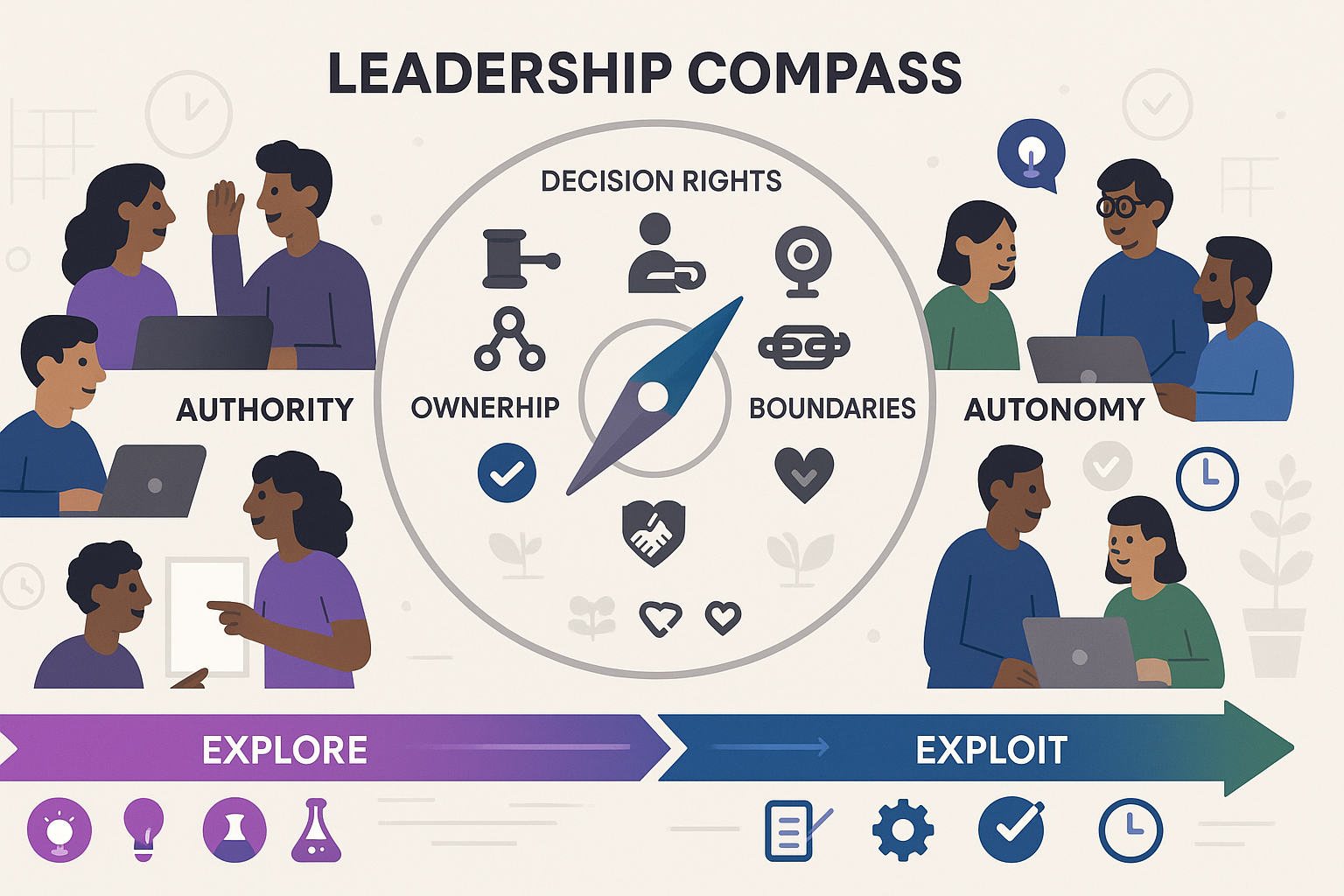
Balance Authority and Autonomy: A Blueprint for Speed and Trust
Introduction: The balance point that multiplies speed
Senior leaders rarely suffer from a lack of effort. They suffer from a lack of balance. Push authority too hard and you get bureaucracy, delays, and risk-averse teams who wait for permission while opportunities sail past. Push autonomy too hard and you get chaos, duplication, and well-meaning initiatives that collide mid-air. The win isn’t at either extreme. It’s the precise balance point where clarity and freedom create speed, safety and results.
Here’s the brutal truth: most organisations try to fix autonomy problems with more authority. And they try to fix authority problems by shouting about empowerment. Both approaches fail. What works is a deliberate operating system that aligns decision rights with accountability, builds shared context, and then moves decisions to the edge.
This is your blueprint.
The false choice: control or chaos is a leadership failure
Authority and autonomy are not opposites. They are complements. When authority rises faster than accountability, you breed resentment. When autonomy outruns guardrails, you get recklessness. The job is to pair the two, explicitly and everywhere. Done well, you replace slow sign-offs with crisp decision rights and replace heroic firefighting with predictable throughput. The practical frame is simple: match decision-making rights with responsibility for execution, or expect pain. The quadrant is obvious to any leader who has lived the scars: empowerment without boundaries becomes recklessness; control without ownership creates resentment .
Operating principle: align authority with accountability, always
A high-performance system hard-wires this alignment into the way work is set, led and inspected. Four non-negotiables:
- Decision rights are explicit. Everyone knows who decides, who must be consulted, who performs, and who is informed. Ambiguity here destroys speed. Use a simple RAPID-style pattern: Decide, Agree, Recommend, Input, Perform. Publish it, teach it, and use it in meetings and docs .
- Single ownership per decision and deliverable. One owner. No committees. Collaboration is welcome, but ownership cannot be shared without diluting outcomes .
- Leader’s Intent replaces instruction. Leaders state outcomes, context and constraints. Teams choose the how. This increases initiative without losing coherence .
- Goals, Boundaries, Linkages are visible. Goals create focus and accountability. Boundaries define what must not happen. Linkages specify where coordination is required. This triad gives teams freedom to move fast without creating cross-team collisions .
Shared consciousness first, empowered execution second
If you decentralise decisions without shared understanding, you scale confusion. The order matters. Build shared consciousness through open information, a single narrative, and routine cross-team forums, then empower execution at the edge. Teams with shared context use autonomy effectively; teams without it create rework. This is the core lesson from Team of Teams: replace command-and-control with a network that shares information widely and executes locally . Done right, you don’t get the 70 percent solution tomorrow. You get the 90 percent solution today, because context is abundant and decisions are pushed closest to reality .
Design decision rights you can actually scale
Decision clarity fails when it stays theoretical. Make it operational with three artefacts:
- A Decision Map: catalogue the top 30 recurring decisions in your business. For each one, assign D/A/R/I/P and publish escalation paths. Keep it to one page per function .
- A Mandate for each team: define its goals, boundaries and linkages. Five bullets each, maximum. Anything more becomes noise and reduces initiative .
- A Decisions Log: a living register of major calls, the deciders, the why, and the date. Trade gossip for a single source of truth. This is a core leadership task: decisions logged and accessible .
Calibrate autonomy differently for Explore and Exploit
Not all work needs the same level of autonomy. Exploration thrives on freedom within broad, risk-based guardrails. Exploitation requires tighter control for reliability and efficiency. Treating these domains the same guarantees frustration. Use separate rhythms, metrics and decision rights for each. Explore work optimises learning velocity and risk mitigation. Exploit work optimises quality, cost and on-time delivery. Strategyzer’s Explore–Exploit portfolio makes the trade-offs clear. Match leadership mindset and governance to the domain you are in .
The cultural engine: psychological safety plus high standards
Autonomy without psychological safety is a trap. People will not take initiative if they fear humiliation for being wrong. Make it clear that ideas, concerns and intelligent failures are welcome. Measure psychological safety, don’t guess. Then pair it with high standards and single-point accountability. This is not softness. It is the precondition for speed under pressure .
Guardrails that enable creativity: boundaries and linkages
Boundaries, expressed in the negative, liberate creativity by clarifying what must not happen. Linkages, expressed relationally, make collaboration efficient by codifying interfaces and handshakes. This language gives leaders a cleaner way to set constraints without smothering initiative. Publish these guardrails alongside goals so teams see the full playing field and the touchlines at once .
Governance that protects autonomy: fewer rules, clearer mandates
Boards and executive committees often swing between overreach and neglect. Neither supports autonomy. The fix is a mandate that is as broad as possible and only specific where absolutely necessary. This keeps oversight muscular without micromanaging the means. You want optimised control balance: sufficient oversight to avoid risk cliffs, with enough freedom to innovate and adapt at speed .
Where leaders break it: common failure modes and fixes
You will recognise these patterns. Fix them with precision.
- People wait for permission, windows close, escalations spike. State Leader’s Intent for every priority. Assign a single owner. Clarify decision rights. Run short sprints with daily quick syncs to surface blockers early .
- Meetings are polite but useless, challenge is low. Calibrate support and challenge. Use a blameless debrief rhythm. End meetings with clear commit statements so autonomy converts to action .
- Project sprawl, goal drift, busyness without outcomes. Reset with one set of Objectives and three to five Key Results. Publish goals, boundaries and linkages. Prune anything that doesn’t move the KRs .
- OKRs don’t align to strategy or are imposed top-down. Co-create OKRs, align them to strategy, and never link them to individual performance ratings. Invite teams to propose their contribution, don’t just cascade tasks .
- Structure becomes the scapegoat. You reorganise again, nothing changes. Take a holistic view. Clarify decision allocation, interfaces and operating rhythms before redrawing boxes and lines .
- Corporate functions clog flow. Redefine role and authority. Decide which functions are full-service providers, sole providers for a short list, vendors of choice, coordinators, or professional standard-bearers. Then match decision rights accordingly .
The weekly operating rhythm that scales autonomy without bureaucracy
Speed comes from cadence. Leaders create clarity not by more documents, but by a steady drumbeat that keeps context fresh and decisions crisp.
- Quick Syncs: 10–15 minutes a day per squad. Surface blockers, confirm owner on each deliverable, record decisions, and move on. No status theatre, only commitments and help needed .
- Looking Up / Looking Back / Looking Forward: a weekly leadership review that re-anchors teams to intent, inspects outcomes, and anticipates next moves. Cut drift before it compounds .
- Decisions Log review: highlight 3–5 material decisions, reaffirm decision rights, name single owners, and restate constraints. Keep the system honest .
- Blameless Debriefs: after material events. Extract learning at speed, improve methods, and reduce fear. Autonomy grows when teams know mistakes become data, not punishment .
People want autonomy for a reason: it drives motivation
For creative and complex work, autonomy is not a perk, it is performance fuel. Pair it with mastery and purpose and you light a fire most incentives cannot touch. If you crush autonomy with low-trust controls, you crush the very motivation that drives quality and innovation .
The PerformanceNinja big picture: balance across the 6Ps
Authority and autonomy aren’t a “people problem.” They are a system problem that touches every lever of performance.
- Purpose: make trade-offs visible so teams choose well without waiting. Codify goals, boundaries, linkages where purpose meets reality .
- People: define roles with single ownership and the skill to decide at the edge. Teach decision-making and debriefing as core skills, not extras .
- Proposition: separate Explore and Exploit so product bets have the right autonomy and governance .
- Process: install the weekly operating rhythm that aligns without bureaucracy. Quick syncs, decisions logged, blameless debriefs .
- Productivity: use OKRs correctly. Align to strategy, co-create contributions, never tie to performance ratings. Inspect work through outputs and outcomes, not effort .
- Potential: protect time and authority for experimentation. Use explicit guardrails so autonomy in innovation does not cannibalise core delivery .
Implementation plan: 30–60–90
0–30 days
- Map your top 30 decisions and assign D/A/R/I/P.
- Publish team mandates with goals, boundaries, linkages.
- Start daily quick syncs. Open a decisions log.
- Begin measuring psychological safety .
31–60 days
- Rebuild your OKR set through co-creation.
- Run blameless debriefs on the biggest two misses this quarter.
- Split Explore vs Exploit work with distinct rhythms and owners.
- Teach Leader’s Intent to every manager .
61–90 days
- Tighten governance where risk is real and relax it where capability is proven.
- Recut interfaces between teams using linkages.
- Calibrate corporate functions’ roles and decision rights.
- Audit the decisions log and remove at least three approvals you no longer need .
What you should feel when the balance is right
- Fewer escalations, faster local decisions, better global coherence.
- Crisper ownership, fewer meetings, higher throughput.
- More initiative from the edge, fewer heroics from the centre.
- A culture that is direct, safe, and decisive under pressure.
The balance between authority and autonomy is not a vibe. It is designed. It lives in your decision rights, your operating rhythm, your guardrails, and your culture. Build shared consciousness, set non-negotiable boundaries, and then push power to the edges. Be a gardener, not a chess master. That’s how you get speed and trust at the same time .
Next Steps
Want to learn more? Check out these articles:
Raise the Leadership Signal-to-Noise Ratio [Leader's Guide]
Decide Faster Without More Meetings: The Leader’s Playbook
Protect Culture Integrity as You Scale: A Leader’s Playbook
To find out how PerformanceNinja could help you, book a free strategy call or take a look at our Performance Intelligence Leadership Development Programme.