
Quarterly Business Reviews for Scaling Teams That Actually Work
Most quarterly business reviews are theatre.
A deck gets built at 11pm the night before. Leaders talk at people for two hours. Everyone nods. A few “actions” are captured. Then the organisation goes back to doing what it was already doing. Nothing changes except your calendar is now clogged again in 90 days.
In a scaling team, that is not just inefficient. It is dangerous.
Because scale doesn’t forgive fuzzy priorities. It punishes them. The bigger you get, the more every unclear decision multiplies into duplicated work, conflicting messages to customers, and managers making up “strategy” locally just to keep moving.
This article shows you how to run quarterly business reviews (QBRs) in scaling teams so they produce alignment, accountability, and decisions. Not vibes. Not slides. Decisions.
What a QBR is actually for (and what it is not)
A QBR is not a status update. If you need a quarterly meeting to discover what happened, your operating cadence is broken.
A QBR is a decision forum. It exists to do three things:
Lock in priorities for the next 90 days based on reality, not hope.
Resolve cross-functional trade-offs that teams cannot solve in isolation.
Reinforce what “good” looks like so execution is consistent as headcount grows.
If your QBR does not produce decisions, it is a monthly business review with a nicer title.
The scaling-team trap: local optimisation becomes your default
When you scale, you gain capacity but you lose shared context. People start filling the gaps with assumptions.
That is how you end up with:
Marketing chasing lead volume while Sales fights lead quality.
Product shipping features while Support drowns in tickets.
Operations building controls while Delivery screams about speed.
Leaders “aligning” in meetings while middle managers quietly re-prioritise on Monday.
A good QBR is where you force those conflicts into the open, and you resolve them with explicit choices.
The PerformanceNinja big-picture lens: the 6Ps that QBRs must touch
In scaling organisations, QBRs fail because they focus on Productivity (tasks, actions, roadmaps) while ignoring the other forces that drive performance.
At minimum, your QBR must scan across the PerformanceNinja 6Ps to avoid blind spots:
Purpose: Are we still clear on why we exist and what winning means this year?
People: Do we have the capability and leadership capacity for the next stage?
Proposition: Is our value proposition staying sharp as the market shifts?
Process: Where is bureaucracy creeping in, and where are we still dangerously ad hoc?
Productivity: Are the right outcomes being delivered, and is follow-through disciplined?
Potential: Are we building future growth without distracting from today’s execution?
This is not six separate workshops. It is a structured way to prevent your QBR becoming a glorified project update.
The non-negotiables of a high-performance QBR
If you want your QBR to change behaviour, there are four non-negotiables. Miss any one and you will drift back into theatre.
1) Separate “reporting” from “review”
Reporting is asynchronous. Review is synchronous.
Every scaling team claims they do this. Most still turn the QBR into live narration of a deck.
Do it properly:
48 hours before: distribute a short pre-read with metrics, outcomes, and decisions required.
Before the meeting: attendees must submit questions in writing.
In the meeting: you only discuss exceptions, trade-offs, and decisions.
If someone arrives unprepared, you do not “bring them up to speed”. You move on. Scaling requires standards.
2) Make the QBR outcome-based, not activity-based
Activity is comforting. Outcomes are confronting.
A scaling organisation can be very busy while getting worse. Your QBR must anchor on outcomes that map to the business model.
Use a small set of metrics that show whether the machine is working. Examples:
Growth: pipeline coverage, win rate, CAC payback, net revenue retention.
Delivery: cycle time, on-time delivery, quality defects, rework rate.
Customer: NPS or CSAT trend, churn reasons, ticket volume and ageing.
People: regrettable attrition, time-to-productivity for new hires, manager span of control health.
Pick metrics that your leaders can influence. Avoid vanity metrics that make everyone feel better and change nothing.
3) Force trade-offs into the open
In scaling teams, the real work is not execution. The real work is prioritisation under constraint.
Your QBR must surface these trade-offs explicitly:
Where are we overcommitted?
What are we saying “no” to this quarter?
What are the top three cross-functional dependencies that could break execution?
What is the single most important risk we are choosing to live with?
If nobody is uncomfortable, you did not prioritise. You just listed.
4) Close the loop with ruthless follow-through
A QBR without a follow-up system is just a motivational talk.
Every decision made in the QBR must translate into:
a named owner
a measurable outcome
a due date
a check-in cadence (weekly or fortnightly)
If you do not have a mechanism to chase delivery, your organisation will revert to whoever shouts loudest.
The QBR structure that works in scaling teams
Here is a structure that scales cleanly from 30 people to 300, without turning into bureaucracy.
Step 1: Pre-work (48 hours before)
This is where discipline starts. Your pre-read should be short and decision-oriented.
Include:
Scorecard (1 page): the 8 to 12 core metrics, with targets, trend, and short commentary on variances.
Last quarter commitments: what was promised, what was delivered, what slipped, and why.
Customer reality: top churn reasons, top escalation themes, and one or two customer stories that cut through internal spin.
People and capability: critical role gaps, leadership bottlenecks, and any hotspots (attrition risk, performance issues).
Decision list: 5 to 10 decisions required in the QBR, written as clear questions.
Rules:
No more than 10 pages total.
Every chart must answer “so what?”.
No “highlights” section. Leaders are paid to face reality.
Step 2: Meeting agenda (120 to 180 minutes)
Time-boxing is your friend. The agenda below assumes a scaling leadership team and key functional heads.
0) Opening standard (5 minutes)
Set the tone:
We are here to make decisions.
We will speak in facts, not narratives.
We will leave with clear commitments.
1) Scorecard exceptions only (20 minutes)
Go straight to red and amber metrics. Ask:
What changed?
What did we learn?
What will we do differently in the next 30 days?
Do not allow deep dives yet. Park them as decision items.
2) Last quarter delivery: promises vs reality (25 minutes)
This is where trust is built.
Review commitments from the last QBR. For each miss, classify it:
Planning failure (we overcommitted)
Execution failure (we under-delivered)
Priority change (we made a conscious trade-off)
Dependency failure (cross-team friction broke flow)
Then do the uncomfortable bit: decide what will change in your system so the same miss does not repeat.
3) The three strategic questions (30 minutes)
This is where leaders earn their keep. Discuss and decide:
What must be true in 12 months for us to be winning?
What is the one constraint that will stop us getting there?
What is the single priority that best attacks that constraint?
This prevents the QBR turning into a “departmental show-and-tell”.
4) Decision block (45 to 70 minutes)
Work through the decision list from the pre-read. Typical QBR decisions in scaling teams:
Headcount allocation across functions
Which customer segments to pursue or drop
What to stop doing to protect focus
Which operational processes must now be standardised
Which initiatives move to the innovation pipeline vs delivery pipeline
Every decision must be recorded with a clear owner and rationale. The rationale matters because it reduces re-litigation later.
5) 90-day commitments (20 minutes)
This is the output: a short list of outcomes for the next quarter.
Requirements:
No more than 3 to 5 enterprise priorities.
Each priority has leading indicators (weekly signals) and lagging indicators (quarterly results).
Each priority has a single accountable owner, not a committee.
Each functional leader states what they will de-prioritise to deliver.
6) Close: communication and cadence (10 minutes)
Agree:
what will be communicated to the wider team within 48 hours
what will be reviewed weekly
what will be reviewed monthly
If you do not translate QBR outcomes into the operating rhythm, you are wasting everyone’s time.
How to keep QBRs from becoming a power struggle
Scaling teams often have a hidden problem: leaders use the QBR to win political battles. The meeting becomes a contest of persuasion, not a forum for truth.
Fix it with structure.
Use a standard decision template
For each decision, document:
Decision statement: what are we deciding?
Options: at least two real alternatives.
Recommendation: by the accountable owner.
Criteria: how will we judge the best option? (revenue impact, customer impact, risk, time-to-value, capability fit)
Impact: what changes as a result?
This makes debate productive. It limits rhetorical nonsense.
Define decision rights before the meeting
Ambiguity creates politics.
Be explicit:
Who decides budget shifts?
Who decides roadmap trade-offs?
Who decides hiring priority?
Who can veto, and under what conditions?
You can use RAPID or a simple “D/A/C/I” model. The model matters less than the clarity.
Install a “disagree and commit” rule with teeth
Leaders are allowed to disagree in the meeting. They are not allowed to run a shadow strategy afterwards.
Make it concrete:
If you disagree, you state your concern and what evidence would change your mind.
Once decided, you communicate the decision as if it was yours.
If new evidence emerges, you reopen the decision deliberately, not through gossip.
This is how you scale leadership maturity.
The QBR artefacts you need (and only these)
Scaling organisations drown in documents. Your QBR should produce a small set of artefacts that are actually used.
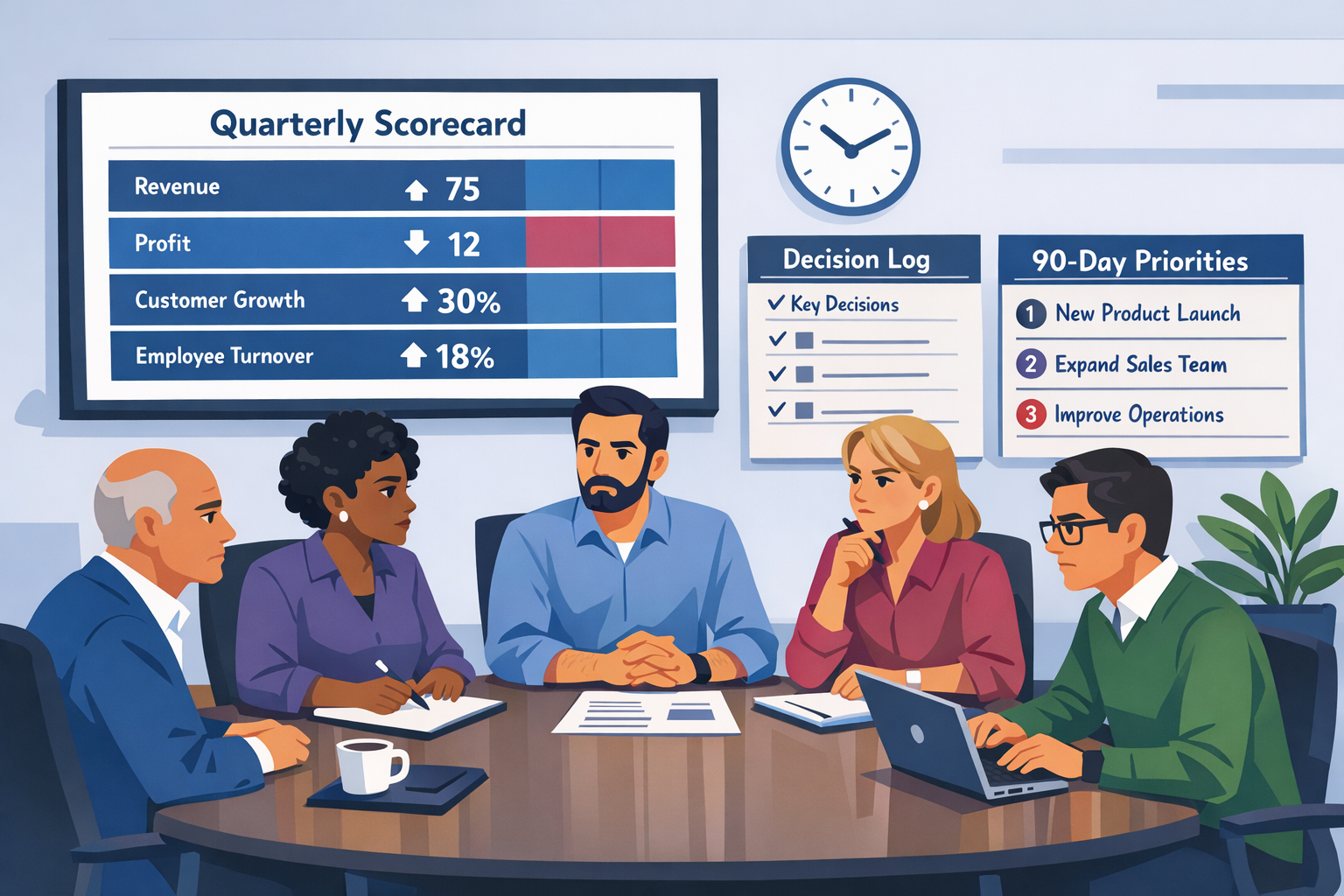
1) The one-page scorecard
A single page that shows the health of the business. Trends beat snapshots. Targets beat commentary.
2) The 90-day priorities list
A clear list of enterprise priorities, with outcomes, owners, and measures. This becomes the backbone of weekly execution check-ins.
3) The decision log
A running record of decisions, rationale, and date. This prevents re-litigating the same arguments every quarter.
4) The risk register (lightweight)
Top 5 to 10 risks only, each with:
probability
impact
mitigation
owner
If your risk register is a spreadsheet graveyard, you missed the point.
Common QBR failure modes in scaling teams (and how to fix them)
If your QBRs feel heavy and still ineffective, you are likely stuck in one of these traps.
Failure mode 1: Too many priorities
Symptom: everything is “important”, nothing ships cleanly.
Fix: cap enterprise priorities at 3 to 5. If leaders cannot choose, they are not leading.
Failure mode 2: Metrics without meaning
Symptom: dozens of KPIs, no decisions.
Fix: cut to 8 to 12 core metrics. Each must have an owner, a target, and a decision threshold. Example: “If onboarding activation falls below X for two weeks, we stop feature work and fix onboarding.”
Failure mode 3: Blame disguised as accountability
Symptom: people hide problems until it is too late.
Fix: make the review about the system, not the person. Then hold the line on commitments. Psychological safety is not softness. It is truth without punishment, paired with standards.
Failure mode 4: The QBR is isolated from day-to-day execution
Symptom: good decisions, no follow-through.
Fix: convert QBR priorities into weekly metrics and a short weekly leadership review. If you do not have a weekly cadence, the quarter will evaporate.
Failure mode 5: Innovation competes with delivery
Symptom: either innovation starves, or delivery collapses.
Fix: explicitly separate:
Run: keep the core service/product stable and profitable.
Improve: remove friction and increase performance.
Bet: explore new offerings or markets with controlled investment.
Your QBR is where you decide the allocation, then defend it.
A brief implementation plan: install a QBR system in 30 days
If your current QBR is inconsistent, do not attempt a perfection rebuild. Install a simple system, then iterate.
Week 1: Define the scorecard and decision rights
Agree the 8 to 12 metrics that reflect business health.
Define owners and targets.
Clarify who decides what in the QBR.
Week 2: Build the templates
One-page scorecard template.
Decision template.
90-day priorities template.
Week 3: Pilot the pre-read and question submission
Send the pre-read 48 hours before.
Require written questions 24 hours before.
Remove live slide narration.
Week 4: Run the QBR and lock the weekly cadence
Run the QBR using the agenda above.
Publish outcomes within 48 hours.
Schedule weekly follow-through reviews tied to the 90-day priorities.
This is how you turn a meeting into an operating system.
The standard you should hold your leadership team to
A scaling organisation does not fail because people are lazy. It fails because leadership tolerates ambiguity.
Your QBR is the quarterly moment where you remove ambiguity. Where you force reality into the room. Where you decide what matters, what does not, and what will change.
Run QBRs like a CEO, not a conference organiser.
Because in a scaling team, alignment is not a nice-to-have. It is the only way you keep speed without losing control.
Next Steps
Want to learn more? Check out these articles:
Execution Discipline in Scaling Teams: How to Fix Slippage Fast
Build a Management Operating System for Growing Teams That Scales
Set Organisational Priorities When Everything Feels Urgent
To find out how PerformanceNinja could help you, book a free strategy call or take a look at our Performance Intelligence Leadership Development Programme.