
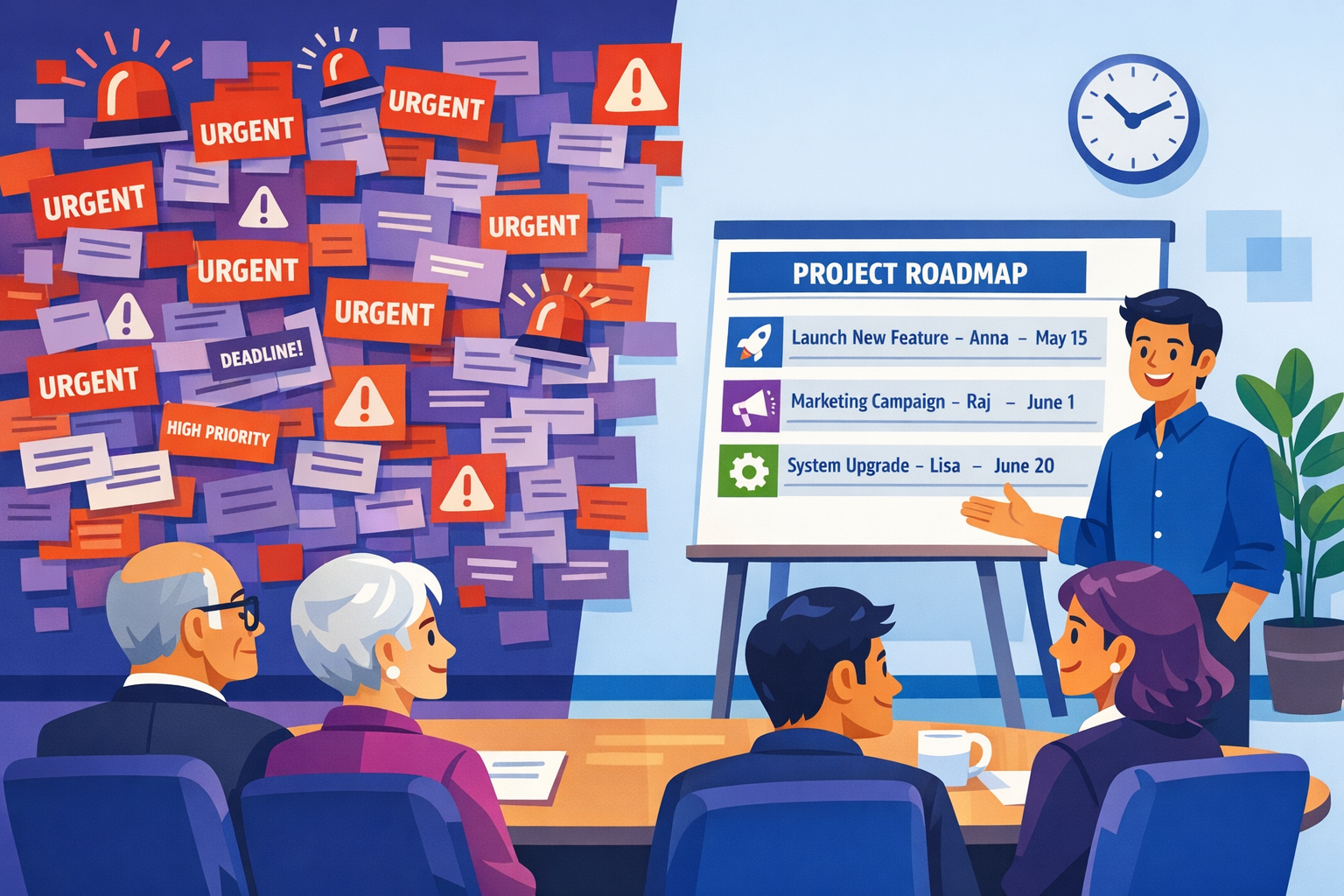
Set Organisational Priorities When Everything Feels Urgent
Your organisation is not “busy”. It is under-led.
If everything feels urgent, it is because your system for deciding what matters is broken, avoided, or quietly hijacked by the loudest voice in the room. And when urgency becomes your strategy, you get predictable outcomes:
- Teams thrash across ten “critical” initiatives and finish none.
- Good people burn out, then leave, then get replaced with “resources”.
- Leaders spend their days reacting, then call it responsiveness.
- Customers feel the chaos before your dashboard does.
This is not a motivation problem. It is a prioritisation design problem.
This article gives you a practical, senior-leader-ready method to set organisational priorities when everything feels urgent, without pretending urgency will disappear. You will learn how to separate real urgency from manufactured urgency, how to choose a small set of priorities that can actually be executed, and how to make those priorities stick through decisions, resourcing, and governance.
The brutal truth: urgency is often a leadership convenience
“Everything is urgent” is a comforting story. It makes overload feel inevitable. It reduces hard choices to a weather report.
But in most organisations, urgency is created by one of four root causes:
- No single definition of success. Different executives optimise different outcomes, so everything becomes a priority to protect local interests.
- Too many promises. Sales sells options, product sells possibility, operations sells certainty. Then delivery is left holding the risk.
- Weak decision hygiene. Meetings create tasks instead of decisions. Work multiplies without trade-offs.
- Capacity denial. Leaders plan as if people have infinite bandwidth, then act shocked when deadlines slip.
If you are serious about performance, you need to treat prioritisation as organisational infrastructure, not a quarterly ritual.
First, stop confusing “urgent” with “important”
Urgent means time-sensitive. Important means value-bearing. The overlap is smaller than your calendar suggests.
When leaders fail to distinguish them, you get two failure modes:
- Firefighting addiction: teams chase urgent noise, neglect important work, and create more fires later.
- Strategic theatre: leaders talk strategy, then fund and reward interruptions.
Here is the simple diagnostic. For any “urgent” request, ask these two questions:
- What measurable consequence occurs if we do not act in the next 14 days?
- Does this move a key business outcome, or is it merely preventing discomfort?
If you cannot name the consequence and the outcome, it is not urgent. It is anxiety wearing a deadline.
Use a hard definition of “true urgency”
Adopt this definition across the executive team:
- True urgency is a time-bound issue with a defined impact on revenue, cost, risk, customer trust, or legal compliance.
- False urgency is work that feels pressing because of internal pressure, poor planning, or vague ownership.
This is not semantics. It is how you stop your organisation being manipulated by noise.
Prioritisation is not choosing what to do. It is choosing what not to do.
Most leadership teams “prioritise” by ranking a long list. That is not prioritisation. That is organising guilt.
Real prioritisation creates exclusion:
- We will not start these projects this quarter.
- We will stop these initiatives now.
- We will not respond to these types of requests in less than X days.
If nobody is disappointed after your priority-setting process, you did not set priorities. You negotiated peace.
A practical system: the 3-layer priority stack
When everything is urgent, you need a hierarchy that makes trade-offs unavoidable. Use a three-layer stack:
- Enterprise priorities: 3 to 5 outcomes for the next 90 days.
- Functional priorities: what each function will do to deliver the enterprise outcomes.
- Team commitments: the actual work that will be executed, with owners and capacity.
Most organisations have layer 1 in PowerPoint and layer 3 in Jira, but layer 2 is missing. That gap is where chaos breeds. Layer 2 is where alignment becomes operational.
Layer 1: set 3 to 5 enterprise priorities for 90 days
Not 12. Not “strategic pillars”. Not “focus areas”. Actual priorities with measurable outcomes.
Each priority must pass these tests:
- Outcome-based: phrased as a result, not an activity.
- Measurable: you can tell if you won.
- Owned: a single executive is accountable.
- Resourced: people and budget are explicitly allocated.
- Trade-off backed: something else is paused or stopped.
Example, strong: “Reduce onboarding time from 21 days to 10 days for mid-market customers by 30 June.”
Example, weak: “Improve onboarding.”
Why 90 days? Because humans cannot execute at high quality when priorities change weekly, and markets do not wait for your annual planning cycle. 90 days creates urgency without panic.
Layer 2: convert enterprise priorities into functional bets
Every function must translate enterprise outcomes into their 90-day bets, with explicit deliverables. This is where you remove “everyone owns it” nonsense.
For each enterprise priority, ask each function to answer:
- What will we deliver in the next 90 days that directly enables this outcome?
- What will we stop, delay, or deprioritise to make space?
- What dependencies do we need resolved, by whom, and by when?
Then publish a single-page view that shows:
- Enterprise priorities
- Functional deliverables
- Owners
- Key dependencies
- Capacity assumptions
This becomes your operational contract.
Layer 3: turn bets into team commitments with capacity limits
Now do the part most leaders avoid: capacity reality.
Teams do not fail because they are lazy. They fail because leaders treat capacity like a rounding error.
Set three rules:
- Start less: limit each team to a small number of concurrent projects.
- Protect focus: create interruption buffers for true urgency.
- Make work visible: if it is not tracked, it is not real, it is a hope.
A simple but effective approach is to split capacity:
- 70% planned delivery aligned to priorities
- 20% operational load business-as-usual
- 10% true urgent buffer incidents, critical customer issues, compliance
If your urgent work regularly exceeds the buffer, you do not need “better prioritisation”. You need to fix the system creating incidents.
Use the PerformanceNinja 6Ps to diagnose what is driving “everything is urgent”
When urgency is chronic, the problem is rarely isolated. It usually spans the operating system. Use a quick scan across the 6Ps to find the real source:
Purpose: are you clear on what winning looks like?
If the organisation cannot articulate a crisp direction, priorities turn into politics.
- Do leaders agree on the top outcomes for the next 12 months?
- Can managers explain the “why” without slides?
People: do you have decision-makers or consensus collectors?
Priority-setting is a leadership capability. If leaders cannot say no, everything becomes yes by default.
- Do leaders protect their teams from low-value work?
- Do they escalate trade-offs early, or dump them late?
Proposition: are you trying to be everything to everyone?
Undefined value propositions create infinite requests. Every customer segment becomes “strategic”.
- Which customers will you actively disappoint, and why?
- Which offers are you willing to stop selling?
Process: do meetings create decisions or create tasks?
Bad process manufactures urgency. If every meeting ends with new actions and no decisions, you are multiplying work.
- Do you have clear decision rights?
- Do you kill work that is blocked, stale, or low value?
Productivity: can you see what is being worked on and why?
When priorities are not visible, people prioritise for self-protection.
- Can you name the top five initiatives consuming capacity?
- Can you quantify throughput and cycle time?
Potential: is innovation competing with delivery?
Innovation without governance becomes a distraction factory. Delivery without innovation becomes slow death.
- Do you have a defined innovation pipeline with explicit funding?
- Do experiments have clear exit criteria?
This scan is not a workshop. It is a leadership mirror. If you do not like what you see, good. Now you can fix it.
The priority-setting meeting that actually works
Most executive priority meetings are either a fight or a performance. Here is a structure that forces clarity in 90 minutes.
Step 1: start with a single scorecard
Bring one page of facts, not ten dashboards. Include:
- Revenue and pipeline health
- Gross margin or cost to serve
- Customer churn, NPS, or key satisfaction metric
- Delivery throughput and reliability
- Top risks and incidents
The goal is not completeness. It is shared reality.
Step 2: list every “urgent” item and classify it
Create a table with three columns:
- True urgent (time-bound, material consequence)
- Important but not urgent (strategic, value-bearing)
- Noise (unclear value, vague owner, politics)
Be ruthless. If an item cannot be classified quickly, it is probably noise.
Step 3: choose 3 to 5 enterprise priorities and kill the rest
Use explicit selection criteria:
- Impact on strategic outcomes
- Time sensitivity
- Feasibility within capacity
- Risk reduction
- Customer trust impact
Then do the part that separates leaders from managers: name what will stop.
Create a “Not Now” list and assign an executive to defend it. Because without defence, it will be quietly undermined by the next escalation.
Step 4: assign one accountable owner per priority
Not a committee. One name. That person can delegate tasks, but they own the outcome.
If you cannot assign an owner, you do not have a priority. You have a wish.
How to make priorities stick when the real world attacks
Even good priorities fail if you do not change the rules of the game. Here are four mechanisms that lock priorities into daily behaviour.
1) Set a “priority gate” for new work
New work enters through a gate, not through Slack.
Define a simple intake rule:
- All new initiatives must state the business outcome, urgency consequence, estimated effort, and which existing work will be displaced.
- Only a named group (for example, the exec team or a delivery council) can approve displacement.
This stops the silent expansion of scope that kills delivery.
2) Replace status updates with trade-off reviews
Status meetings are where time goes to die. Replace them with a weekly trade-off review focused on:
- What is blocked?
- What has changed in the environment?
- What are we stopping, to protect the priorities?
Measure leaders by the quality of decisions, not the volume of updates.
3) Make “stop doing” a formal leadership action
Create a habit: every month, each executive must propose:
- One initiative to stop
- One report to remove
- One meeting to kill
This is how you remove the organisational plaque that slows everything down.
4) Build consequences into governance
If priorities are optional, they will be treated as optional.
- Resource allocation must follow priorities.
- Performance conversations must reference priority outcomes.
- Pet projects must be exposed, not hidden in “BAU”.
People do what gets funded, reviewed, and rewarded. Everything else is theatre.
The hidden killer: “priority debt”
When you repeatedly declare new priorities without finishing the last set, you build priority debt. It behaves like technical debt:
- It compounds silently.
- It reduces speed.
- It increases failure rates.
- It makes the next change harder.
Priority debt shows up as:
- Half-built systems
- “Temporary” workarounds that become permanent
- Staff turnover in delivery teams
- Customer confusion and rework
The cure is not another planning cycle. It is finishing. Your organisation needs to relearn the discipline of closure.
Install a “definition of done” at the enterprise level
For each enterprise priority, define:
- What done means (metrics and observable outcomes)
- What is explicitly out of scope
- What must be true for the priority to be considered complete
If you cannot define done, you cannot execute. You can only stay busy.
High-level implementation plan (14 days to stability)
You do not need a six-month transformation to regain control. You need decisive action and a simple cadence.
Days 1 to 3: create shared reality
- Build the one-page scorecard.
- List all active initiatives and their owners.
- Estimate capacity at team level, honestly.
Days 4 to 7: set the 90-day enterprise priorities
- Run the 90-minute priority meeting using the structure above.
- Select 3 to 5 priorities, assign owners, publish the “Not Now” list.
- Freeze new initiatives unless they pass the priority gate.
Days 8 to 14: align execution
- Translate priorities into functional bets and team commitments.
- Stand up a weekly trade-off review.
- Remove or pause work that conflicts with the new priorities.
After 14 days, your organisation will not be “fixed”. But it will be controllable. And controllable beats chaotic every time.
What senior leaders must stop doing immediately
If you want priorities that stick, stop these behaviours. They create organisational chaos faster than any market change.
- Stop rewarding heroics. Heroics are often the result of poor planning and weak systems.
- Stop asking for “just a quick thing”. Quick things are how priorities die.
- Stop changing direction in public, without a decision. Your leaders will mimic your inconsistency.
- Stop delegating trade-offs. Only senior leaders have the authority to choose who loses.
Prioritisation is not a tool. It is a leadership posture.
Closing: urgency will not save you. Choices will.
Your organisation can be fast, or it can be frantic. It cannot be both.
When everything feels urgent, the solution is not pushing harder. It is choosing harder.
Set fewer priorities. Make them measurable. Assign owners. Fund them properly. Kill competing work. Review trade-offs weekly. Build a culture where “no” is not negativity, it is strategy.
That is how you set organisational priorities when everything feels urgent. Not with another spreadsheet. With leadership that refuses to pretend capacity is infinite, and refuses to let noise run the business.
Next Steps
Want to learn more? Check out these articles:
OKR Implementation for Growing Organisations: Make Scale Predictable
Build Accountability Without Micromanagement: A Leader’s Playbook
Recruiting the Team You Need for 2026 [Systems, Skills, Speed Now]
To find out how PerformanceNinja could help you, book a free strategy call or take a look at our Performance Intelligence Leadership Development Programme.