
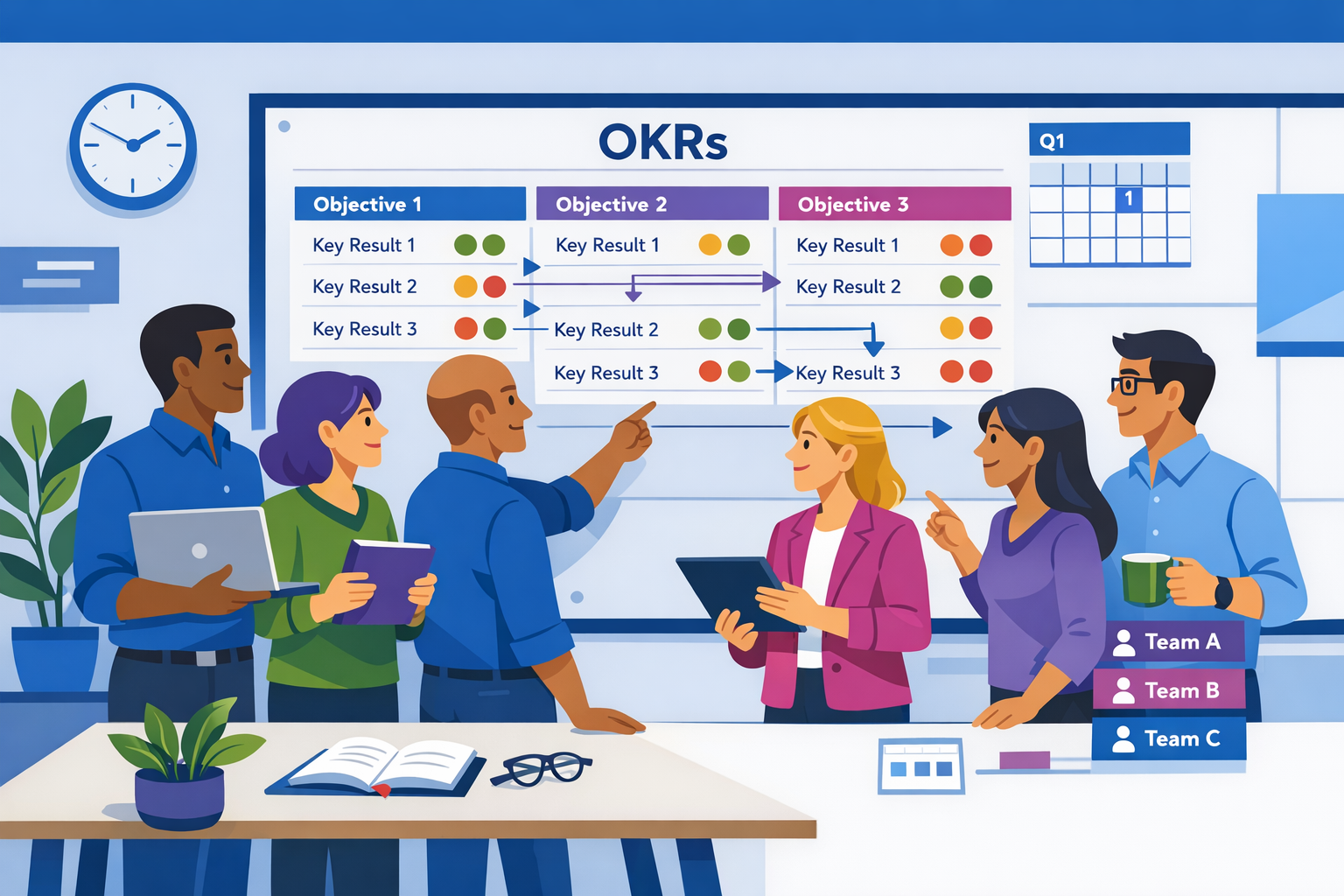
OKR Implementation for Growing Organisations: Make Scale Predictable
OKRs sound simple until your organisation starts to grow.
When you are small, alignment is informal. The founders know everything. Priorities travel by osmosis. People make good calls because they can see the whole machine.
Then headcount climbs. Teams specialise. Handovers multiply. Meetings breed. Suddenly, everyone is busy and nobody is sure if it is the right kind of busy.
That is when leaders reach for OKRs.
And if you implement them badly, you do not get focus. You get theatre.
You get beautifully written Objectives that nobody believes, a blizzard of Key Results that measure activity not outcomes, and quarterly check-ins that turn into performance-management cosplay. People learn the game. They sandbag. They negotiate metrics. They hit numbers that do not move the business.
This article is the blunt, practical guide to OKR implementation for growing organisations. Not the textbook version. The version that survives real scaling constraints like unclear accountability, cross-team dependencies, diluted culture, and leaders who can no longer keep everything in their heads.
Why OKRs fail right when you need them most
OKRs tend to be introduced at the exact moment your organisation becomes harder to steer. That is good timing in theory, and dangerous timing in practice.
Growth creates predictable failure modes. If you see yourself in these, your OKR rollout must address them directly.
1) You are confusing motion with progress
Growing teams get efficient at producing output. More tickets closed. More features shipped. More campaigns launched. More client meetings held.
But the business is not a factory. Output only matters when it creates outcomes.
Bad OKRs amplify this problem by rewarding “busyness metrics” like:
- Publish 12 blog posts
- Run 6 webinars
- Ship 20 features
- Hire 10 people
These are not Key Results. They are to-do lists with numbers.
2) Your strategy is implicit, so OKRs become a proxy for strategy
OKRs cannot compensate for vague strategy. They will expose it.
If leaders cannot state what matters most this quarter, the organisation will write OKRs that try to matter to everyone. That produces diluted focus and too many priorities.
OKRs are not strategy. They are a mechanism to execute a strategy. If the “why this, why now” is unclear, the OKR process becomes a quarterly argument about preferences.
3) Accountability is fuzzy, so ownership becomes political
As organisations grow, roles drift. Responsibilities overlap. Leaders inherit legacy commitments. Everyone touches everything.
OKRs force a hard question: who owns the outcome?
In weak implementations, this turns into:
- Objectives “owned by the leadership team”
- Key Results “owned by a function”
- Initiatives “owned by whoever has capacity”
That is a recipe for missed targets and finger-pointing.
4) Dependencies multiply, so teams optimise locally
In a 10-person company, dependencies are handled by talking. In a 100-person company, dependencies are a system problem.
OKRs without dependency management create a specific kind of dysfunction:
- Each team hits its own numbers
- Cross-team outcomes fail
- Clients experience the gaps
That is how you end up “green” internally while customers churn externally.
5) You weaponise OKRs as performance management
Most OKR literature is clear that OKRs should not be directly tied to individual performance pay. The reason is simple: it incentivises gaming and sandbagging. Google popularised this principle for a reason.
Growing organisations often ignore it because they want control. They end up buying compliance and losing truth.
If your people do not feel safe to report “red” status, your OKR system becomes a lying machine.
The brutal truth: OKRs do not create alignment, leaders do
OKRs are an alignment tool. They are not alignment itself.
If your senior team is not aligned on priorities, trade-offs, and what “winning” means, your OKR process will simply scale disagreement.
This is where the PerformanceNinja 6Ps lens helps at the big-picture level. OKRs live primarily in Productivity, but they fail when Purpose is unclear, Proposition is muddy, People capability is uneven, Process is chaotic, and Potential work is stealing focus.
Use OKRs to execute. Do not use them to discover who you are.
What good OKRs look like in a growing organisation
Good OKRs do three things at the same time:
- Translate strategy into outcomes people can influence within a quarter.
- Force trade-offs so “priority” actually means something.
- Create a cadence of truth about what is and is not working.
That sounds abstract. Here is what it looks like on the ground.
Objectives are directional and decision forcing
A good Objective is specific enough to guide decisions and broad enough to allow creativity.
Strong examples:
- Reduce onboarding time-to-value for mid-market customers
- Make delivery predictable for top 20 accounts
- Stabilise the platform so feature teams can ship safely
Weak examples:
- Improve customer experience
- Be best in class
- Drive growth
If your Objective could appear in a motivational poster, it is too vague to run a business.
Key Results are measurable outcomes, not tasks
A Key Result answers: “How would we know we achieved the Objective?”
Strong Key Results tend to be about:
- Customer behaviour (activation, retention, expansion)
- Commercial results (pipeline conversion, margin, cycle time)
- Operational performance (lead time, defect rate, SLA achievement)
- Capability (measurable readiness, not training completion)
Weak Key Results measure activity:
- Deliver X project
- Launch Y initiative
- Run Z workshops
Those are initiatives. Initiatives can be useful, but they are not Key Results.
Initiatives are explicitly optional
This matters in growing organisations because people are drowning in commitments.
Good OKR practice makes the relationship clear:
- Objectives and Key Results are the commitment.
- Initiatives are the current best guess for how to achieve them.
- If an initiative stops working, you change it without changing the outcome.
This is how you keep focus while staying adaptable.
The scaling problem OKRs must solve: focus under constraint
As you grow, you do not just add people. You add constraints:
- More coordination cost
- More process debt
- More customer promises
- More compliance and risk
- More leaders who are new to leading
OKRs are valuable because they make constraints visible. They expose where you are overcommitted.
The point is not to create more work. The point is to stop doing the wrong work.
A practical OKR implementation plan for growing organisations
If you want OKRs to work, implement them like an operating system. Not like a workshop.
Here is a high-level plan that works for most growing organisations in the 30 to 300 headcount range.
Step 1: Decide what level OKRs will operate at (and be strict)
Do not start with everyone writing OKRs. That creates chaos.
Choose one of these starting points:
- Company and functional OKRs (common for 50 to 300 headcount)
- Company and product squads (common for product-led firms)
- Company and client delivery streams (common for services firms scaling delivery)
Pick the smallest set of groups that covers the majority of value creation. Expand later.
Step 2: Set 1 to 3 company Objectives per quarter
Most growing organisations cannot execute more than three real priorities at once without fragmenting.
To get to 1 to 3, force this discipline in the leadership team:
- List everything you want.
- Rank it.
- Draw a line.
- Actively say “not this quarter” to the rest.
This is where most teams flinch. Do it anyway.
Step 3: Write Key Results that change a scoreboard you already care about
If you have to invent brand new metrics to make your OKRs work, you are at risk of creating a parallel reality.
Start with existing business scoreboards:
- Revenue retention, churn, expansion
- Sales cycle length, win rate, pipeline coverage
- Delivery lead time, rework rate, utilisation (for services)
- NPS or CSAT if you trust it, and behaviour metrics if you do not
- Reliability and incident metrics for tech platforms
Then choose the 2 to 4 metrics per Objective that, if moved, would prove progress.
Tip: use baselines. A Key Result without a baseline is a wish.
Step 4: Make ownership singular and explicit
Every Objective and every Key Result needs a single accountable owner. Not a committee. Not “the team”. One person.
Ownership does not mean doing all the work. It means:
- Defining the outcome precisely
- Driving cross-team commitments
- Surfacing risks early
- Reporting status truthfully
If you cannot name an owner, you do not have an OKR. You have a hope.
Step 5: Separate OKRs from individual performance ratings
If you are growing, you need truth more than you need compliance.
Keep OKRs as a team and organisational execution system. Use performance management to assess:
- Role expectations
- Competency growth
- Values and behaviour
- Impact and contribution
But do not make “hitting OKRs” the same thing as “being a good performer”. In a scaling environment, some KRs will miss for good reasons, like learning something important or encountering a dependency.
If you punish misses automatically, people will stop taking meaningful bets and start protecting themselves.
Step 6: Install a weekly cadence that makes truth unavoidable
Quarterly OKR check-ins are too slow. In a growing organisation, you can lose a month to confusion without realising it.
A simple weekly cadence is enough:
- 15 minutes per Objective in a leadership execution meeting.
- Status is numeric first: what changed in the Key Result metrics since last week?
- Then blockers: what is stopping progress?
- Then decisions: what trade-off must be made this week?
This is where OKRs become operational, not aspirational.
Step 7: Manage dependencies explicitly, not socially
Dependencies are not solved by “alignment”. They are solved by agreements.
Implement a dependency protocol:
- Every cross-team dependency must have a named requester and a named provider.
- Define the deliverable, quality bar, and due date.
- Track it in the same place as the OKR work.
- Escalate within 48 hours if it is at risk.
This prevents quiet failures and last-minute surprises.
Step 8: Keep the system light, or it will be rejected
Growing organisations are allergic to bureaucracy, and rightly so. Many OKR implementations collapse because they add too much ceremony.
Guardrails that keep it light:
- One page per team OKR set
- No more than 3 Objectives per team
- No more than 4 Key Results per Objective
- Metrics updated weekly, not rewritten weekly
If your OKR deck needs a table of contents, you are doing it wrong.
Common OKR traps in growing organisations (and fixes)
These show up repeatedly in companies attempting OKR implementation during growth.
Trap: Too many OKRs, so nothing is a priority
Fix: Cap the total number of company Key Results to 8 to 12. If you have more, your strategy is not a strategy. It is a list.
Trap: Teams inherit OKRs instead of owning them
Fix: Use a two-way contract. Leadership sets the company Objectives. Teams propose their own KRs and initiatives that support them. Leadership approves or challenges based on trade-offs and capacity.
Trap: Key Results are not controllable by the team
Fix: Mix lagging and leading indicators. For example, retention is lagging. Activation behaviours and onboarding time-to-value are leading. A team needs at least one KR it can directly influence weekly.
Trap: “Green” status becomes the goal
Fix: Define what each status means. For example:
- Green: on track, no material risks
- Amber: at risk, mitigation plan exists
- Red: off track, requires a leadership decision this week
Then make “red” useful by treating it as an early warning system, not a confession.
Trap: OKRs become the only conversation, and delivery work suffers
Fix: Keep the OKR layer thin and link it to existing execution systems. OKRs should shape your backlog, roadmap, and delivery plans. They should not replace them.
Examples: OKRs that actually fit growing organisations
Below are patterns that work. Do not copy them blindly. Use them to pressure-test your own thinking.
Example 1: Services firm scaling delivery quality
Objective: Make client delivery predictable across all accounts
Key Results:
- Increase on-time milestone delivery from 62% to 85%
- Reduce unplanned rework hours from 18% to 10%
- Improve top-20 account renewal rate from 78% to 85%
Why this works: It ties operational performance to a commercial outcome. It also forces leaders to confront process and capability gaps instead of blaming individuals.
Example 2: SaaS firm improving activation
Objective: Reduce time-to-value for new customers
Key Results:
- Reduce median time to first successful workflow from 14 days to 7 days
- Increase activation rate from 38% to 55%
- Reduce onboarding support tickets per account from 6.2 to 3.5
Why this works: It focuses on customer behaviour and friction, not internal output.
Example 3: Internal platform stabilisation without killing product speed
Objective: Stabilise the platform so product teams can ship safely
Key Results:
- Reduce P1 incidents from 9 per month to 3 per month
- Increase deployment success rate from 92% to 98%
- Reduce average lead time for change from 12 days to 7 days
Why this works: It avoids the common trap of stability goals that accidentally freeze delivery.
How to know your OKR implementation is working
You will feel it before you measure it. The organisation gets quieter. Less thrash. Fewer “urgent” surprises. Better decisions with less debate.
Operational signals include:
- Teams can explain the top priorities in one minute, consistently.
- Meetings end with decisions and owners, not “we will follow up”.
- Work that does not support KRs is challenged openly.
- Cross-team support becomes scheduled and explicit, not heroic.
- Leaders can say “no” without guilt because the trade-off is visible.
And the biggest signal: people tell the truth about progress because the system rewards transparency, not optics.
Final word: OKRs are a forcing function, not a comfort blanket
In a growing organisation, the hardest job is not setting goals. It is choosing what you will not do.
OKR implementation done properly will force uncomfortable clarity:
- Your real priorities
- Your actual capacity
- Your weakest dependencies
- Your leadership discipline
That discomfort is the point.
If you want OKRs to work, do not start by writing better words. Start by making better decisions, then use OKRs to make those decisions executable at scale.
Next Steps
Want to learn more? Check out these articles:
Build Accountability Without Micromanagement: A Leader’s Playbook
Recruiting the Team You Need for 2026 [Systems, Skills, Speed Now]
Decision Rights for Fast Growth: A Tactical Leader Playbook
To find out how PerformanceNinja could help you, book a free strategy call or take a look at our Performance Intelligence Leadership Development Programme.