
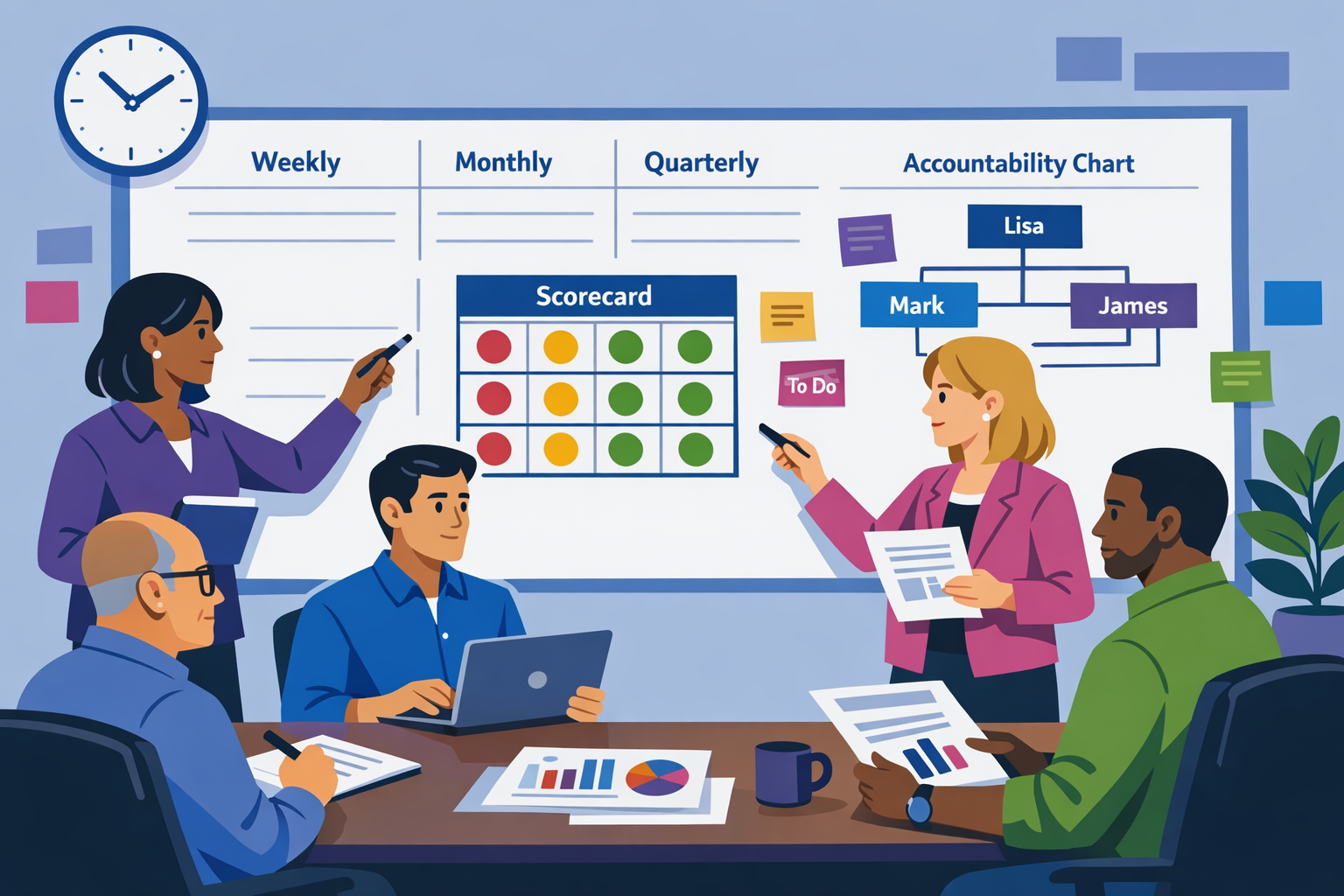
Build a Management Operating System for Growing Teams That Scales
Your team is growing. Your management is not.
When you were ten people, leadership was a conversation.
At twenty, it became coordination.
At fifty, it becomes a system. Or it becomes chaos with a payroll.
Most growing businesses do not fail because the product stops working. They fail because the organisation cannot keep promises at speed. Priorities thrash. Decisions stall. Meetings multiply. Delivery slips. Great people start behaving like average people, because the environment makes excellence impossible.
That is the moment you need a management operating system.
Not a piece of software. Not a weekly meeting. Not OKRs pasted into a slide deck.
A management operating system is the minimum set of mechanisms that makes execution predictable as you scale. It is how you:
- Decide what matters
- Convert intent into coordinated action
- Track delivery without micromanaging
- Surface problems early, while they are still cheap
- Build leaders who can lead without you
If you do not build this, your business will build the worst version for you. It will be accidental. It will be political. It will be slow.
This article shows you how to build a management operating system for growing teams in a way that is practical, lightweight, and scalable.
What a management operating system actually is
A management operating system (MOS) is the repeatable cadence, artefacts, roles, and decision rules that convert strategy into delivery.
It answers six brutally important questions:
- What are we trying to achieve this quarter?
- What will we not do?
- Who owns what, and what does “done” mean?
- How do we monitor progress without noise?
- How do we solve issues fast, at the right level?
- How do we learn and improve the system itself?
A real MOS is not “more process”. It is less confusion.
The goal is not to make everyone busy. The goal is to make outcomes inevitable.
The warning signs you need an MOS (or a better one)
If three or more of these are true, you are already paying the price:
- Priorities change weekly, but nothing actually gets finished
- Delivery depends on heroics and late nights
- Leaders spend more time chasing updates than making decisions
- The same problems reappear, just with new names
- Cross functional work is painful, slow, or blame driven
- Meetings are where work goes to die
- You cannot tell if you are winning until results arrive too late to change them
- New managers copy the loudest person, not the best practice
Start with the big picture: The PerformanceNinja 6Ps (one pass only)
If you jump straight into rituals and dashboards, you will build a busywork machine.
Before you design the operating system, sanity check the foundations using the 6Ps:
- Purpose: What are we here to do, and what do we refuse to do?
- People: Do we have managers who can lead, not just do?
- Proposition: Is the strategy clear enough that teams can make trade offs?
- Process: Are roles, handoffs, and workflows defined where it matters?
- Productivity: Do we have a cadence to decide, align, and deliver?
- Potential: Are we innovating deliberately, without distracting the core?
Your MOS mostly lives in Process and Productivity. But it will collapse if Purpose and Proposition are fuzzy, or if People are not ready.
The MOS blueprint: five layers that make execution predictable
Most management systems fail because they are either too vague to drive behaviour, or too heavy to sustain.
Use this five layer blueprint. Build it in order.
Layer 1: Strategy to focus (the “no list” is the real strategy)
Growing teams need focus more than they need motivation.
Set direction with a small number of measurable outcomes. Three to five is usually the maximum before you are lying to yourself.
Your output should include:
- A 12 month strategic intent (plain English, one page)
- 3 to 5 quarterly outcomes (measurable, time bound)
- A “not doing” list (explicit trade offs)
If you cannot produce a credible “not doing” list, you do not have strategy. You have wishes.
Tactical rule: every quarterly outcome must have a single accountable owner, even if many teams contribute.
Layer 2: Structure for accountability (who owns what, for real)
Accountability collapses when ownership is shared.
You need clarity on:
- The core functions you must perform to deliver the proposition
- The leaders who own those functions
- Decision rights for cross functional work
Use a simple accountability map:
- List the 8 to 12 most important recurring responsibilities in the business (example: Sales pipeline health, Customer onboarding quality, Delivery throughput, Platform reliability, Hiring velocity).
- Assign one accountable owner per responsibility.
- Write a one paragraph definition for each, including what “good” looks like.
If two leaders both believe they own the same thing, no one owns it.
Layer 3: Cadence (meetings that create decisions, not theatre)
Your MOS cadence should be boring and effective.
You need three core rhythms:
- Weekly execution
- Monthly performance and resourcing
- Quarterly direction setting
Anything beyond that should earn its place.
Weekly: Execution meeting (60 to 90 minutes)
This is not a status meeting. It is an issue clearing meeting.
Inputs (prepared in advance):
- A single page scorecard with 8 to 15 leading indicators
- Top priorities for each team (the work that moves quarterly outcomes)
- A short list of stuck items
Agenda (repeatable):
- Scorecard review (10 mins): red, amber, green only. No storytelling.
- Priority progress (15 mins): what moved, what did not.
- Issues (30 to 50 mins): pick the top 3 issues and solve them.
- Commitments (5 mins): decisions made, owners, due dates.
Rules that prevent nonsense:
- If it is not on the scorecard or a quarterly priority, it is not discussed.
- Problem owners must propose options, not just report pain.
- Decisions are recorded live, with a due date.
Monthly: Performance and capacity (90 to 120 minutes)
This is where you stop overloading the system.
Monthly focuses:
- Trend review: Are leading indicators moving in the right direction?
- Capacity reality: What can we deliver with the people we have?
- Resource shifts: What do we stop, start, or delay?
- Risks: Where will the quarter fail if nothing changes?
This meeting protects the organisation from optimistic planning.
Quarterly: Planning and reset (half day to one day)
Quarterly planning is where you prevent thrash.
Outputs:
- Confirmed quarterly outcomes and owners
- Team level priorities linked to those outcomes
- Top cross functional initiatives with a clear driver
- Agreed measures and targets
- Updated “not doing” list
Do not allow “initiative soup”. If you cannot measure it or resource it, it is not real.
Layer 4: A scoreboard that drives behaviour (not a dashboard that impresses)
Most dashboards exist to comfort leaders, not to drive action.
A useful scorecard is:
- Small: 8 to 15 metrics
- Leading: shows problems before customers feel them
- Owned: every metric has an accountable owner
- Reviewed weekly: otherwise it is decoration
Suggested scorecard categories for growing teams:
- Customer: retention, NPS trend, onboarding time, support backlog
- Delivery: cycle time, on time delivery, escaped defects, rework rate
- Commercial: pipeline coverage, win rate, average sales cycle length
- People: regrettable attrition, time to hire, manager 1:1 completion
- Cash and operations: gross margin trend, utilisation (if relevant), burn multiple (if relevant)
Do not copy metrics from big companies. Choose metrics that reflect your constraints.
Also, keep a strict split:
- Scorecard metrics (leading, operational)
- Outcome metrics (quarterly results)
If you mix them, you will argue about numbers instead of running the business.
Layer 5: Issue management (how you stop repeating the same problems)
Growing teams suffer from “recurring surprise”. The same failures happen again and again because no one owns root causes.
You need a simple issue system:
- Capture issues continuously (single list, visible to leadership)
- Categorise quickly (customer, delivery, people, commercial, finance)
- Decide the level to solve (team, leadership, executive)
- Resolve with a root cause method
- Track the fix to completion
A practical root cause method that works in leadership meetings:
- Define the problem in one sentence
- Confirm the impact (what is it costing us?)
- List possible causes (fast brainstorm)
- Use “5 Whys” on the most plausible cause
- Decide the smallest testable fix
- Assign an owner and date
If you never track fixes, your MOS becomes an expensive talking shop.
The management operating system artefacts (keep them ruthlessly simple)
You do not need ten templates. You need four that get used.
1) One page strategy and trade offs
Include:
- Who we serve
- What we deliver
- What makes us different
- The constraints we must manage
- What we will not do
If leaders cannot recite this, teams will invent their own strategy.
2) Quarterly outcomes and priorities sheet
Include:
- Outcome name
- Owner
- Measure and target
- Key initiatives (3 to 7 max)
- Dependencies
This becomes the bridge between leadership intent and team execution.
3) Weekly scorecard
Include:
- Metric
- Owner
- Target
- Current
- Trend (up, down, flat)
- RAG status
The scorecard is your early warning radar.
4) Decision and commitment log
If it is not written down, it did not happen.
Record:
- Decision
- Date
- Rationale (one line)
- Owner
- Due date
- Status
This single artefact eliminates a shocking amount of organisational waste.
The hardest part: building managers who can run the MOS
A management operating system does not replace leadership. It exposes it.
The uncomfortable truth in growing teams is this:
Your best individual contributors were promoted because they were reliable. Now you need them to be leaders. Those are different skills.
New managers typically fail in three predictable ways:
- They stay in the work, because it is where they feel competent
- They avoid conflict, so standards fall quietly
- They over communicate but under decide
To make the MOS stick, define the manager’s job clearly:
- Set expectations and standards
- Run the weekly cadence for their area
- Coach performance, not just manage tasks
- Escalate issues early with options
- Build capability and succession
If you do not train this explicitly, you will get accidental management.
Common traps that kill MOS adoption
You can build a clean MOS and still fail if you trigger these landmines.
Trap 1: Turning the MOS into bureaucracy
If every meeting creates more reporting, people will route around it.
Fix:
- Kill status updates. Require pre reads.
- Limit metrics. Keep the scorecard tight.
- Use meetings to decide and unblock.
Trap 2: Confusing activity with progress
Busy teams can still fail.
Fix:
- Tie work to quarterly outcomes.
- Measure throughput and cycle time, not effort.
- Track completion, not attendance.
Trap 3: Leadership inconsistency
If leaders ignore the system when it is inconvenient, everyone else will too.
Fix:
- Make the MOS non negotiable for executives.
- Hold leaders accountable to the same commitments log.
- Use the scorecard in every weekly meeting, no exceptions.
Trap 4: No mechanism for cross functional work
This is where scaling companies bleed out.
Fix:
- Assign a single initiative driver for each cross functional initiative.
- Define decision rights upfront.
- Review dependencies weekly.
Trap 5: Innovation that hijacks execution
You need innovation, but not at the cost of reliability.
Fix:
- Ring fence capacity for innovation.
- Run a separate pipeline and review cadence for experiments.
- Require clear hypotheses, time boxes, and kill criteria.
A brief implementation plan (six weeks, high level)
You can build a functional MOS quickly if you avoid perfectionism.
Week 1: Diagnose and choose the minimum
- Identify the top three execution problems (delivery, priorities, decisions)
- Select 8 to 15 scorecard metrics and owners
- Draft the one page strategy and “not doing” list
Week 2: Define quarterly outcomes
- Set 3 to 5 quarterly outcomes with measures and owners
- Break into team level priorities
- Identify cross functional initiatives and assign drivers
Week 3: Build the cadence
- Schedule weekly, monthly, quarterly sessions for the next 90 days
- Publish meeting charters and agendas
- Create the commitments log and make it visible
Week 4: Run week one properly
- Use pre reads
- Enforce the scorecard
- Resolve real issues, not symptoms
- Record decisions and due dates live
Week 5: Train managers in the system
- Teach: expectation setting, coaching basics, escalation with options
- Require managers to run their own weekly cadence
- Standardise how metrics and priorities are reported
Week 6: Inspect and adapt
- Ask: what is creating value, what is creating noise?
- Remove anything not driving decisions or delivery
- Tighten measures and ownership
The standard you are aiming for
A strong management operating system creates a specific feeling inside the business:
- People know what matters
- Work moves without constant escalation
- Leaders have time to lead, not chase
- Problems surface early and get solved once
- Customers feel consistency
If that sounds like a fantasy, it is not. It is the result of deliberate design.
Growing teams do not need more motivation. They need a management operating system that makes performance normal.
Next Steps
Want to learn more? Check out these articles:
Set Organisational Priorities When Everything Feels Urgent
OKR Implementation for Growing Organisations: Make Scale Predictable
Build Accountability Without Micromanagement: A Leader’s Playbook
To find out how PerformanceNinja could help you, book a free strategy call or take a look at our Performance Intelligence Leadership Development Programme.