
Execution Discipline in Scaling Teams: How to Fix Slippage Fast
Execution discipline does not collapse because your people suddenly got lazy.
It collapses because scaling quietly rewards ambiguity.
In a small team, you can run on trust, proximity, and heroic memory. Everyone is close enough to see what matters. You can shout across the room, resolve a conflict in five minutes, and notice when something is drifting.
Then you scale.
Now priorities multiply. Dependencies form. Handovers appear. Meetings breed. Decision rights blur. And suddenly, the same leaders who used to pride themselves on speed are asking a question that should terrify them:
“Why can’t we just get things done anymore?”
This article gives you a blunt, practical answer. You will learn how to improve execution discipline in scaling teams by installing a system that makes progress inevitable, not optional.
The brutal truth: execution discipline is a design problem
Most leaders treat execution discipline as a motivation problem.
They think the fix is:
- Better accountability
- More pressure
- Stronger performance management
- Another delivery tool
- A tougher tone at the Monday meeting
That might create a short burst of activity. It will not create reliable throughput.
When execution slips as you scale, it is usually because your organisation has outgrown its operating system.
Your “system” is currently a messy mix of:
- People’s personal to-do lists
- Slack messages and email threads
- Calendar invites as commitments
- Tribal knowledge about who decides what
- “We said we would” as a substitute for a tracked commitment
If that is your reality, it is not a discipline issue. It is an engineering issue.
What execution discipline actually looks like (and what it does not)
Execution discipline is not micromanagement. It is not endless reporting. It is not turning leaders into project administrators.
Execution discipline is the ability to:
- Choose a small number of priorities
- Translate priorities into explicit commitments
- Allocate capacity to those commitments
- Track progress visibly
- Remove blockers fast
- Learn and adjust without thrashing
In scaling teams, discipline is not about working harder. It is about reducing the surface area for failure.
Why scaling teams lose discipline: 7 predictable failure modes
If you are scaling, you will recognise most of these. They are not character flaws. They are structural.
1) Too many priorities, not enough choices
You cannot execute ten “top priorities”. You can only execute the three you actually fund with time, people, and leadership attention.
When everything is a priority:
- Trade-offs are implicit
- Work expands to fill the week
- People protect themselves by starting things, not finishing them
2) Work enters the system through too many doors
In small teams, work shows up in a single conversation.
In scaling teams, work comes from:
- Sales promises
- Client escalations
- Executive ideas
- Product requests
- Operational fires
- “Just a quick favour” from another department
If you do not have a single intake and triage mechanism, you do not have a controllable execution environment.
3) “Ownership” is vague and multi-person
The fastest way to kill delivery is to assign work to a group.
Groups coordinate. Individuals commit.
If you cannot name one owner with the authority and capacity to deliver, you have not assigned the work.
4) Dependencies become invisible until they explode
Scaling creates cross-team dependencies. Most organisations do not model them.
So the plan looks fine on Monday and collapses by Thursday.
Then leaders blame “communication”, when the real problem is that the dependency network is unmanaged.
5) Decision rights are unclear
Execution slows when people do not know:
- Who decides
- What “good” looks like
- What constraints exist
- How fast decisions must happen
Unclear decision rights produce two failure modes:
- Everyone waits
- Everyone acts independently and you pay for rework
6) Meetings replace mechanisms
When your organisation lacks an execution cadence, meetings become the operating system.
But meetings are expensive and unreliable. They rely on memory and persuasion instead of signals and process.
7) Leaders keep solving delivery by adding headcount
Headcount does not fix weak prioritisation, unclear ownership, or chaotic intake.
It amplifies them.
You get more work in progress, more handovers, more coordination cost, and slower delivery.
This is basic queueing theory in practice. More parallel work increases cycle time.
The execution discipline stack: what scaling teams must install
You want discipline without bureaucracy. That means a small number of repeatable mechanisms, not a mountain of policies.
At PerformanceNinja we often look at the big picture through six lenses (Purpose, People, Proposition, Process, Productivity, Potential). Execution discipline sits primarily in Process and Productivity, but it collapses if Purpose and People are weak.
Here is the stack to install.
1) Ruthless prioritisation: cap the work in progress
The first move is not “work harder”. It is “do less at once”.
A scaling team without a cap will always feel busy and still miss deadlines.
The rule: one page of priorities, not a slide deck
Create a single page that contains:
- 3 to 5 priorities for the next 90 days
- Why each priority matters (one sentence)
- The measurable outcome for each priority
- The accountable owner for each priority
- The capacity assumption (what will not be done because of this)
If your priorities do not fit on one page, you are not prioritising. You are listing.
The discipline: kill or pause something every time you add something
New work is not the enemy. Unfunded work is.
When a new initiative enters, force a trade-off:
- What stops?
- What slips?
- What resources move?
If nobody can answer those questions, the new work does not start.
2) Translate strategy into commitments: outcomes, not activities
Scaling teams often track activity because it is easy.
Activity metrics create the illusion of progress.
Execution discipline requires outcome commitments.
Use this commitment format
For every meaningful piece of work, capture:
- Outcome: what changes in the business or customer experience?
- Definition of done: what evidence proves it is complete?
- Owner: one person accountable
- Due date: a real date, not “ASAP”
- Dependencies: named teams or individuals
- Risks: top 1 to 3 risks and mitigation
This is not admin. This is clarity.
3) Install a single intake and triage mechanism
If work enters through multiple channels, you will never stabilise execution.
Your best people will be hijacked by whoever shouts loudest.
The minimum viable intake system
You need:
- One place requests go (a form, a ticket, a board)
- One triage meeting per week (30 minutes)
- Clear acceptance criteria
- A visible queue
Acceptance criteria to enforce
Do not accept work unless it has:
- A named requestor
- The business reason (revenue, risk, retention, efficiency)
- The deadline and why it is that date
- The “cost of delay” if it is late
- The dependencies and impacted teams
This alone will eliminate a significant amount of low-value noise.
4) Make ownership real: one throat to choke, one hand to shake
You do not need harsher leaders. You need unambiguous ownership.
The ownership rules
- One owner per commitment
- Owners can delegate tasks, not accountability
- Owners must have authority proportional to the outcome
- Owners must have protected capacity
If an owner has no capacity, they are a figurehead and your plan is fiction.
Fix the most common ownership lie
Lie: “Jane owns it, but she needs approvals from three people.”
Truth: Jane does not own it.
Ownership without decision rights is theatre.
5) Create an execution cadence that forces truth to surface
Discipline is not created by intensity. It is created by rhythm.
Scaling teams need a cadence that exposes drift early, while it is still cheap to fix.
The three-meeting cadence that works
You do not need ten ceremonies. You need three.
- Weekly Execution Review (45 minutes)
- Monthly Outcomes Review (60 to 90 minutes)
- Quarterly Priority Reset (half-day)
1) Weekly Execution Review: remove blockers, update reality
Agenda:
- Review the top commitments (not every task)
- For each: on track, at risk, off track
- Identify blockers and assign actions with owners and dates
- Confirm next week’s focus
Rules:
- No solution debates unless a decision is required
- No status theatre. Evidence only.
- If something is off track, name the cause and the next action
2) Monthly Outcomes Review: are we winning?
This is where you look at:
- Outcome metrics
- Delivery throughput
- Quality signals (rework, defects, client complaints)
- Resource allocation
Then you adjust.
This prevents the classic scaling failure where teams execute perfectly… on the wrong thing.
3) Quarterly Priority Reset: reallocate, kill, focus
Every quarter you must:
- Reconfirm the 3 to 5 priorities
- Reallocate capacity
- Stop initiatives that are not paying off
- Resolve structural constraints (roles, decision rights, process)
If you skip this, you accumulate zombie projects.
6) Build a visible execution system, not private to-do lists
If progress is invisible, it is not managed.
What “visible” means
Anyone relevant should be able to answer in two minutes:
- What are we committing to?
- Who owns each commitment?
- What is the current status?
- What is blocked?
- What changed since last week?
You can do this in Jira, Asana, Monday, Trello, a spreadsheet, or a whiteboard.
The tool is not the point.
The point is a single source of truth.
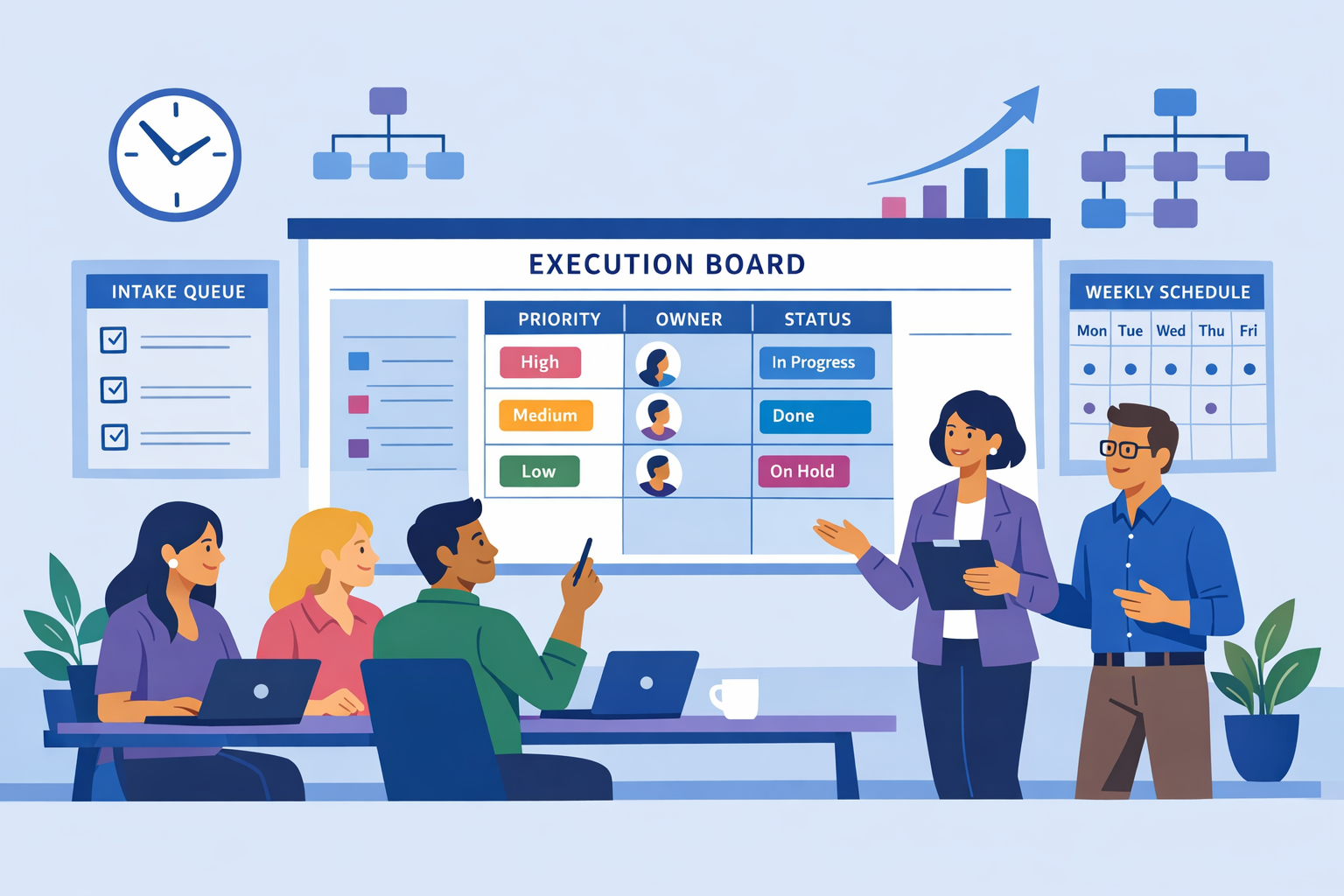
The execution board structure
Use three layers:
- Priorities (3 to 5 outcomes)
- Initiatives (major workstreams tied to priorities)
- Commitments (weekly deliverables)
If you only track tasks, you lose the strategic thread.
If you only track priorities, you lose the delivery reality.
7) Tighten decision-making: speed is a strategic advantage
Execution discipline dies in slow decisions.
Not because people are indecisive, but because decision rights are unclear.
Use a simple decision-rights map
For recurring decisions, define:
- D: Decider
- A: Advisers
- E: Executors
- I: Informed
Publish it. Enforce it.
Most organisations are shocked how many “decisions” are actually negotiations because nobody has the D.
Add decision SLAs
For decisions that block delivery, set service levels:
- Standard decisions: 48 hours
- High-risk decisions: 5 working days
- Strategic decisions: scheduled in the monthly review
If leaders cannot meet these SLAs, execution is being starved by leadership bandwidth.
That is a leadership problem, not a team problem.
8) Fix the middle: scaling requires leaders who can run systems
The hard truth is that many scaling failures are leadership transitions that did not happen.
Your best individual contributors became managers, but nobody taught them how to:
- Set expectations
- Manage delivery systems
- Coach performance
- Run crisp execution conversations
The new management standard
Every team lead must be able to:
- Convert priorities into weekly commitments
- Run a tight execution review
- Escalate risks early with evidence
- Protect the team from randomisation
- Hold peers accountable across dependencies
If they cannot do that, the organisation will feel chaotic no matter how good the strategy is.
9) Protect focus: stop letting “urgent” eat “important”
Scaling teams drown in escalation.
You need rules for interrupts.
The interrupt policy (simple and enforceable)
Define three lanes:
- Planned work (protected)
- Unplanned urgent work (true production issues, client-critical incidents)
- Noise (requests that can wait)
Then set capacity allocations, for example:
- 70 percent planned
- 20 percent urgent buffer
- 10 percent improvement work
If urgent work exceeds the buffer, you do not just “try harder”. You trigger a root cause review.
10) Run a weekly “commitment audit” to harden discipline
This is the simplest, highest leverage tactic most leadership teams never do.
Every week, audit your commitments.
The audit questions
- Did we deliver what we said we would deliver?
- If not, what was the failure mode?
- Was the commitment unrealistic, unfocused, or under-resourced?
- Did we accept untriaged work mid-week?
- Did a decision delay us?
- Did dependencies fail?
The only acceptable output
One improvement to the system each week.
Not a long post-mortem. One change.
Small, compounding process improvements are how discipline becomes culture.
What this looks like in practice: a high-level implementation plan
You can install execution discipline in weeks, not years, if you stop trying to change everything at once.
Weeks 1 to 2: create clarity and a single source of truth
- Publish the 90-day priorities (one page)
- Define owners and outcomes
- Stand up the execution board
- Start the weekly execution review
Weeks 3 to 4: control intake and stabilise capacity
- Implement the single intake and triage
- Introduce work-in-progress limits
- Create the interrupt lanes and capacity buffers
Weeks 5 to 8: harden decision rights and cross-team delivery
- Map decision rights for the top recurring decisions
- Set decision SLAs
- Make dependencies explicit on the board
- Start the commitment audit loop
Ongoing: upgrade leadership capability
- Train team leads to run the cadence
- Coach on expectation setting and accountability
- Replace heroic delivery with repeatable mechanisms
The warning signs you are still pretending
If any of these are true, your execution discipline is cosmetic.
- You “track” work, but nobody trusts the data
- Owners change weekly because priorities are unstable
- Everything is marked “in progress”
- Escalations are your main coordination method
- People are rewarded for starting, not finishing
- The loudest stakeholder consistently gets capacity
The payoff: scaling without losing your edge
Execution discipline is not about control. It is about freedom.
When your team trusts the system:
- Leaders stop chasing updates
- Teams stop context switching
- Delivery becomes predictable
- Innovation stops being a distraction and becomes a pipeline
- Culture strengthens because commitments mean something
Scaling is supposed to make you stronger. If it is making you slower, the answer is not more hustle.
It is a better operating system.
Install it. Enforce it. And make execution a competitive advantage again.
Next Steps
Want to learn more? Check out these articles:
Build a Management Operating System for Growing Teams That Scales
Set Organisational Priorities When Everything Feels Urgent
OKR Implementation for Growing Organisations: Make Scale Predictable
To find out how PerformanceNinja could help you, book a free strategy call or take a look at our Performance Intelligence Leadership Development Programme.