
Effective One-to-One Meetings: A Manager’s No-Nonsense Playbook
Most one-to-ones are not meetings. They are theatre.
A recurring calendar invite where a manager asks, “So… how’s it going?” and the employee replies, “Good.”
Everyone leaves with the same problems they walked in with.
If you are a senior leader, the cost is brutal. Weak one-to-ones create slow execution, fuzzy accountability, surprise resignations, and “people problems” that should have been handled months earlier. Your organisation does not drift into underperformance by accident. It drifts because the basic management system is missing, and one-to-ones are the most neglected part of it.
This article gives you a practical, repeatable method for how to run effective one-to-one meetings as a manager. Not fluffy advice. A working operating rhythm you can implement tomorrow morning.
Why most one-to-ones fail (and what it costs you)
One-to-ones fail for predictable reasons. Managers treat them like:
Status updates that could have been an email, a Slack message, or a dashboard.
Therapy sessions with no structure, no decisions, and no follow-up.
Performance interrogations that turn psychological safety into a fairy tale.
Ad hoc check-ins that get cancelled the moment a “real meeting” appears.
The cost shows up later, in more expensive forms:
Execution slips because no-one is tracking commitments and dependencies.
Misalignment because individuals are optimising locally, not against priorities.
Culture dilution because nobody is reinforcing standards in the moments that matter.
Talent loss because the best people quietly conclude you do not care about their growth.
A strong one-to-one is not a nice-to-have. It is a core management control loop.
What a one-to-one is actually for (and what it is not)
A one-to-one is a private working session between a manager and a direct report to:
Improve performance through clarity, prioritisation, and fast problem solving.
Build trust through predictable support, candour, and follow-through.
Grow capability through coaching and deliberate development.
Reduce organisational drag by surfacing blockers early and removing them.
It is not for:
Replacing team meetings.
Rehashing every project detail.
Surprise performance reviews.
Offloading your stress onto your team.
If you treat one-to-ones as “time to chat”, you will get chat. If you treat them as a performance system, you will get results.
The manager mindset shift: you are building a system
High-performing organisations do not rely on heroic managers with great intuition. They build systems that produce consistent outcomes.
Your one-to-one cadence is part of that system. It sits inside the bigger picture of organisational performance. At PerformanceNinja, we often sanity-check leadership rhythms against a six-part lens:
Purpose: do people know why the work matters and how it connects?
People: are skills, behaviour, and capability improving or decaying?
Proposition: are we learning what customers value and adjusting?
Process: are there repeatable ways of working or constant reinvention?
Productivity: are priorities clear and tracked, or are we drowning in activity?
Potential: are we making space for innovation without losing focus?
Your one-to-one is where these realities become personal. It is where you translate strategy into behaviour. Or you fail to.
The non-negotiables of effective one-to-ones
If you want one-to-ones that actually improve performance, make these rules non-negotiable.
1) Protect the meeting like you protect your revenue
Cancelling one-to-ones tells people exactly where they sit in your priorities. If you cancel repeatedly, do not be surprised when they stop escalating issues early and start job hunting quietly.
Rules that work:
Hold one-to-ones weekly for new starters and new managers, otherwise fortnightly as a minimum.
Default duration: 30 minutes. Use 45 minutes for complex roles.
If you must move it, reschedule within the same week. Do not “skip this one”.
2) Separate “status” from “thinking”
Status should be mostly asynchronous. The one-to-one is for decisions, trade-offs, and problem solving.
Implement this boundary:
Have the direct report send a short update 24 hours before: priorities, progress, blockers, help needed.
Use the meeting for what cannot be done well in writing: alignment, judgement calls, conflict, coaching.
3) Always leave with clear commitments
A one-to-one without commitments is a chat. A one-to-one with vague commitments is worse, because it creates the illusion of progress.
Every meeting ends with:
Who is doing what.
By when.
What “done” means.
What support is required.
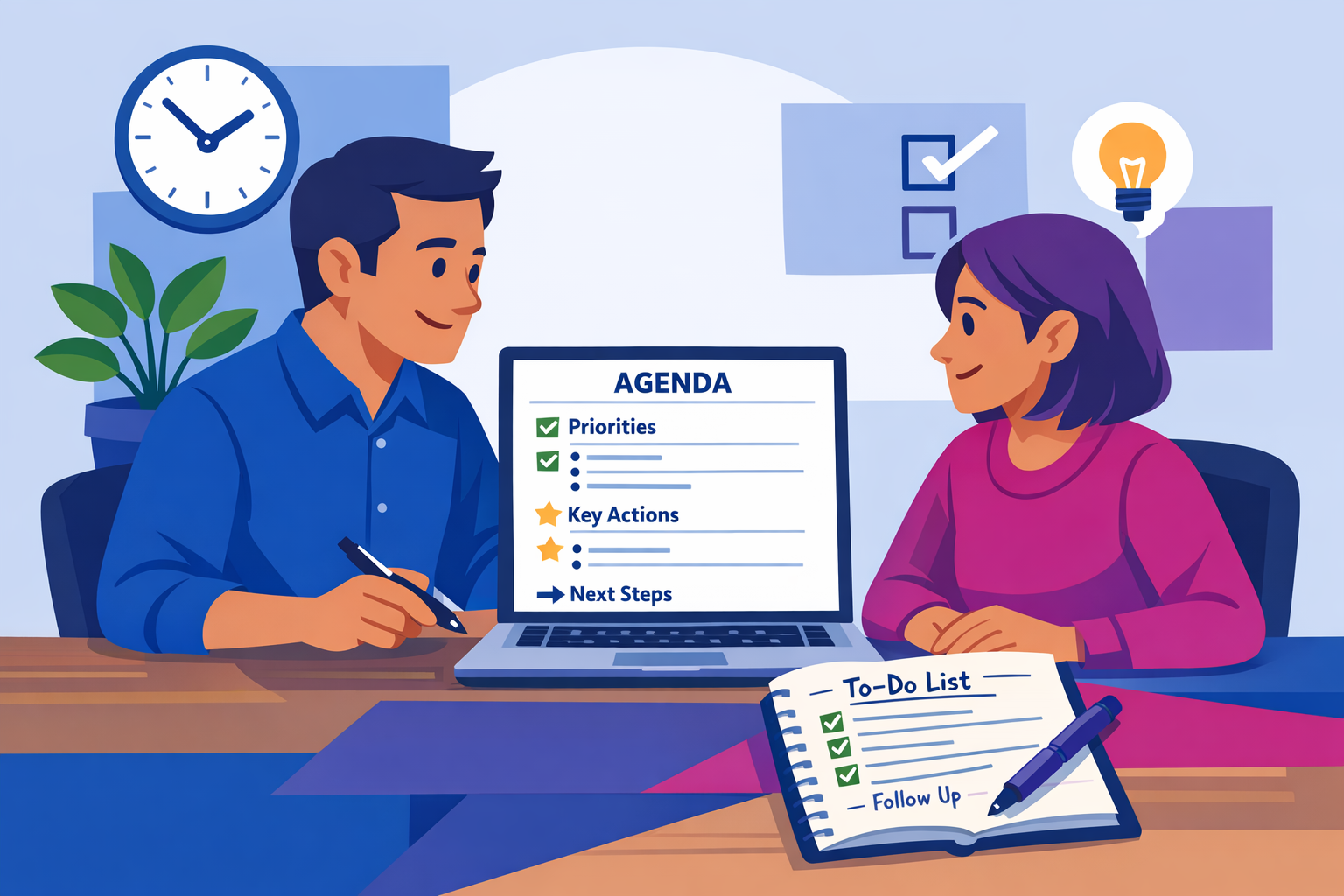
A simple agenda that works every time (30 minutes)
Managers love to overcomplicate agendas. Do not. Use a tight structure that creates momentum.
The 30-minute agenda
5 minutes: check-in and context
One question that matters: “What is the biggest thing on your mind right now that could affect your performance?”10 minutes: priorities and progress
Focus on the next 7 to 14 days. Confirm top priorities, not the entire task list.10 minutes: blockers, decisions, and trade-offs
This is the value. Identify constraints, remove them, and make calls.5 minutes: growth and commitments
One development topic, then lock actions and owners.
If you have 45 minutes, extend the blockers and growth sections. Do not extend the status section. That is how one-to-ones die.
The questions great managers ask (and weak managers avoid)
You do not need a hundred clever prompts. You need a handful of questions that force reality into the room.
Execution and prioritisation
“What are the three most important outcomes you need to deliver before we meet again?”
“Which of your tasks would you kill if you could only do half this week?”
“What decision are you waiting on that is slowing you down?”
“Where are we at risk of missing a commitment, and what is the earliest intervention?”
Quality and standards
“What does good look like for this deliverable, specifically?”
“Show me the work. What are you not confident about?”
“If this goes wrong, why will it go wrong?”
Trust, engagement, and retention
“What part of your role is currently wasting your talent?”
“What are you not saying in team meetings?”
“What would make you consider leaving in the next six months?”
Growth and capability
“What skill, if improved, would make the biggest difference to your impact?”
“What feedback would you like from me that you are not getting?”
“What decision are you avoiding, and what would you do if you were already confident?”
Use these sparingly. Pick one or two that fit the moment. Your job is not to run a questionnaire. Your job is to create clarity and movement.
How to handle the hard stuff without poisoning the relationship
This is where most managers either go soft or go aggressive. Both fail.
You can be direct without being disrespectful. You can be supportive without being vague.
When performance is slipping
Do not hide behind hints. Use a three-part approach:
Observation: “I have noticed the last two client handovers were late and required rework.”
Impact: “That puts delivery at risk and increases load on the rest of the team.”
Expectation and support: “From now, handovers need to be on time and complete. What is the root cause, and what support do you need from me this week?”
Then agree a specific plan and review it in the next one-to-one. If there is no follow-up, you are not managing, you are commenting.
When the employee brings emotion
Emotions are data. They tell you where friction exists. The mistake is either dismissing it or getting trapped in it.
Use this sequence:
Name it: “It sounds like you are frustrated.”
Clarify it: “What specifically is driving that?”
Convert it: “What needs to change, and what is within our control this week?”
Stay calm. Stay factual. Keep momentum.
When there is conflict with another team
One-to-ones are where cross-team friction should surface early, before it becomes politics.
Ask:
“What are they optimising for?”
“What do we need from them, by when, in what format?”
“What is the smallest agreement that unblocks progress?”
Then decide whether you will intervene manager-to-manager, or whether your direct report will handle it with your backing. But decide. Do not leave it as “We will see”.
The two-way contract: what you owe them and what they owe you
High-performing one-to-ones are built on an explicit contract. This prevents resentment and passive-aggressive behaviour.
What the manager owes the direct report
Clarity on priorities and what good looks like.
Fast decisions when they are blocked.
Coaching that builds capability, not dependence.
Advocacy when they are delivering and deserve visibility.
Truth about performance and growth, delivered early.
What the direct report owes the manager
Preparedness with a short written update and a clear ask.
Ownership of commitments and quality.
Transparency about risks early, not at the deadline.
Solutions, not just problems.
Feedback when management actions are slowing progress.
Say this contract out loud once. Then reinforce it with behaviour.
Stop doing one-to-ones like a diary, start doing them like a pipeline
Many managers treat each meeting as a fresh start. That guarantees repetition.
Effective one-to-ones behave like a pipeline of topics and commitments that move from “identified” to “resolved”.
Use a shared running agenda
Create one shared document per direct report with these sections:
Top priorities (current)
Blockers and decisions needed
Open commitments (with dates)
Development focus
Notes and context
Keep it lightweight. The purpose is continuity and accountability, not documentation for its own sake.
Track commitments like you mean it
If you assign actions and never revisit them, you teach people that deadlines are optional.
At the start of each one-to-one, scan last meeting’s commitments for 60 seconds:
Done, not done, or needs renegotiation.
If it needs renegotiation, decide: change scope, change date, or change owner.
This is how you stop “task delivery slipping because there is no system to follow up”. The system is you, executed consistently.
Coaching inside the one-to-one (without turning it into a lecture)
Coaching is not telling people what to do. It is improving their judgement so they can deliver without you.
Use the “two levels down” rule. Instead of fixing the immediate problem, ask what capability would prevent this class of problem recurring.
A practical coaching loop
Situation: “What is happening?”
Options: “What are three ways you could handle this?”
Trade-offs: “What is the risk of each option?”
Decision: “What will you do, by when?”
Learning: “What will you do differently next time?”
This is how you convert one-to-ones from management overhead into capability building. It is also how you stop promoting great individual contributors into management roles and watching them drown.
Common one-to-one scenarios and exactly what to do
Scenario 1: The employee has “nothing to talk about”
This usually means one of two things: they do not trust the meeting, or they are not thinking strategically about their work.
Do this:
Ask for their top three priorities and top two risks for the next fortnight.
Ask what decision they are currently avoiding.
Assign preparation: a short pre-read with achievements, blockers, and asks.
If they still bring nothing repeatedly, treat it as a performance signal. Professionals bring issues, improvements, and insights.
Scenario 2: The employee talks, but nothing changes
You have a conversion problem. Talking is not the output. Changed behaviour and delivered outcomes are the output.
Do this:
End every meeting with written commitments.
Ask: “What will you do in the next 48 hours?”
Start the next meeting by reviewing those commitments.
Scenario 3: You are doing all the talking
This is usually because you are anxious about control. It will backfire. You will become the bottleneck.
Do this:
Have the direct report own the agenda.
Use a rule: you speak second on any problem.
Ask for options before you give your opinion.
Scenario 4: Remote or hybrid one-to-ones feel flat
Remote one-to-ones fail when managers rely on “vibes” instead of structure.
Do this:
Always use video for the first five minutes and for any sensitive topic.
Use a shared document on screen to drive focus and commitments.
Replace “How are you?” with one precise check-in question.
Signals your one-to-ones are working (and what to measure)
You cannot improve what you refuse to measure. Keep it simple. You are not building a research project.
Look for these signals over 4 to 8 weeks:
Fewer surprises: risks are raised earlier, not at the deadline.
Faster decisions: fewer items stuck waiting for approval.
Cleaner execution: less rework, clearer outputs, tighter handovers.
Higher ownership: people propose solutions and trade-offs unprompted.
Better retention indicators: higher engagement, more career conversations, fewer “silent quit” behaviours.
If nothing is changing, do not blame the team. Fix the system.
A brief implementation plan (you can start this week)
You do not need a transformation programme. You need discipline.
Week 1: Put the operating rhythm in place
Set a recurring cadence for every direct report.
Create a shared running agenda document.
Explain the two-way contract and the purpose of the meeting.
Week 2: Make it decision-driven
Introduce a 24-hour pre-read: priorities, progress, blockers, asks.
Stop doing status verbally unless it triggers a decision.
End every meeting with written commitments.
Week 3: Add coaching and standards
Pick one development focus per person.
Use the coaching loop on one live issue.
Reinforce what good looks like with specific examples.
Week 4: Tighten the feedback loop
Review recurring blockers and remove root causes.
Ask for feedback on your management: “What should I start, stop, continue?”
Adjust meeting length and cadence based on role complexity and performance.
This is not complicated. It is just rare. Most managers do not do the basics consistently.
The bottom line: one-to-ones are your leadership microscope
If you want high performance, stop pretending your calendar is neutral. Your calendar is a strategy document. It shows what you actually care about.
Run one-to-ones properly and you get alignment, execution, and trust. Run them badly and you get noise, drift, and costly surprises.
Be the manager who creates clarity, removes friction, and builds capability. Not the one who “checks in” while the organisation quietly slows down.
Next Steps
Want to learn more? Check out these articles:
Skip-Level Meetings That Work: A Leader’s Playbook
Decision Latency in Leadership Teams: Stop Paying the Hidden Tax
Psychological Safety in Leadership Teams: The Unspoken KPI
To find out how PerformanceNinja could help you, book a free strategy call or take a look at our Performance Intelligence Leadership Development Programme.