
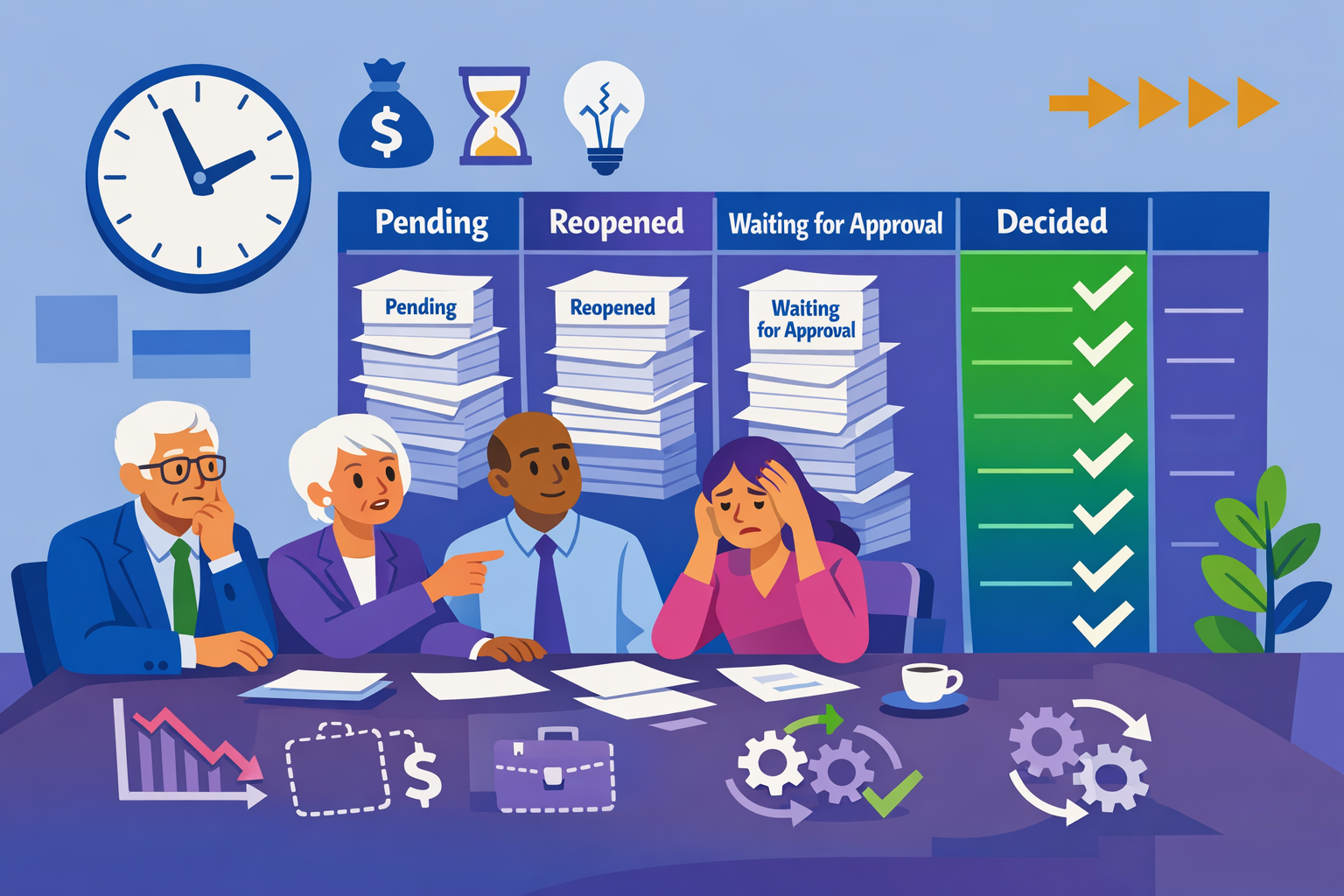
Decision Latency in Leadership Teams: Stop Paying the Hidden Tax
Decision latency is not a “soft” problem. It is a hard, measurable drag on growth. It shows up as missed windows, duplicated work, exhausted leaders, and a culture that quietly learns one lesson: don’t bother.
If you run a leadership team, you already know the feeling. The meeting ends with “good discussion” and “we’ll circle back”. Two weeks later nothing has moved, except the market.
This is the hidden tax most senior teams pay without putting it on the P&L. And it is optional.
What decision latency really is (and why it spreads)
Decision latency is the elapsed time between when a decision is required and when a clear decision is made, communicated, and acted on. Not when it is “discussed”. Not when it is “socialised”. When it is made and the organisation can move.
Most leadership teams underestimate it because they confuse activity with progress. They are busy, but the organisation is stuck.
The three forms of decision latency
You can usually diagnose it into one of three patterns:
Pre-decision drag where teams delay because they want more data, more alignment, more comfort, or fewer political consequences.
Meeting churn where decisions bounce from forum to forum, agenda to agenda, because nobody is sure who owns the call.
Post-decision fade where a decision is “made” but not translated into actions, owners, deadlines, and trade-offs. The organisation does not feel the decision, so it effectively did not happen.
All three forms compound. As latency increases, trust drops. As trust drops, leaders seek more certainty and wider buy-in. That creates more latency.
The brutal truth: latency is a leadership failure, not a process issue
Yes, you can improve meeting hygiene. Yes, you can implement decision logs and RACI charts. But decision latency is rarely fixed by templates alone. It is driven by what leaders are unwilling to do.
Here is what slow leadership teams tend to avoid:
Making clear trade-offs because saying yes to one path means explicitly saying no to others.
Assigning a single accountable owner because shared accountability feels safer, even though it kills momentum.
Calling time on debate because leaders fear being seen as controlling or missing something.
Disappointing peers because cohesion is being bought with vagueness.
Taking responsibility for consequences because a delayed decision spreads the risk across the group.
When you see these avoidance patterns, do not blame “the organisation”. This is the organisation doing exactly what leaders are signalling is acceptable.
Why “more alignment” is often the excuse that kills performance
Alignment is valuable. False alignment is lethal.
False alignment is when everyone nods in the room because the decision is ambiguous enough that each leader can interpret it their own way. It feels harmonious. It produces chaos.
Teams chase false alignment when:
The purpose is unclear, so every decision becomes a values debate.
The proposition is fuzzy, so priorities shift with whoever speaks last.
The process for decisions is undefined, so every decision becomes a negotiation.
The people capability is uneven, so the team over-compensates with consensus.
The productivity system does not force closure, so meetings become therapy.
The potential agenda is unmanaged, so innovation ideas interrupt execution and create constant reconsideration.
This is where the big-picture view matters. Decision latency is often a symptom of deeper organisational design flaws, not individual incompetence.
The real cost of decision latency (it is bigger than you think)
Leaders usually describe decision latency as “frustrating”. That is an emotional label for a financial problem.
Decision latency creates five measurable costs
Rework because teams start work based on assumptions, then reverse when the real decision lands.
Opportunity loss because competitors move faster, customers choose someone else, and talent leaves for sharper organisations.
Coordination overhead because more meetings are required to manage confusion created by non-decisions.
Risk migration because risks that could be managed early become crises later.
Cultural decay because high performers stop pushing ideas when nothing gets decided.
If you want a fast diagnostic: ask your top performers how long it takes to get a decision from the leadership team. Then ask what they do while waiting. If the answer is “we just get on with it and hope”, you have already lost control.
What causes decision latency in leadership teams
There are many triggers, but most fall into a tight set of root causes. Fixing these is where performance unlocks.
1) Unclear decision rights
If nobody knows who decides, everybody debates. If everybody debates, nobody decides.
Common anti-patterns include:
“We decide as a team” for everything, including operational calls.
Decisions that require unanimous agreement without stating that explicitly.
Senior leaders overriding domain owners late in the process.
Tactical fix: define decision categories and assign a single decider per category. Not a committee. A person. Input can be broad. Accountability cannot.
2) Decisions are not framed properly
Teams waste time because they are not answering the same question.
In a typical slow meeting, you will see:
People debating solutions before agreeing the problem.
People arguing from anecdotes rather than agreed constraints.
People presenting options with no recommendation because they want to avoid being wrong.
Tactical fix: every decision item must start with a one-page decision brief. If it cannot fit on one page, you do not understand it well enough yet.
3) Fear of consequence and political debt
Some decisions are delayed because leaders know it will upset someone. It might cut a pet project. It might expose underperformance. It might reduce headcount. It might contradict last quarter’s narrative.
So the team delays, looking for a way to make the decision without owning the pain.
Tactical fix: name the consequence in the room. Literally say, “This decision will disappoint X and we are choosing it anyway because Y.” That level of clarity is uncomfortable. It is also leadership.
4) Too many forums, too many meetings, no closure mechanism
Decision latency thrives in organisations with overlapping leadership forums.
SteerCo, ExCo, SLT, weekly ops, monthly review, quarterly offsite. Everyone is busy. Nobody is accountable for closing decisions.
Tactical fix: implement a single “decision closure” mechanism. One forum owns final closure for a defined set of decisions, with a defined SLA on timing.
5) Data theatre
Teams delay under the banner of “we need more data”. Sometimes that is true. Often it is avoidance.
Data theatre is when people demand analysis to reduce anxiety, not uncertainty. It adds time but does not change the decision.
Tactical fix: adopt a minimum viable evidence rule. Before requesting more analysis, the decider must answer two questions:
What specific uncertainty will this reduce?
What decision will change based on the result?
If the answer is unclear, decide with what you have.
How to measure decision latency (so you stop guessing)
You cannot manage what you do not measure. Most leadership teams do not track decision throughput, which is like trying to run a factory without counting output.
Track these four metrics for 30 days
Keep it simple and visible. A shared decision log is enough.
Decision age: days since the decision was first raised as necessary.
Time to close: days from “on the agenda” to “decision made and communicated”.
Reopen rate: percentage of decisions reopened within 30 days. High rates indicate weak framing or weak commitment.
Execution activation time: days from decision to first verifiable action started.
A good target is not “zero time”. It is predictable time. Predictability creates trust. Trust reduces the need for consensus. That reduces latency.
The Decision Sprint: a practical way to cut latency fast
If your team is stuck in churn, you do not need a year-long transformation. You need a short, disciplined reset that proves speed is possible without recklessness.
Step 1: Create a decision inventory
List every decision currently in motion. Include:
What the decision is
Why it matters
Who is the decider
Who provides input
Deadline for closure
Dependencies and trade-offs
This exercise is usually embarrassing. Good. That embarrassment is the signal that the system has been allowed to drift.
Step 2: Classify decisions into three speeds
Not all decisions deserve the same diligence. Treating them equally is a major cause of delay.
Type 1, irreversible: high stakes, hard to unwind. Use deeper analysis and stronger governance.
Type 2, reversible: you can iterate and correct. Decide quickly and learn.
Type 3, delegated: should never reach the leadership team. Push it down immediately.
This is conceptually aligned with well-known decision frameworks used in high-performing organisations. The point is not novelty. The point is discipline.
Step 3: Run two decision-focused meetings per week for three weeks
Not your usual meeting. A closure meeting.
Rules:
No slide decks. Use one-page briefs.
The decider speaks last. Input first, decision last.
Every decision ends in one of three outcomes: decide, delegate, or schedule a final decision time with explicit missing information.
Every decision is recorded with an owner, deadline, and communication plan.
If you do this properly, you will feel the organisation exhale. Because people can finally move.
Decision hygiene: how high-performing leadership teams stay fast
Speed is not an event. It is a system. Once you cut the backlog, you need habits that stop latency creeping back in.
Adopt these six non-negotiables
One decision, one decider. Input is plural. Accountability is singular.
Decision briefs as standard. If you cannot write it clearly, you cannot decide it cleanly.
Decision SLAs. For example: Type 2 decisions close within 7 days of being raised.
Decision logs are public. Not for policing, for clarity. Visibility reduces politics.
Explicit trade-offs. Every meaningful decision states what will be deprioritised.
Communication is part of the decision. If the organisation does not understand it, it will not implement it.
This is where most teams fail. They “decide” in the room and assume everyone will magically interpret it correctly. That assumption is lazy. It is also expensive.
How to communicate decisions so the organisation actually moves
A decision that is not understood becomes a rumour. A rumour becomes resistance.
Use a simple decision announcement format
Leaders should communicate decisions in a consistent structure:
The decision: one sentence.
Why now: what triggered it.
What it changes: what we will do differently from today.
What we are not doing: the explicit trade-off.
Who owns execution: named individual.
What happens next: first milestone and date.
This reduces clarification meetings, reduces anxiety, and increases pace. It also forces leaders to be honest about trade-offs, which is where clarity comes from.
When decision latency is a sign you need deeper organisational work
Sometimes slow decisions are not a leadership team “problem”. They are a symptom of misalignment across the organisation.
In PerformanceNinja terms, decision latency often shows you where the operating system is broken:
Purpose is unclear, so teams argue values and direction instead of choices and execution.
People issues exist, so leaders compensate with consensus to avoid conflict.
Proposition is unstable, so priorities swing with every customer conversation.
Process is overbuilt or undefined, so work and decisions flow poorly.
Productivity discipline is missing, so actions do not get tracked and closed.
Potential is unmanaged, so innovation becomes a constant interruption rather than a pipeline.
If you address only meetings, latency will return. If you address the operating system, speed becomes normal.
A brief implementation plan (high-level, but real)
If you want a pragmatic start without turning it into a six-month initiative, do this:
Week 1: Build the decision inventory and introduce a public decision log.
Week 2: Define decision rights for the top 20 recurring decision categories and agree Type 1, 2, 3 definitions.
Week 3: Run the first Decision Sprint meetings with one-page briefs only and hard closure rules.
Week 4: Measure time-to-close and reopen rate, then adjust SLAs and forum design.
Do not over-engineer this. The goal is not a perfect system. The goal is to prove you can close decisions and build confidence that speed is safe.
The standard you should hold: clarity over comfort
Decision latency is not a mystery. It is what happens when leadership teams choose comfort over clarity.
Clarity feels sharp. It creates winners and losers. It forces trade-offs. It also makes organisations move, learn, and win.
If your leadership team wants a simple challenge, use this in your next meeting: before anyone leaves, write down the decision in one sentence, name the owner, and state what you are saying no to.
If you cannot do that, you did not decide. You just talked.
Next Steps
Want to learn more? Check out these articles:
Psychological Safety in Leadership Teams: The Unspoken KPI
Manage Underperformance Without Losing Your Best People
How to Retain Top Talent in a Growing Organisation
To find out how PerformanceNinja could help you, book a free strategy call or take a look at our Performance Intelligence Leadership Development Programme.