
Skip-Level Meetings That Work: A Leader’s Playbook
Skip-level meetings are one of the most abused tools in leadership.
Done badly, they turn into management gossip sessions, a backdoor performance review, or a cheap way to "check up" on your managers. Your middle layer feels undermined, your people learn to perform for the visiting senior leader, and you collect a pile of anecdotes you cannot act on without breaking trust.
Done well, skip-levels are a high-leverage diagnostic. They tell you whether the organisation you designed is the organisation people experience. They surface friction before it becomes failure. They give you early warning on culture drift, execution drag, and the quiet resignation that happens months before someone actually quits.
This article is a no-nonsense playbook for how to run effective skip-level meetings, without poisoning your management system.
What a skip-level meeting is (and what it is not)
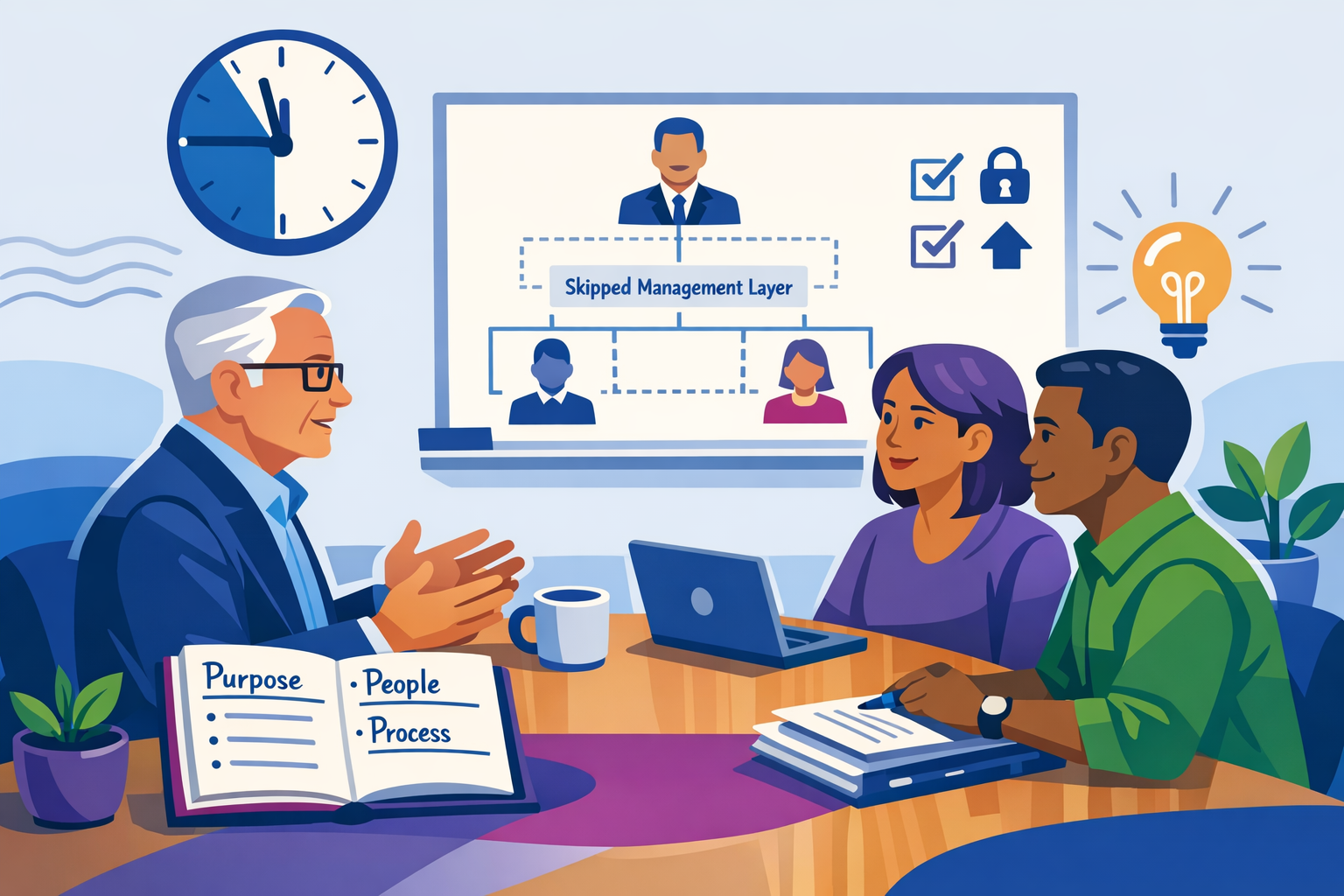
A skip-level meeting is a structured conversation between a leader and the team members who report to that leader’s direct reports. For example, a CEO meeting with staff who report to a Head of Sales, or a Director meeting with engineers who report to an Engineering Manager.
It is not:
A complaint theatre where you collect gripes and promise to fix everything.
A covert investigation into whether a manager is “good enough”.
A substitute for your managers doing their job.
A town hall in miniature.
Skip-levels are an organisational sensing mechanism. If you treat them like surveillance, you will get performative answers and political behaviour. If you treat them like a system, you will get signal.
The real reason skip-levels fail
Most leaders fail at skip-levels for one of three reasons:
No clear intent. People do not know what the meeting is for, so they default to venting or flattery.
No protection for the management layer. Managers feel bypassed, so they start controlling the narrative or discouraging honesty.
No closed loop. You collect input, then nothing changes. People learn it is a waste of time and stop telling you the truth.
If you want skip-level meetings to work, you need to engineer them like any other performance system: clear purpose, clean process, and disciplined follow-through.
Start with the ethics: your managers are not the enemy
Here is the brutal truth. If your primary motive is “I cannot trust what my managers tell me”, you do not have a skip-level problem. You have a leadership and system problem.
Skip-levels should strengthen the chain of leadership, not replace it.
Set these expectations explicitly:
You are not there to adjudicate personal disputes. You are there to understand organisational conditions.
You will not accept surprise attacks on individuals. Specific, constructive patterns are welcome. Ambushes are not.
You will not make commitments in the moment that cut across the manager. You will take issues away, validate them, and respond through the proper channel.
This is how you prevent skip-levels becoming a political weapon.
Use the 6Ps to set the agenda (big picture only)
Skip-levels go off the rails when they become random. Use a simple structure that maps to how organisations actually work. PerformanceNinja’s 6Ps framework is a clean lens to keep the conversation on performance, not personalities:
Purpose: Do people understand why we exist and what “good” looks like?
People: Are skills, behaviours, and leadership capacity strong enough?
Proposition: Do teams understand the strategy and customer value?
Process: Where does work get stuck, duplicated, or degraded?
Productivity: Are priorities clear, decisions fast, and follow-up real?
Potential: Are we learning and innovating without distracting ourselves?
You are not running a workshop. You are using a consistent mental model so patterns are visible across teams and time.
Decide the format: 1:1, small group, or mixed
There is no single best format. Choose based on what you are trying to detect.
1:1 skip-levels (deep truth, slower coverage)
Best when:
You suspect fear, disengagement, or politics.
You need nuance on execution breakdowns.
You are building trust in a new leadership regime.
Risk: you will over-weight one person’s perspective unless you are disciplined about pattern recognition.
Small group skip-levels (fast patterns, social dynamics)
Best when:
You want to see alignment or fragmentation inside a team.
You want to compare how people talk when peers are present.
You need broader coverage with limited time.
Risk: quieter people may self-censor. Dominant voices can hijack the narrative.
Mixed approach (recommended)
Run small groups quarterly, then do targeted 1:1s where signal is weak, conflicting, or high risk.
Before the meeting: engineer trust and reduce fear
People do not speak honestly when they think honesty is unsafe. That is not a character flaw. It is rational.
Send a pre-brief that is short, specific, and firm. Include:
Why you are doing skip-levels. “To understand what is helping and hindering performance, and what I can fix at my level.”
What you will talk about. Use the 6Ps categories in plain English.
What you will not do. “This is not a forum to attack individuals or negotiate personal arrangements.”
Confidentiality boundaries. “I will not quote you by name. If something requires action, I will raise it as a theme.”
What good input looks like. “Specific examples, repeated patterns, and impact on customers or delivery.”
Also brief your managers first. If this is a surprise to them, you have already created mistrust.
How to brief the manager (without asking permission)
You are not asking your managers if skip-levels are allowed. You are informing them how they will work.
In 10 minutes, cover:
Your intent: improve organisational performance and remove systemic blockers.
Your boundaries: you will not do “gotcha” performance conversations.
Your commitments: you will share themes with them, and you will close loops with actions.
Their role: encourage candour, do not coach scripts, and be ready to act on themes.
Then do the hard part. Ask them:
“What do you think I am going to hear that you already know?”
“Where do you think the system is making your team’s life harder?”
This converts skip-levels from a threat into a joint diagnostic.
The agenda that stops skip-levels becoming a mess
Use a tight 45-minute structure. It forces focus and prevents rambling.
0 to 5 minutes: set the rules
Restate the purpose.
Restate confidentiality boundaries.
Ask for specifics and patterns, not hearsay.
5 to 30 minutes: high-signal questions
Ask fewer questions, but make them count. Here are the ones that reliably surface real constraints:
Priority clarity: “If I asked three people what the top three priorities are this quarter, would I get the same answer?”
Execution drag: “Where does work routinely get stuck and why?”
Decision latency: “What decisions are slow, and what is the cost of that slowness?”
Quality and customer impact: “Where are we compromising quality, and what is forcing that compromise?”
Role clarity: “What do people get pulled into that is not their job?”
Manager enablement: “What would make your manager’s job easier that is outside their control?”
Culture truth: “What behaviour gets rewarded here, even if we pretend it does not?”
Retention risk: “If a strong performer left tomorrow, what would the real reason be?”
Notice what is missing: “How do you feel about your manager?” That question invites a personality trial. You want organisational mechanics and patterns.
30 to 40 minutes: test for patterns and contradictions
This is where most leaders waste the opportunity. They treat input as fact. Your job is to test signal quality.
Use prompts like:
“How often does that happen?”
“What is a recent example?”
“Who else experiences that?”
“What have you tried already?”
“If we fixed only one thing, what would create the biggest lift?”
40 to 45 minutes: close properly
End with discipline:
Summarise the top themes you heard.
State what you will do next: validate, cluster themes, decide actions.
Give a timeline: “You will hear back within two weeks.”
If you do not close the loop, do not bother meeting at all.
What to write down (and how to avoid weaponising notes)
Your notes should be designed to detect patterns, not to build a case against someone.
Use a simple template:
Theme: decision delays
Category: Productivity
Observed impact: releases slip, rework increases
Frequency: weekly
Probable root cause: unclear decision rights, too many reviewers
Suggested fix: define a decision owner, reduce approvers
Do not attribute quotes. Do not record names against criticisms. If someone raises a serious risk (bullying, harassment, misconduct), tell them clearly you cannot keep that confidential and you must escalate appropriately.
The follow-up: where effective leaders separate themselves
Most skip-level programmes fail in the follow-up, not the conversation.
You need a closed-loop system that respects your managers and proves to staff that speaking up matters.
Step 1: cluster themes within 48 hours
While memory is fresh, consolidate notes into 5 to 10 themes max. If you have 25 themes, you did not ask the right questions or you lack prioritisation discipline.
Step 2: validate with multiple sources
Before acting, validate themes through at least two of the following:
Another skip-level cohort
Manager perspective
Operational data (cycle time, defects, backlog age, customer complaints)
Artefacts (process maps, meeting cadences, decision logs)
This is how you avoid overreacting to one persuasive story.
Step 3: share themes with the manager first
Do not make your manager hear organisational issues second-hand through their team. That is how you create politics.
In a structured 30 minutes, cover:
The themes (not names)
Your assessment of root causes
What is within the manager’s control vs yours
What support you will provide
Step 4: communicate back to the skip-level participants
Within two weeks, send a short note or do a brief huddle:
What you heard (themes)
What you are going to do (actions)
What you are not going to do (and why)
When you will review progress
This is where trust is either built or destroyed.
Common skip-level traps (and the exact antidotes)
Trap 1: turning skip-levels into a complaints inbox
Antidote: Require problem statements with impact and frequency. Then ask, “What would good look like?” and “What have we tried?”
Trap 2: undermining the manager unintentionally
Antidote: Never agree to changes on the spot that affect the manager’s domain. Say, “I will take this away, validate, and come back through your manager.”
Trap 3: over-indexing on morale talk
Antidote: Focus on the mechanics of work. Morale often follows clarity, capability, and throughput.
Trap 4: using skip-levels as a performance management shortcut
Antidote: If a pattern suggests a leadership issue, address it through normal management channels, with evidence, coaching, and clear expectations. Skip-levels provide signal, not verdict.
Trap 5: inconsistent cadence and random sampling
Antidote: Set a rhythm. For example, quarterly skip-levels per function, rotating participants so you see breadth without burning calendars.
A brief implementation plan (high-level, but usable)
If you want to implement skip-levels in a way that does not create chaos, run this simple rollout.
Weeks 1 to 2: design
Define intent, boundaries, and escalation rules.
Choose format: mixed (small groups plus targeted 1:1s).
Create the question set and notes template.
Weeks 3 to 4: pilot
Run skip-levels in one function.
Cluster themes and run the full closed loop.
Adjust questions and follow-up process based on what you learned.
Quarter 2 onwards: scale with cadence
Roll out to all functions on a quarterly rhythm.
Track top recurring themes by 6Ps category.
Review whether actions reduced friction using basic operational indicators.
This keeps skip-levels from becoming a “leadership hobby” and turns them into an organisational performance instrument.
How to know your skip-levels are working
You will see it in behaviour and outcomes, not in how positive the conversations feel.
Effective skip-levels create:
Higher truth density. People move from vague complaints to specific constraints and examples.
Faster decision-making. The same bottlenecks stop appearing quarter after quarter.
Cleaner execution. Fewer dropped balls because follow-up becomes systemic, not heroic.
Stronger middle leadership. Managers feel supported to fix system issues, not blamed for them.
Less cultural theatre. Values become observable behaviours, not posters.
If skip-levels only produce “interesting conversations”, you are busy, not effective.
The final word: skip-levels are a test of leadership maturity
Skip-level meetings expose the truth about your organisation, and about you.
If you cannot hear hard feedback without reacting, you will train people to lie.
If you collect truth and do nothing with it, you will train people to disengage.
If you use skip-levels to bypass your managers, you will train the organisation to play politics.
But if you run skip-levels with intent, structure, and disciplined follow-through, you get something rare in growing organisations: real signal, early enough to matter.
Next Steps
Want to learn more? Check out these articles:
Decision Latency in Leadership Teams: Stop Paying the Hidden Tax
Psychological Safety in Leadership Teams: The Unspoken KPI
Manage Underperformance Without Losing Your Best People
To find out how PerformanceNinja could help you, book a free strategy call or take a look at our Performance Intelligence Leadership Development Programme.