
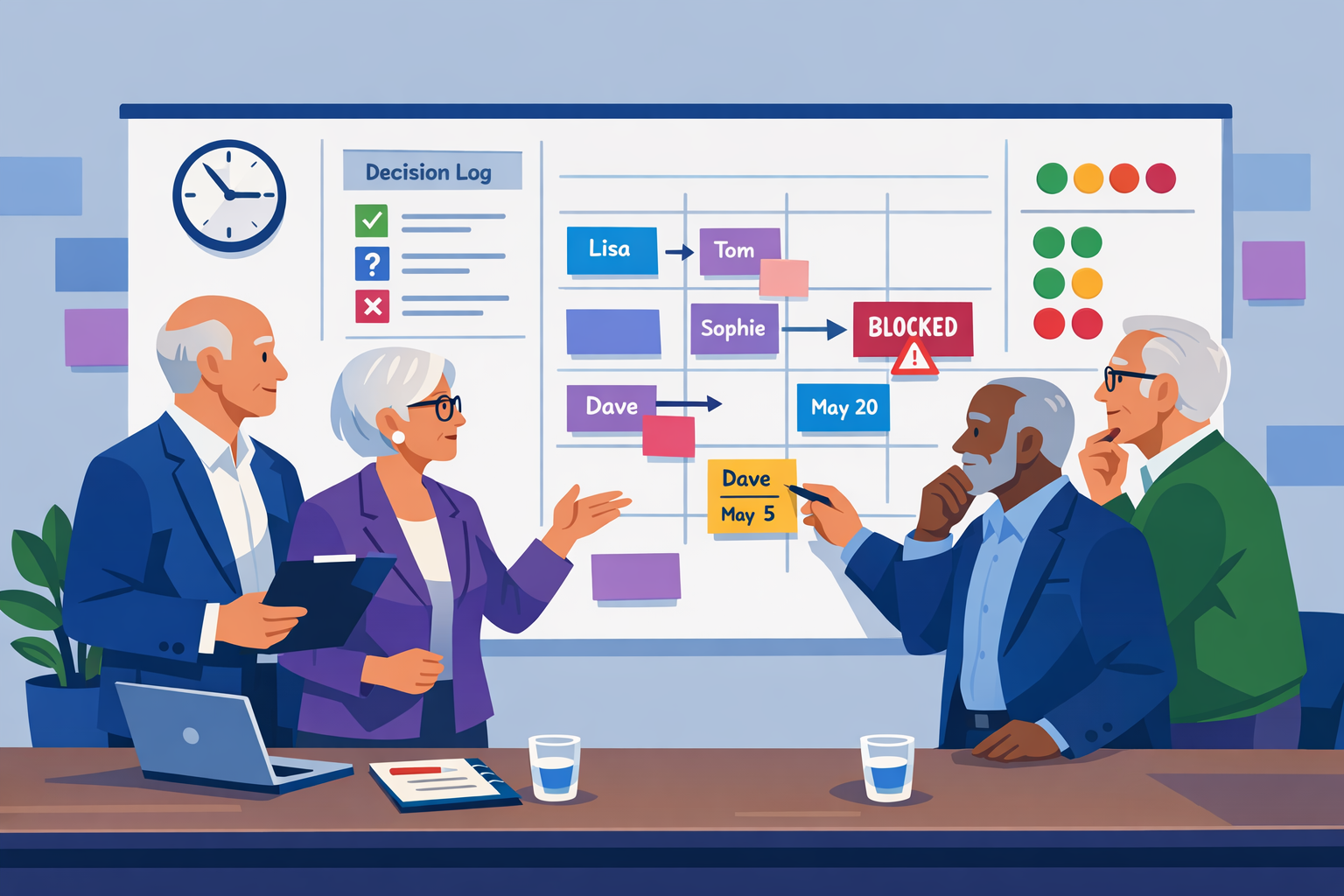
Diagnose Accountability Gaps in Leadership Teams Fast
Most leadership teams do not have an accountability problem. They have an accountability diagnosis problem.
They keep “fixing” symptoms with more meetings, new dashboards, tougher language, and a vague demand for “ownership”. Then they act surprised when nothing changes.
Here is the brutal truth. If you cannot point to the exact moment accountability breaks, you will keep paying for it in missed deadlines, duplicated work, political cover-ups, and quiet resentment. And the more senior the team, the more expensive the confusion becomes.
This article shows you how to diagnose accountability gaps in leadership teams with precision. Not with motivational posters. With practical tests you can run in the next 10 days.
What an accountability gap actually is (and what it is not)
Let’s get specific, because most leadership teams hide behind sloppy language.
An accountability gap exists when:
- A decision is made, but no single person is clearly responsible for the outcome.
- A task is assigned, but nobody tracks it to completion and consequences are unclear.
- A cross-functional outcome is needed, but everyone optimises their silo and calls it “alignment”.
Accountability is not “working hard”. It is not “being committed”. It is not “caring”. Accountability is the combination of:
- Clarity on what winning looks like
- Ownership by a named person for a measurable outcome
- Authority to make the necessary calls
- Follow-through via a cadence that exposes slippage early
If any of those four are missing, you do not have accountability. You have theatre.
The high-cost signals leaders keep rationalising
Most accountability gaps are visible. Leadership teams just normalise them because confronting them creates friction.
Look for these signals. If you see three or more, you have a systemic issue.
- “We agreed” but nothing moves. Meetings produce decisions that do not translate into changed behaviour.
- Deadlines slide quietly. Nobody escalates early. Everyone waits until it is already late.
- Work is duplicated. Two departments build similar solutions because nobody owned the integrated outcome.
- Decisions keep getting reopened. Not because new data arrived, but because the decision never had a true owner.
- Blame is polite and indirect. People hint, imply, and “raise concerns” without naming the real gap.
- Projects are “95% done” for weeks. The last 5% is where accountability goes to die.
- Cross-functional work is slow and political. People negotiate responsibilities instead of executing.
If you are reading this and thinking “that is just how it is here”, that is the point. You have trained the organisation to tolerate drift.
Start with the six root causes, not the drama
Accountability gaps rarely come from bad intent. They come from weak design. At PerformanceNinja we often zoom out using the 6Ps lens. Not to create complexity, but to stop leaders from blaming individuals for structural problems.
1) Purpose gaps: the organisation cannot describe “winning”
If strategic intent is vague, accountability becomes impossible. You cannot hold people to outcomes the business cannot define.
Diagnostics to run:
- Ask each exec to write the top 3 outcomes for the next 90 days. Compare answers.
- Ask “What will we say no to?” If nobody can answer, priority is fake.
2) People gaps: capability or behaviour is below the bar
Some leaders avoid accountability because they cannot deliver, or because they have learned that avoiding consequences is safer than taking risks.
Diagnostics to run:
- Look for leaders who consistently accept work without clarifying scope, success criteria, or authority.
- Track repeat “handover” failures. If the same person drops the baton, it is not bad luck.
3) Proposition gaps: strategy is unclear, so execution fragments
If your strategy does not force trade-offs, every function invents its own version of success. That creates invisible accountability gaps because each area thinks it is winning.
Diagnostics to run:
- Ask: “What are we optimising for this quarter: growth, margin, retention, risk reduction?” If you get multiple answers, expect execution chaos.
- Review major initiatives. If they do not map to a small set of strategic choices, you have a portfolio problem.
4) Process gaps: the organisation cannot hand work across boundaries
Many “leadership accountability” problems are actually broken interfaces between teams. The seams are where work goes missing.
Diagnostics to run:
- Map one end-to-end customer journey that crosses departments. Identify where delays and rework occur.
- Check if there is a named owner for the whole journey, not just each departmental segment.
5) Productivity gaps: weak decision and follow-up systems
This is the most common root cause. Leadership teams think accountability is a cultural issue, then run meetings with no owner, no due date, no check-in, and no consequences. The system creates the behaviour.
Diagnostics to run:
- Audit the last 5 leadership meetings. Count actions with a named owner and due date.
- Check whether actions are reviewed first in the next meeting, or buried at the end if time allows.
6) Potential gaps: innovation competes with execution without rules
If innovation work has no governance, it becomes a safe hiding place. People escape delivery by “exploring options”.
Diagnostics to run:
- List all experiments and initiatives. Identify which have clear success metrics and stop criteria.
- Ask: “Who kills projects?” If the answer is “nobody”, accountability is optional.
The Accountability Gap Diagnostic: 10 tests you can run quickly
You do not need a 12-week transformation programme to find the cracks. You need a set of tests that reveal where responsibility, authority, and follow-through break down.
Run these 10 tests with your leadership team. Be strict. If the answer is unclear, treat it as a fail.
Test 1: The “Name the Owner” test
Pick five strategic outcomes. For each one ask:
- Who is the single accountable owner?
- What is the measurable result?
- By when?
If you get two names, you have zero owners. If you get one name but no measurable result, you have theatre.
Test 2: The “Authority match” test
For each outcome owner, ask what decisions they can make without escalation. If they need permission for the decisions that drive the outcome, you have assigned responsibility without authority. That creates delays, politics, and learned helplessness.
Test 3: The “First domino” test
Ask each owner to state the first domino action that must happen this week. Not a plan. A concrete action.
- If they cannot name it, they are not truly leading the outcome.
- If the first domino depends on another leader, you have an interface accountability gap.
Test 4: The “No surprises” test
Ask: “What will cause us to miss our quarterly outcomes?” Then ask: “When will we know we are off-track?”
If the honest answer is “we will know in week 11”, your follow-up cadence is broken.
Test 5: The “Decision log” test
Great leadership teams treat decisions as assets. Weak teams treat them as conversations.
Look for a decision log that captures:
- The decision
- The decision owner
- The date
- The rationale
- What success looks like
If your team cannot produce this for major decisions, expect constant reopening and quiet sabotage. Research on decision effectiveness consistently links clarity and follow-through to better execution outcomes, yet many executive teams still rely on memory and informal agreement.
Test 6: The “Meeting output” test
Take your leadership meeting agenda and underline every item that is merely an update. Then ask how many items require a decision.
If your “leadership” meeting is mostly reporting, you are not leading. You are running a status broadcast. Accountability will weaken because nothing is being decided with ownership and deadlines.
Test 7: The “Cross-functional outcome” test
Pick one cross-functional initiative. Ask each leader to state:
- What they own
- What they need from others
- What they will deliver and by when
If you cannot produce a clean dependency map in 15 minutes, you have not actually aligned. You have just been polite in the same room.
Test 8: The “Escalation path” test
Ask: “When an action is blocked, how fast do we escalate, and to whom?”
Most teams fail here because escalation feels like conflict. So blockers fester. Accountability dies quietly.
Define a rule:
- If blocked for more than 48 hours, escalate.
- Escalation is not complaining. It is protecting outcomes.
Test 9: The “Consequences” test
Ask the uncomfortable question: “What happens when a leader repeatedly misses commitments?”
If the answer is “we talk about it” with no behavioural change, your system teaches that commitments are optional. Consequences do not need to be punitive, but they must be real. Loss of scope, increased scrutiny, removal from priority work, formal performance management. Something.
Test 10: The “Truth temperature” test
Accountability requires truth. If leaders cannot speak plainly to each other, you will never close the gaps.
Run this simple exercise in your next exec session:
- Each leader states one commitment they made and whether they delivered it.
- If not delivered, they state why, what they will do next, and what support they need.
If this feels tense, good. That tension is the cost of honesty. Over time, it becomes normal, and performance improves. Teams with high psychological safety tend to surface issues earlier, but safety without standards becomes comfort. You need both.
Where accountability breaks in leadership teams (the five common fault lines)
After diagnosing dozens of leadership systems, the same patterns show up. These are the fault lines to inspect first.
Fault line 1: Shared ownership of outcomes
Shared ownership sounds collaborative. In practice it is often a way to avoid hard calls.
Rule: one accountable owner per outcome. Many contributors, one throat to choke. If you dislike that phrase, you probably need it.
Fault line 2: Vague deliverables disguised as “strategic work”
“We are working on the strategy.” “We are improving the culture.” “We are transforming the operating model.”
Translation: nobody can measure progress, so nobody can be held accountable.
Fix it by forcing every strategic initiative to produce:
- A tangible deliverable
- A measurable business effect
- A date
- A decision owner
Fault line 3: The calendar is lying about priorities
Leaders say one thing and schedule another.
If your most important outcomes do not have recurring time blocks for review, problem-solving, and decision-making, then they are not priorities. They are aspirations.
Fault line 4: Nobody owns the interfaces
Accountability fails between departments because “handover” is treated as an event, not a relationship with standards.
Fix it by assigning named owners to:
- End-to-end customer journeys
- Cross-functional initiatives
- Critical internal services (for example, hiring, onboarding, product release)
Fault line 5: Leaders avoid conflict, then call it culture
A calm leadership team is not automatically a healthy one. Sometimes it is just a frightened one.
When leaders do not challenge missed commitments, they are not being kind. They are being negligent.
How to close the gaps without creating bureaucracy
Many executives resist accountability systems because they fear bureaucracy. Fair. But the alternative is already bureaucracy, just informal and political. The goal is a light, explicit system that makes execution inevitable.
Use these four mechanisms. Keep them simple. Run them consistently.
1) One-page outcomes scoreboard
Create a single page that lists your top outcomes for the quarter. For each outcome include:
- Owner
- Metric
- Target
- Status (green, amber, red)
- Next action
This is not a vanity dashboard. It is a forcing function for clarity.
2) Decision rights and escalation rules
Document decision rights for the most common decisions that cause delay. Pricing, hiring, roadmap changes, client exceptions, spend approvals.
Then define escalation rules that are time-based, not emotion-based.
3) A leadership meeting that actually leads
Structure your leadership meeting around decisions and obstacles, not updates.
- First 10 minutes: review last week’s commitments, done or not done
- Next: tackle red and amber outcomes only
- End: capture decisions and actions with owners and dates
Updates belong in pre-reads. If someone has not read them, that is a leadership issue, not a meeting design issue.
4) Consequences that protect the mission
Consequences should feel fair, consistent, and tied to outcomes.
Examples that work without becoming toxic:
- Reduce scope for leaders who repeatedly miss commitments
- Increase check-in frequency for at-risk outcomes
- Require a written recovery plan within 24 hours of a miss
- Move ownership to someone who can deliver if performance does not improve
What you tolerate becomes your operating model.
A brief implementation plan (10 days to clarity)
If your team needs a starting point, do this. No fanfare. Just execution.
Days 1 to 2: Audit reality
- Collect the last 5 leadership meeting notes and action lists.
- Identify actions without owner, due date, or clear outcome.
- List the top 10 current initiatives and who thinks they own them.
Days 3 to 5: Run the 10 tests
- Facilitate a 90-minute session with the exec team to run the tests above.
- Capture failures as design issues, not personal attacks.
Days 6 to 8: Install the minimum system
- Create the one-page outcomes scoreboard.
- Set the meeting cadence and agenda that prioritises decisions and blockers.
- Define escalation rules and decision owners.
Days 9 to 10: Lock in behaviours
- Run the first meeting using the new format.
- Make the first missed commitment visible and handle it cleanly.
- Agree the consequence model for repeated misses.
Then repeat weekly. Accountability is not installed. It is practised.
The leadership team standard that changes everything
Accountability is not about being harsh. It is about being clear. Clarity is respect. Ambiguity is disrespect disguised as politeness.
If you want a leadership team that executes, adopt this standard:
- We name an owner.
- We define the outcome in measurable terms.
- We give the owner authority.
- We review progress at a cadence that makes surprises impossible.
- We address misses immediately, without drama.
Do that, and you will not just “improve accountability”. You will remove the hidden tax your leadership team has been paying for years.
Next Steps
Want to learn more? Check out these articles:
Leading Indicators for Team Performance: Build Yours Fast
Team Accountability in Scale-Ups: Fix It Before It Breaks
Leadership Scorecards That Actually Improve Team Performance
To find out how PerformanceNinja could help you, book a free strategy call or take a look at our Performance Intelligence Leadership Development Programme.