
Team Accountability in Scale-Ups: Fix It Before It Breaks
Accountability in scale-ups is not a people problem
Scale-ups love to say they want “more accountability”. What they usually mean is this:
- Work is slipping.
- Projects are late.
- Dependencies are messy.
- Everyone is busy, but outcomes are thin.
- And the founders are sick of chasing.
Here is the brutal truth. In a scale-up, accountability fails less because people are lazy and more because the organisation stopped being legible.
At 15 people, everyone can see everything. At 60, nobody can.
So you get the worst combination:
- High autonomy with unclear ownership
- Fast change with no stable operating rhythm
- Senior leaders making decisions, but not making them stick
If you want to improve accountability, stop demanding it as a personality trait. Build it as a system.
This article shows you how to do that, without turning your scale-up into a bureaucracy factory.
What accountability actually means (and what it does not)
Most leadership teams confuse accountability with visibility.
Visibility is knowing what is happening. Accountability is knowing who owns the outcome, what “done” means, and what happens if it is not done.
Real accountability has four components:
- Ownership: one person is on the hook for the outcome
- Clarity: the outcome is defined, measurable, and time-bound
- Authority: the owner can make decisions and secure resources
- Consequence: progress is reviewed and slippage triggers action
If any one of these is missing, you get theatre.
- Lots of updates, no delivery
- Lots of meetings, no decisions
- Lots of “we should”, no ownership
The scale-up accountability death spiral
There is a predictable pattern.
Stage 1: Heroics work
Early on, accountability is informal.
People deliver because:
- They sit next to each other
- The mission is fresh
- The founders are watching
You can run on goodwill and adrenaline.
Stage 2: Growth breaks the signal
Then hiring ramps.
Now:
- Work is split across teams
- Decisions are made in one meeting and misunderstood in five others
- Customers experience the hand-offs, and they do not like it
Stage 3: Leaders start chasing
Senior leaders respond by chasing.
They add:
- More Slack pings
- More “quick check-ins”
- More status meetings
Accountability drops further because the system now rewards:
- Looking busy
- Saying yes
- Avoiding risk
Stage 4: Everyone blames “culture”
At this point, leaders call it a culture issue.
It is not.
Culture is what happens when your systems keep producing the same behaviour.
If your system makes it easy to hide, people will hide.
The 6 accountability leaks in scale-ups
If you are serious about improving team accountability in a scale-up, look for these six leaks.
1. Too many priorities, not enough decisions
If everything matters, nothing is owned.
Common symptoms:
- Teams have 15 “top priorities”
- Leaders keep adding work mid-quarter
- Strategy is a slide deck, not a trade-off
Accountability needs constraints. Constraints come from decisions.
2. Ownership is shared, so it is owned by nobody
“Co-owned” outcomes are usually unowned.
You get:
- Diffusion of responsibility
- Polite ambiguity
- Endless loops of alignment
You can collaborate without sharing accountability.
3. “Done” is fuzzy
If done is subjective, delivery becomes a negotiation.
Watch for phrases like:
- “Basically finished”
- “Just needs a quick review”
- “Blocked on feedback”
That is not progress. That is limbo.
4. Teams cannot make decisions
Accountability without authority is punishment.
If every meaningful decision escalates, then owners stop owning.
They wait.
5. No operating rhythm
Many scale-ups have meetings, but no cadence.
A cadence is not “we meet a lot”.
A cadence is:
- the same few meetings
- with fixed inputs and outputs
- that drive decisions, alignment, and follow-through
No rhythm means no follow-up. No follow-up means no accountability.
6. Weak consequences
Most scale-ups avoid consequences because they fear being “too corporate”.
So underperformance becomes:
- quietly tolerated
- slowly normalised
- suddenly catastrophic
Consequences do not need to be harsh. They need to be real.
The principle: Build accountability into the organisation, not the person
Stop trying to motivate people into accountability.
Instead, engineer it using three levers:
- Clarity of outcomes
- Clarity of ownership
- Cadence of review
When those exist, most people become “accountable” overnight.
Because the system makes the right behaviour the path of least resistance.
Step 1: Make priorities executable (not inspirational)
Scale-ups often confuse ambition with priority.
Your job is to turn strategy into a small set of executable outcomes.
Use a ruthless “not doing” list
If you want accountability, you need focus. Focus means saying no.
In your next leadership meeting, force this decision:
- List every major initiative currently in motion
- Rank them by impact on the next 90 days
- Cut or pause at least 20 percent
If you cannot cut anything, you do not have priorities. You have a wish list.
Convert priorities into outcome statements
Every priority should be stated as:
- Outcome: what changes in the business
- Measure: how you know it changed
- Deadline: when it must be true
Example:
- Poor: “Improve onboarding”
- Better: “Reduce time-to-first-value for new customers from 21 to 10 days by 30 September”
Accountability sticks when outcomes are measurable and time-bound.
Step 2: Assign a single owner for every outcome
If you want to improve team accountability in a scale-up, this is the highest leverage change you can make.
One outcome. One owner.
Not one team. Not one committee. Not “shared”.
What a real owner is responsible for
A true owner:
- Commits to the outcome
- Breaks it into deliverables
- Secures cross-team support
- Raises risks early
- Makes trade-offs
The owner is not the person doing all the work. They are the person ensuring the work results in the outcome.
Use a “DACI-lite” to avoid decision fog
You do not need heavyweight RACI charts.
For each outcome, define:
- Driver: the single owner
- Approver: the person with final decision authority
- Contributors: the few roles needed to deliver
- Informed: who must be updated, not consulted
Write it down. Publish it. Refer to it when things get messy.
Step 3: Define “done” with acceptance criteria
Most scale-up delivery problems are not effort problems. They are definition problems.
Use 3 acceptance criteria per deliverable
For every key deliverable, define three checks.
Example for “launch the new pricing page”:
- New pricing page is live on production
- Pricing analytics events are firing and verified in the dashboard
- Sales team has the updated one-page pricing explanation and confirms it matches pitch
No criteria, no “done”.
This removes the loophole where work sits at 90 percent for weeks.
Step 4: Install an operating rhythm that forces follow-through
Accountability dies in the gaps between meetings.
So you need a rhythm that closes the gap.
Here is a simple cadence that works in scale-ups without creating bureaucracy.
Weekly execution meeting (45 minutes)
Purpose: remove blockers, confirm commitments, push decisions.
Rules:
- Only owners speak to their outcomes
- No storytelling, only facts and next actions
- Every blocker has an explicit next step and named owner
Inputs:
- The list of quarterly outcomes
- A short scorecard of leading indicators
Outputs:
- Updated status per outcome (on track, at risk, off track)
- Decisions made or escalated
- Commitments for the next 7 days
Monthly performance review (60 to 90 minutes)
Purpose: review the system, not just the work.
Agenda:
- What outcomes moved, what did not
- What patterns are causing slippage
- What decisions are required from leadership
This meeting is where you fix the machine.
Quarterly reset (half-day)
Purpose: reset priorities, capacity, and ownership.
Deliverables:
- 3 to 5 outcomes for the quarter
- owners confirmed
- dependencies mapped
- “not doing” list published
Scale-ups drift when quarters are not reset properly.
Step 5: Make progress visible in a way that drives action
Most dashboards are noise.
If your reporting does not change decisions, it is theatre.
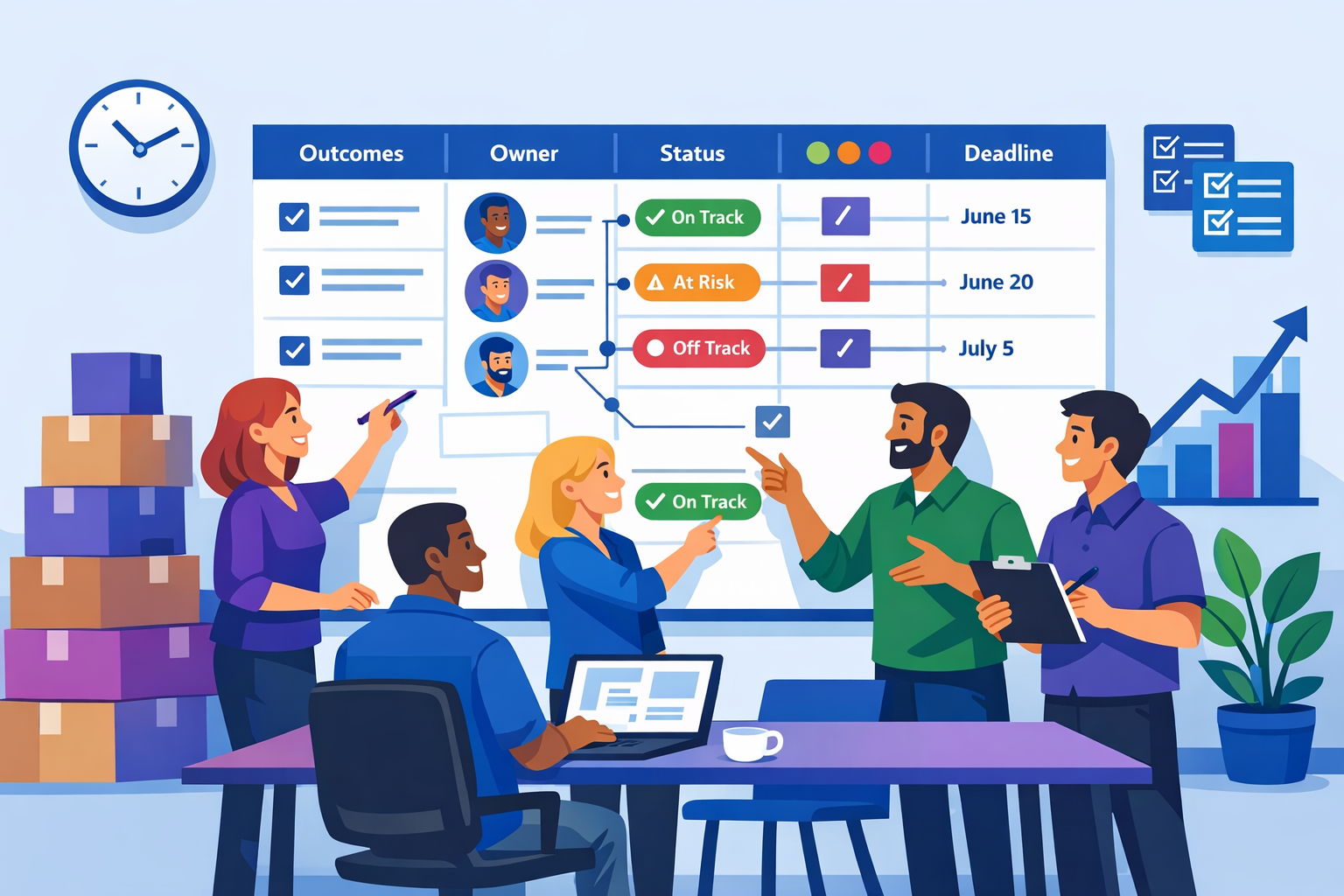
Use a one-page accountability board
Keep it simple. For each outcome:
- Outcome statement
- Owner
- Status (on track, at risk, off track)
- Leading indicator
- Next milestone date
- Current top blocker
Two rules:
- Status must be owned by the outcome owner, not the PMO or ops person
- “At risk” is safe to say early, “surprised off track” is not acceptable
This creates a culture where raising risk is a strength.
Step 6: Build consequences that are adult, fair, and fast
Accountability without consequence is a request.
Consequence does not mean punishment. It means response.
Three levels of consequence you must use
- Immediate: a missed commitment triggers a same-week recovery plan
- Systemic: recurring slippage triggers a change to process, scope, or resourcing
- Personal: repeated failure to own outcomes triggers a role conversation
If you avoid level 3 forever, you will eventually lose your best performers. They will not tolerate carrying passengers.
Separate “missed” from “hidden”
In a scale-up, misses happen. Especially with uncertainty.
What you cannot tolerate is hiding.
So treat these differently:
- Missed with early warning: solve it
- Missed with surprise: investigate it
- Missed with repeated surprise: escalate it
Your standard should be predictable delivery, not perfect delivery.
The leadership behaviour that makes or breaks accountability
You can install all the right mechanics and still fail if leaders behave badly.
Here are the most common leadership behaviours that destroy accountability in scale-ups.
Leaders who keep rescuing
If leaders constantly jump in to save outcomes, the organisation learns:
- Ownership is optional
- Escalation is a delivery strategy
Rescue occasionally. But always follow it with a fix:
- What capability was missing
- What decision was unclear
- What process failed
Leaders who change priorities mid-flight
You cannot demand accountability and also:
- add urgent work every week
- change the goalposts
- override agreed trade-offs
If you must change priorities, do it explicitly:
- what stops
- who is affected
- what outcome is now at risk
Leaders who punish bad news
If people fear consequences for being honest, you will get optimism and silence.
Then you will get failure.
Reward early warning. Challenge late surprises.
Accountability across teams: where scale-ups bleed out
Single-team accountability is easy. Cross-team accountability is where delivery goes to die.
Map dependencies like a grown-up
For each quarterly outcome, explicitly list:
- upstream dependencies
- downstream impacts
- the single point of contact in each team
- the “latest responsible date” for each dependency
Then review these in the weekly execution meeting.
Stop using “blocked” as a status
“Blocked” is not a status. It is an abdication.
Replace “blocked” with one of these:
- Waiting on decision from [name] by [date]
- Waiting on deliverable from [team] by [date]
- Waiting on external factor, mitigation is [action] by [date]
Every wait state must have a next action.
The big picture: accountability is a 6P problem
If you zoom out, accountability failures usually come from misalignment across the PerformanceNinja 6Ps.
- Purpose: people do not understand what matters now
- People: managers have not learned to set expectations and hold the line
- Proposition: strategy is unclear so priorities churn
- Process: hand-offs and decision paths are undefined
- Productivity: no cadence, no scorecard, no follow-up
- Potential: innovation competes with execution with no portfolio discipline
Do not try to fix accountability in isolation.
Fix the parts of the machine that create ambiguity.
A brief implementation plan (30 days to real traction)
You do not need a six-month transformation. You need a clean start.
Week 1: Clarity and ownership
- Choose 3 to 5 outcomes for the next 90 days
- Write them as measurable outcome statements
- Assign one owner per outcome
- Publish the one-page accountability board
Week 2: Define “done”
- Break each outcome into 3 to 7 deliverables
- Add 3 acceptance criteria per deliverable
- Confirm decision authority and escalation path
Week 3: Install the cadence
- Run the first weekly execution meeting
- Enforce the rules, especially no storytelling
- Capture decisions and commitments in writing
Week 4: Add consequences and learning
- Run the first monthly performance review
- Identify the top two recurring failure patterns
- Change one process or resourcing decision immediately
If you do this properly, accountability improves because ambiguity disappears.
The test: can your organisation answer these questions in 60 seconds?
Ask your leadership team these questions.
If they cannot answer quickly and consistently, you do not have accountability. You have activity.
- What are the 3 to 5 most important outcomes this quarter?
- Who owns each outcome?
- What does “done” mean for each?
- What is the current status and the single biggest blocker?
- What decision will we make this week to keep delivery on track?
Answer those, and you will feel the organisation tighten.
Not through fear. Through clarity.
Final word: accountability is kindness
In scale-ups, vague expectations are expensive.
They cost:
- time
- morale
- customer trust
- and eventually, your best people
The leaders who build accountability systems are not control freaks. They are serious about winning.
You do not need more reminders. You need a better machine.
Build it, and accountability stops being a complaint and becomes your competitive advantage.
Next Steps
Want to learn more? Check out these articles:
Leadership Scorecards That Actually Improve Team Performance
Reduce Meeting Overload in Leadership Teams Without Losing Control
Cross-Functional Collaboration: Fix Friction, Speed Delivery, Build Trust
To find out how PerformanceNinja could help you, book a free strategy call or take a look at our Performance Intelligence Leadership Development Programme.