
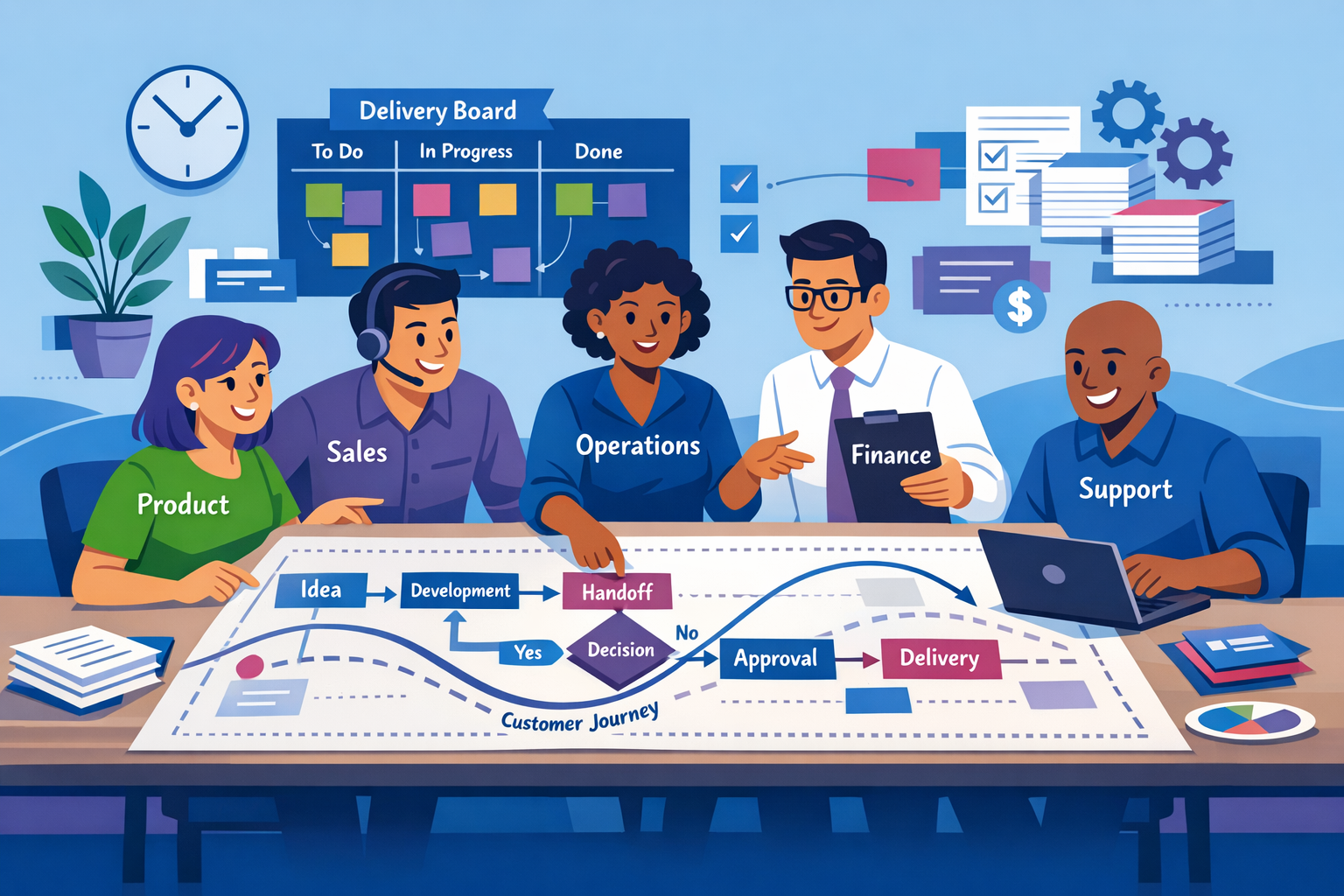
Cross-Functional Collaboration: Fix Friction, Speed Delivery, Build Trust
Cross-functional collaboration is not a “soft skill”. It is an operational capability. And most organisations are bad at it.
You feel it when work slows down for no clear reason. When Slack threads multiply, meetings breed, and nobody can tell you who owns the outcome. When Sales promises, Ops scrambles, Product denies, Finance blocks, and the customer pays the price.
Leaders often misdiagnose the problem as attitude. “They need to communicate better.” Wrong. Most collaboration failures are not people problems. They are design problems.
This article shows you how to improve cross-functional collaboration without adding bureaucracy, without drowning in meetings, and without waiting for a culture miracle. You will learn the real causes of cross-team friction and the exact operating moves that make collaboration fast, predictable, and professional.
The brutal truth: collaboration fails by default
Cross-functional collaboration is hard because it cuts across the grain of how organisations naturally work. Functions are built to optimise their own goals, protect their capacity, and reduce risk inside their domain. That is not dysfunction. That is what functions are for.
Collaboration fails when you ask functions to behave like one team, but you do not give them the conditions that make “one team” possible.
In practice, this shows up as:
Hidden hand-offs that nobody designed, so work vanishes into gaps.
Competing priorities because each function is measured differently.
Unclear decision rights so every decision becomes a negotiation.
Dependency chaos where teams block each other without warning.
Escalation as a workflow because basic alignment is missing.
If you recognise this, you do not have a motivation problem. You have an operating system problem.
What “good” cross-functional collaboration looks like
Before you fix anything, define the target state. High-performing cross-functional collaboration is boring in the best way.
It looks like:
Clear outcomes that everyone can repeat in one sentence.
Known interfaces so teams understand how work moves between them.
Fast decisions made at the right level, with the right inputs.
Predictable delivery because dependencies are planned and managed.
Low-drama conflict where trade-offs are explicit and resolved quickly.
Customer experience continuity even when five teams touch the work.
Notice what is missing: heroic effort. Great collaboration is not created by “going above and beyond”. It is created by good design.
Why cross-functional collaboration breaks (the five root causes)
1) You have purpose drift, not alignment
Most leadership teams think they have a shared purpose because they have a strategy deck. But teams do not collaborate around decks. They collaborate around decisions, trade-offs, and priorities.
When teams disagree on what matters most this week, collaboration collapses into local optimisation. People start defending their function because there is no higher-order clarity to defend.
Tactical fix: define “what winning means” at the level people actually work.
Write a single measurable outcome for the cross-functional initiative.
List three non-goals to stop scope creep pretending to be ambition.
State the trade-off policy: speed vs quality, revenue vs risk, custom vs standard.
This is not vision. This is operational purpose.
2) You built functions, then hoped interfaces would magically work
Functions create boundaries. Boundaries create interfaces. Interfaces either get designed or they become friction.
Most organisations do not design interfaces. They rely on relationships, favours, and “just ask Sarah, she knows how it works”. That is fine at 20 people. It is lethal at 200.
Tactical fix: define the interface like you would define an API.
Input: what do we need from the other team, in what format, by when?
Output: what do we deliver back, with what acceptance criteria?
Constraints: what rules must be respected (compliance, brand, budget)?
Escalation: what happens when we cannot meet the agreement?
If you cannot write this down, you do not have an interface. You have a gamble.
3) Decision-making is vague, so politics fills the gap
When decision rights are unclear, collaboration turns into lobbying. People bring more stakeholders into calls to feel safe. Meetings become crowded because accountability is missing.
There is a reason unclear decision rights correlate with slow execution. The organisation is trying to reduce risk by spreading it. The result is that nobody owns the outcome.
Tactical fix: assign decision roles explicitly for the decisions that matter.
For each recurring cross-functional decision, name:
Decision owner: the person who makes the call.
Required inputs: the people whose information must be considered.
Constraints: boundaries the owner cannot break.
Decision deadline: when the call will be made, no matter what.
This is where many leaders flinch. They want collaboration without authority. That is not collaboration. That is indecision with good intentions.
4) Your productivity system measures activity, not outcomes
Cross-functional collaboration dies when work is tracked as tasks inside functional tools, but the outcome lives nowhere. Everyone is “busy”. Nobody is done.
You get:
Long task lists with unclear deliverables
Projects that are “90% done” for six weeks
Dependency surprises late in the cycle
Progress updates that are stories, not evidence
Tactical fix: run collaboration through deliverables, not tasks.
Use a simple cross-functional delivery plan where each line item is:
Deliverable (a tangible output)
Acceptance criteria (what “done” means)
Single owner (one throat to choke, one brain to trust)
Due date
Dependencies (named people, not vague teams)
Then review it on a fixed cadence. Not to “check in”. To unblock, re-scope, and make decisions.
5) People are punished for helping
This is the quiet killer. In many organisations, cross-functional collaboration is requested like a favour, but measured like a distraction.
Example: Product is measured on roadmap delivery. Support needs product changes to fix churn. Product helps, misses roadmap, and gets punished. Next time, Product “protects focus”. Support escalates. Leadership calls for more collaboration. Everybody rolls their eyes.
Tactical fix: make cross-functional work visible in goals and capacity.
Allocate explicit capacity for cross-functional commitments.
Make cross-functional outcomes part of performance conversations.
Stop praising firefighting, start rewarding prevention and interface quality.
If collaboration is not resourced, it is theatre.
How to improve cross-functional collaboration (the operating moves)
Below are the moves that consistently work. Not because they are trendy, but because they remove ambiguity where ambiguity is expensive.
Move 1: Create a single “north star outcome” per initiative
Cross-functional work collapses when you have multiple truths. Establish one.
Define:
Outcome: the measurable result
Customer impact: what changes for the customer
Business impact: revenue, risk, cost, time
Time horizon: by when it matters
Keep it short enough that people can repeat it without notes. If they cannot repeat it, they cannot align to it.
Move 2: Build a “collaboration map” in 60 minutes
Get the right people in a room. Whiteboard the flow of work end-to-end. Then do something most teams avoid: name the friction.
Your collaboration map should show:
The major steps from request to delivery
Where work is handed over
Where approvals happen
Where rework happens
Where customers feel delay
Then ask two questions:
Where do we lose time repeatedly?
Where do we lose trust repeatedly?
This exercise is uncomfortable because it makes dysfunction observable. That is the point.
Move 3: Replace “stakeholder” with “role”
Stakeholder is a lazy word. It hides accountability.
For every cross-functional initiative, define four roles:
Accountable leader: owns the outcome and trade-offs
Execution lead: runs the day-to-day delivery
Functional representatives: bring domain constraints and capacity
Customer advocate: holds the experience line across hand-offs
If you cannot name these roles with real people attached, you are not ready to “collaborate”. You are ready to debate.
Move 4: Set interface agreements, then enforce them
Most interface agreements fail because they are written once and ignored forever. Treat them as living operational contracts.
Start with three interfaces that cause the most pain, usually:
Sales to Delivery
Delivery to Support
Product to Marketing
For each interface, define:
Definition of ready: what must be true before work is accepted
Definition of done: what must be true before work is complete
SLA or cadence: response times, review cycles, handover windows
Quality rules: what “good” looks like
Then enforce it with one simple mechanism: if the input does not meet “ready”, it is rejected with a clear reason. Not to be difficult. To keep the system stable.
Move 5: Run a weekly cross-functional execution review (30 minutes)
Not a status meeting. An execution review.
Agenda:
Outcome check: are we on track, yes or no?
Deliverables due this week: confirm owners, confirm acceptance criteria
Blocked items: remove blocks with decisions, not sympathy
Dependency risks: what is likely to break next week?
Decision log: what was decided, by whom, and what changed?
Rules that keep it clean:
No problem-solving in the meeting unless it ends in a decision
If it needs deep work, assign a breakout with a deadline
Everything discussed maps to a deliverable or risk
This is how you reduce meetings overall: you concentrate coordination into a single, disciplined cadence.
Move 6: Introduce “disagree and commit” with guardrails
Leaders love to quote “disagree and commit” and then ignore the hard part: you must create conditions where disagreement is safe and commitment is real.
Guardrails:
Disagreement must be based on data, constraints, or customer impact, not preference.
The decision owner must explicitly state: “I have heard X and Y, I am deciding Z.”
Once decided, undermining is treated as a performance issue, not a personality quirk.
Cross-functional collaboration is trust under pressure. Guardrails stop pressure turning into sabotage.
Move 7: Make conflict visible early using a trade-off register
Most cross-functional conflict is not interpersonal. It is a trade-off that nobody wants to name.
Create a lightweight trade-off register with three columns:
Trade-off (what is being balanced)
Current decision (what we are choosing right now)
Trigger to revisit (what would make us change our mind)
This stops teams relitigating the same arguments every two weeks. It also protects new joiners from reopening settled debates because they do not know the history.
Use the 6Ps to diagnose collaboration fast (big picture only)
If you want to improve cross-functional collaboration quickly, you need a diagnostic that separates symptoms from causes. A simple scan across the 6Ps works because collaboration fails when one or more of these are misaligned.
Purpose: do teams share a clear outcome and trade-off policy?
People: do leaders have the skill to resolve conflict and hold the line?
Proposition: is the value promise forcing hidden complexity across teams?
Process: are interfaces designed, or left to relationships?
Productivity: is work tracked as deliverables with owners and deadlines?
Potential: is innovation creating churn in priorities that breaks delivery?
Do not turn this into a workshop marathon. Use it to pinpoint the one or two leverage points where a small design change removes a lot of friction.
The warning signs you are “collaborating” but not delivering
If any of these are true, you are paying the cost of collaboration without getting the benefit.
You have lots of cross-functional meetings and few cross-functional deliverables
People say “we are aligned” but cannot state what changed since last week
Work is constantly blocked by approvals that nobody owns
Teams complain about each other’s attitude instead of naming constraints
Customers experience the organisation as fragmented, even when individuals are competent
These are not culture issues. They are control system failures.
A brief implementation plan (14 days to momentum)
Days 1 to 3: pick one collaboration battlefield
Choose one cross-functional workflow causing real pain (revenue leakage, churn, delivery delays)
Name the accountable leader and execution lead
Define the single outcome and three non-goals
Days 4 to 7: map the flow and design the interfaces
Run the 60-minute collaboration map session
Define “ready” and “done” for the top three hand-offs
Assign decision owners for recurring decisions and set deadlines
Days 8 to 14: install the cadence and measure delivery
Start the weekly 30-minute execution review
Track deliverables and blocked items publicly
Capture decisions and trade-offs in a shared log
By day 14 you should see one thing: fewer surprises. That is the first signal that collaboration is becoming a system, not a mood.
What to measure (so collaboration does not become theatre)
If you cannot measure it, you will argue about it. Measure a small set of indicators that reflect flow and reliability.
Lead time across the workflow: request to delivered outcome
Blocked work age: how long items stay blocked
Rework rate: how often outputs are rejected at hand-off
Decision cycle time: question raised to decision made
Customer handover defects: where the experience breaks between teams
These measures force the right conversations. They make it hard to hide behind busyness.
The leadership standard: stop hoping, start engineering
Cross-functional collaboration will not improve because people “try harder”. It improves when leaders design clarity into the organisation.
Your job is to:
Make the outcome undeniable
Make ownership explicit
Make interfaces enforceable
Make decisions fast and logged
Make delivery visible
Do that, and collaboration becomes a competitive advantage. Not a weekly frustration.
Next Steps
Want to learn more? Check out these articles:
Build a Weekly Leadership Rhythm That Actually Drives Execution
New Team Agreements: Build the Operating System Teams Use
Execution Discipline: How to Get Work Done Right, Every Week
To find out how PerformanceNinja could help you, book a free strategy call or take a look at our Performance Intelligence Leadership Development Programme.