
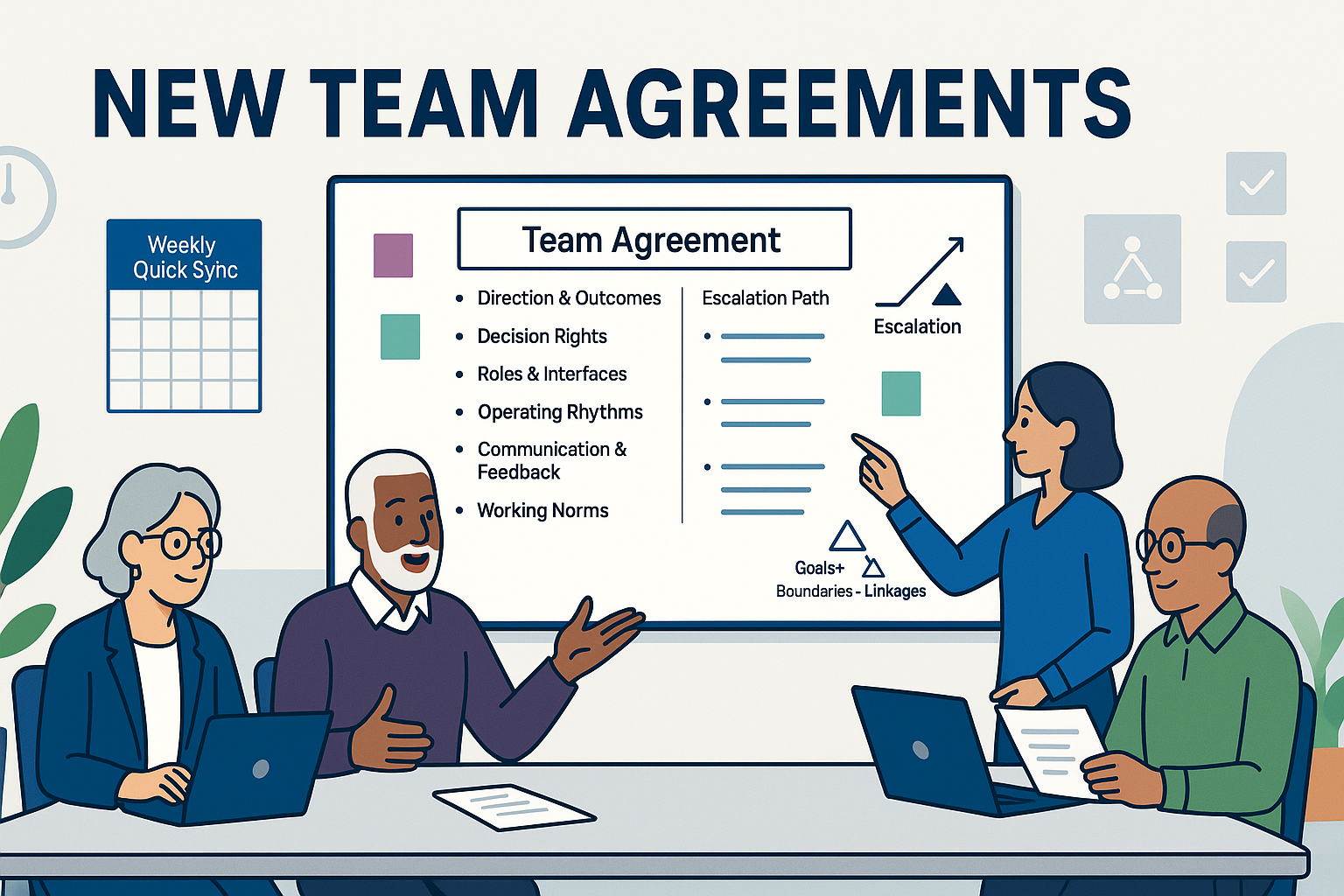
New Team Agreements: Build the Operating System Teams Use
If your team is misaligned and slow, you need new team agreements
If you lead a team that is smart but slow, busy but misaligned, and full of good people who somehow keep tripping over each other, the problem is not the people. It is the operating system. And yes, your team already has one. It was cobbled together through habits, hurried Slacks, and a few passive-aggressive calendar invites. You just did not design it. New team agreements are where you take control.
This is not about posters or platitudes. It is not a values workshop. It is the crisp, tactical, written set of rules for how we decide, deliver, and deal with friction. Get this right and you gain speed without chaos, autonomy without anarchy, and accountability without micromanagement.
Here is the brutal truth. Leaders often say they “trust” their teams, when in practice they are assuming people know expectations they have never made explicit. Trust without clarity is abdication. Trust with clear, agreed norms is empowerment you can scale. Make expectations explicit and you will unlock ownership, communication, and accountability fast .
What follows is a practical, field-tested playbook to design and deploy new team agreements in 90 minutes, and make them stick in one week.
What new team agreements are (and are not)
A new team agreement is a living, one-page contract that defines how the team will work. It codifies the minimum viable structure to create speed, quality, and safety. It is written in plain language, visible, and reviewed regularly.
It is not a policy manual, a values statement, or a meeting to-do list. It is the team’s operating system in explicit form. That includes decision rights, working norms, operating rhythms, and the edges of authority. When these are visible, you avoid the classic trap of confusing trust with unstated assumptions, and you foster active communication and accountability rather than passive oversight .
The anatomy of a high-performance team agreement
New team agreements are short. Aim for one page. They are specific. No jargon. They are practical. Every line should be observable in the way the team works.
1) Direction and outcomes
Your team needs a shared line of sight that connects work to outcomes. Tie your agreement to the few goals that matter now. Define outcomes in terms of value to users or stakeholders. When you define outputs, state deliverables as nouns not verbs. That frees the team to choose the best method while keeping the outcome in focus, which boosts accountability and speed . Use short cycles to reduce drift and commit to reviewing and adapting the plan together at the end of each cycle .
Use statements like:
- We prioritise work that moves our top two outcomes this quarter.
- We define deliverables as tangible outputs, not activity descriptions.
- We will plan work in short cycles and reserve the right to change course between cycles based on data.
2) Decision rights and escalation
Indecision kills momentum. Define who decides, how, and when to escalate. Write down the thresholds that trigger escalation and the path for doing it. This is a core element of any operating system: clear decision-making protocols and how they are communicated, plus known escalation routes to protect speed and reduce risk .
Use statements like:
- One named owner per decision. Contributors advise, the owner decides.
- Escalate cross-team blockers within 24 hours via our agreed path. If unresolved in 48 hours, escalate to the next level.
- Decisions are logged and shared in the channel for visibility.
3) Roles, responsibilities, and interfaces
Blurred interfaces create waste. Map the key hand-offs and declare who is accountable versus who is consulted or informed. Limit the number of cooks. Where teams intersect, define the boundary and the linkage. This is the difference between collaboration and collision .
Use statements like:
- For each recurring workflow, we name who is Responsible, Accountable, Consulted, and Informed.
- Before any hand-off, the owner confirms acceptance criteria and the definition of done.
- We maintain a visible map of our team interfaces so dependencies are not discovered late.
4) Operating rhythms
Rhythm beats intensity. Set a simple cadence and stick to it. Use a weekly Quick Sync to move work forward. Keep cycles short. Review together and adapt. Short cycles reduce drift. Frequent inspection of deliverables maintains focus and autonomy. A simple “Looking Back, Looking Up, Looking Forward” pattern helps everyone see progress, context, and next actions clearly .
Use statements like:
- Weekly Quick Sync: Progress, Problems, Plan in 20 minutes. Decisions and actions captured live.
- Two-week delivery cycles. We do not change goals mid-cycle except for true emergencies.
- End-of-cycle review focuses on deliverables, learning, and system tweaks, not blame .
5) Communication code and feedback
Teams need a shared language for how to speak, listen, and challenge. Define the invitations you expect from each other. Build psychological safety intentionally. The goal is a learning zone, not a comfort zone. Safety plus high standards is where growth happens .
Use statements like:
- We invite the right type of feedback: celebrate wins, shape ideas, critique work, confirm understanding, create safety.
- We ask great questions and assume positive intent. We debate the work, not the person.
- We run blameless debriefs. We focus on learning and next steps .
6) Working norms and constraints
Constraints focus creativity. Make boundaries explicit. Capture the tools you use, core hours for collaboration, and rules for responsiveness. Boundaries reduce risk and clarify freedom. They also stop tool sprawl and calendar chaos .
Use statements like:
- We use one channel per initiative. Decisions are captured in one log. No side agreements.
- Core collaboration hours: 10:00–16:00 UK. Outside these hours, response is best effort.
- We agree the definition of done for each deliverable before work starts.
Write it in 90 minutes: a practical workshop plan
Get the right people in the room. No spectators. You need the leader, the core team, and any regular cross-functional partners who get affected by your norms.
Materials:
- A single shared document visible to all.
- A blank one-page canvas with six sections: Direction & Outcomes, Decision Rights, Roles & Interfaces, Operating Rhythms, Communication & Feedback, Working Norms & Constraints.
Agenda (90 minutes):
- Set the frame (10 minutes)
State the purpose. This is our team’s operating system, not a nice-to-have. Make expectations explicit. What we write, we will live. - Draft fast, not perfect (35 minutes)
Split into pairs across the six sections. Write short, testable statements. Keep or cut. If it does not change behaviour on Monday, delete it. - Converge and commit (35 minutes)
Read it aloud. Challenge ambiguity. Assign a named owner for each line. Set inspection points. Agree when and how you will review it. - Finalise and publish (10 minutes)
Clean copy to one page. Link it from your team channel. Print it and put it on the wall if you are co-located.
Sample statements you can steal
Use these as raw material and adjust the edges to fit your context.
Direction & Outcomes
- We prioritise two outcomes at any time and deprioritise the rest.
- Every deliverable is named as a noun with clear acceptance criteria.
- We will change plan only at the end of a cycle unless data proves otherwise.
Decision Rights & Escalation
- Single owner per decision. We use an advice process and decide by a clear deadline.
- Escalation threshold is 2 days blocked or cross-team impact. Path is channel, then senior owner.
- Decisions and rationales are visible to the team.
Roles & Interfaces
- Each recurring process has a visible RACI model. No deliverable without an accountable owner.
- Interfaces with Team X and Team Y are documented. Owners meet fortnightly to clear dependencies.
Operating Rhythms
- Weekly Quick Sync: 20 minutes max. Update board, clear blockers, confirm plan.
- Delivery cycles are two weeks. End-of-cycle review focuses on outcomes and learning.
Communication & Feedback
- We name our invitation: celebrate, shape, critique, confirm, or safe space.
- We make it safe to ask for help and to admit mistakes. We default to curiosity over defensiveness .
- We run blameless debriefs using Start, Stop, Continue and capture actions .
Working Norms & Constraints
- One source of truth for plans and decisions. No screenshots of spreadsheets in chat.
- Core collaboration hours 10:00–16:00 UK. Outside that, response times vary by context.
- We protect 4 hours of focus per person per day. Meetings have a clear purpose or they do not happen.
Implementation plan: make it real in one week
- Day 1: Run the 90-minute workshop. Publish the one-pager. Name an owner for each line.
- Day 2: Align interfaces. Meet adjacent teams for 30 minutes to share key boundaries and linkages.
- Day 3: Stand up the cadence. Put the weekly Quick Sync and end-of-cycle reviews on the calendar .
- Day 4: Launch decision and escalation paths. Create the decision log and test an escalation case .
- Day 5: Do a mini-debrief. What is working. What to tweak. Confirm that owners are inspecting what they own .
Keep it alive: governance without bureaucracy
Agreements die when no one owns them. Appoint a rotating steward who inspects adherence fortnightly, gathers feedback, and proposes edits. Version your agreement. Sunset stale lines. If a line is ignored for two cycles, either enforce it or delete it.
Run blameless debriefs on real work to improve the system. Focus on what happened, what we learned, and what we change next. Avoid witch hunts. The point is to evolve the operating system in service of outcomes and health.
Avoid these common failure modes
- The novel, not the one-pager. If it is longer than a page, you will not use it.
- Aspirational fluff. If it cannot be observed on Monday, it does not belong.
- No inspection. A rule without inspection is a suggestion. Name owners and review.
- Tool fights. Pick one place for plans and decisions. Make it visible and stop context switching.
- Parallel everything. Operating rhythms exist to reduce overload, not to add theatre.
- Off-the-peg copying and sacred cows. Tailor to your context and challenge arbitrary constraints. Change fails when you import solutions uncritically or protect decisions with no rational basis .
Where this fits in the big picture
New team agreements are the connective tissue across the PerformanceNinja 6Ps. They align Purpose with People by translating intent into behaviours. They operationalise Process and drive Productivity through decision protocols, rhythms, and metrics. They protect Potential by setting boundaries that enable safe experimentation without derailing core work. They anchor your Proposition to how work is actually delivered. In short, they make your organisational system visible and usable .
Quick templates you can use today
Copy this skeleton into your doc and fill it in. Keep it to one page.
- Direction & Outcomes
Our two outcomes this quarter are:
We define deliverables as:
We plan in cycles of: - Decision Rights & Escalation
One owner per decision is:
Advice process looks like:
Escalation triggers and path: - Roles & Interfaces
RACI exists for these workflows:
Key interfaces and owners: - Operating Rhythms
Weekly Quick Sync slot is:
End-of-cycle review slot is:
We inspect adherence by: - Communication & Feedback
Our feedback invitations are:
Debrief method and cadence: - Working Norms & Constraints
Tools and sources of truth:
Core collaboration hours:
Definition of done is documented where:
The leadership promise
You can outsource tasks but not clarity. New team agreements are the promise you make to your people that you will create an environment where they can do the best work of their lives, together. Make it explicit. Keep it short. Inspect it relentlessly. Your team will repay you with speed, ownership, and performance.
References woven into the playbook
- Use short cycles to avoid drift and define deliverables, not process, which empowers teams and improves accountability. The practical cadence and review patterns come from proven sprint and Quick Sync practices that emphasise frequent check-ins and end-of-cycle learning .
- The communication code gives teams a shared language to invite the right type of conversation, which increases clarity and reduces defensiveness. This, combined with psychological safety, keeps teams in the learning zone where standards are high and people speak up .
- Decision-making protocols, escalation paths, and Goals–Boundaries–Linkages are foundational operating system elements. Make them explicit to reduce ambiguity, cut friction, and scale empowered execution .
Make this your team’s reality in the next week. Then keep improving it. That is how you shift from busy to effective, from effort to impact, from hope to high performance.
Next Steps
Want to learn more? Check out these articles:
Execution Discipline: How to Get Work Done Right, Every Week
Mastering Delegation: Essentials for Effective Team Leadership
Mastering High-Performance Team Coaching: A Blueprint
To find out how PerformanceNinja could help you, book a free strategy call or take a look at our Performance Intelligence Leadership Development Programme.