
Build a Weekly Leadership Rhythm That Actually Drives Execution
Most leaders think they have an execution problem.
They do not.
They have a rhythm problem.
Execution fails long before the work fails. It fails when priorities are unclear, when decisions are slow, when meetings are theatre, and when “accountability” means “we will ask again next week”. If your calendar is a junk drawer of reactive meetings, your organisation will behave exactly like one.
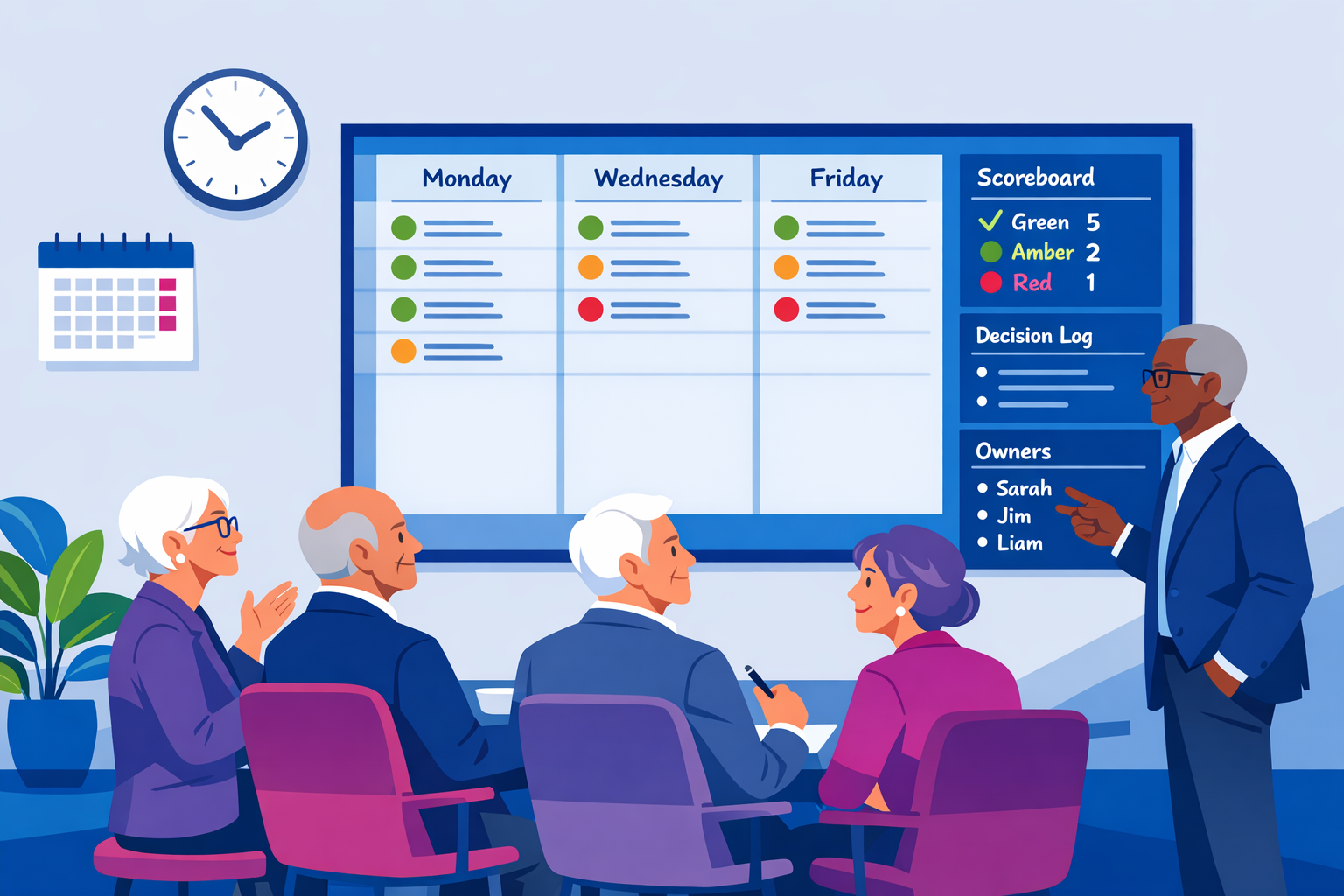
A weekly leadership rhythm is not a set of meetings. It is an operating system. It creates a predictable cadence for deciding, aligning, and following through. It prevents the most expensive form of waste in growing organisations, intelligent people working hard on the wrong things.
This article shows you how to build a weekly leadership rhythm that drives execution, without adding bureaucracy, without turning your week into an all-hands marathon, and without relying on heroics. You will get a practical blueprint, tight agendas, and rules that force clarity.
The brutal truth: your calendar is your strategy in disguise
Leaders love to say, “Execution is slipping.”
What they often mean is:
- We keep changing priorities and calling it agility.
- We make decisions late, then demand urgency from everyone else.
- We confuse updates with progress.
- We assign tasks, then never close the loop.
- We let the loudest issues hijack the week.
None of that is solved by “better communication”. It is solved by a rhythm that makes truth unavoidable.
In high-performing organisations, the leadership team does three things relentlessly:
- Decides quickly and clearly.
- Aligns the organisation to those decisions.
- Follows up until the outcome is delivered.
A weekly rhythm is simply the smallest repeatable system that guarantees those three things happen every week.
What a weekly leadership rhythm actually is (and isn’t)
Let’s be precise.
It is:
- A decision and delivery cadence that turns strategy into weekly commitments.
- A control loop that detects drift early and corrects course before failure becomes visible to customers.
- A mechanism for leadership truth where reality wins over optimism.
It is not:
- A set of “nice to have” meetings.
- A place for long updates that could be written.
- A forum for debate without decisions.
- A way to micromanage execution.
The purpose is simple: reduce the time between a problem appearing and leadership doing something intelligent about it.
Start with the big picture: the 6Ps that your rhythm must serve
A leadership rhythm only works if it reinforces the right system. At PerformanceNinja we look at the organisation as an integrated machine across six dimensions: Purpose, People, Proposition, Process, Productivity, and Potential.
Your weekly rhythm primarily lives in Productivity, but it must protect the other five:
- Purpose: Are we still aligned on why we exist and what winning looks like?
- People: Are we building leaders or burning them?
- Proposition: Are we delivering value customers will pay for?
- Process: Are the systems enabling or blocking delivery?
- Productivity: Are priorities, decisions, and commitments crystal clear?
- Potential: Are we innovating without distracting from the core?
If your weekly rhythm only chases urgent work, it will starve Purpose and Potential, and you will eventually lose your edge.
The symptoms you need a weekly rhythm (even if you deny it)
If you recognise any of the following, you are already paying the price:
- Work is “nearly done” for weeks because nobody is accountable for closing the last 10 percent.
- Cross-team delivery is painful and customers feel the seams.
- Leaders are surprised by delivery issues that were obvious to everyone else.
- Priorities change mid-week and people quietly stop trusting leadership direction.
- You have meetings about meetings because nobody knows where decisions happen.
- Great individual contributors are now leading but have no management system, just good intentions.
Growth makes these problems worse because complexity increases and informal coordination breaks. The “just walk over and sort it out” era ends. A rhythm is how you replace informal coordination with a system that scales.
The core design: four weekly sessions that create execution
You do not need 14 meetings. You need a small set with clear ownership, a strict purpose, and ruthless agendas.
Here is the weekly rhythm that works in most leadership teams from 20 to 500 people. Adjust the timings, keep the intent.
1) Monday: Leadership Direction (30 to 45 minutes)
Purpose: Set the week. Lock priorities. Remove ambiguity.
Attendees: CEO or GM, functional heads. Keep it to the true leadership team.
Inputs required (written, before the meeting):
- Top 5 outcomes for the week (proposed).
- Key risks and constraints.
- Customer commitments due in the next 14 days.
Agenda (tight):
- Reconfirm the “One Thing” for the week. If you cannot say it in one sentence, you do not have it. (5 minutes)
- Top outcomes review: accept, reject, or trade off. No “add more”. (10 minutes)
- Decision log: what decisions must be made this week, by whom, by when. (10 minutes)
- Blockers and resources: only items requiring leadership intervention. (10 minutes)
Rules that make it work:
- No verbal updates. If it is not a decision, a risk, or a blocker, it does not belong.
- Trade-offs are explicit. If you add a priority, you remove one.
- Every outcome has an owner and a measurable definition of done.
2) Mid-week: Execution Control (45 to 60 minutes)
Purpose: Detect drift early. Force follow-through. Keep promises.
Attendees: Same leadership team. Optionally invite owners of critical cross-functional outcomes for their item only.
Agenda:
- Scoreboard: outcomes on track, at risk, off track. (10 minutes)
- At risk and off track only: what changed, what is the constraint, what decision is needed. (30 minutes)
- Commitment refresh: updated owners, next actions, and due dates. (10 minutes)
Rules:
- Red is not bad. Red is truth. Hidden red is failure.
- No solutions without a constraint. Name the bottleneck first, then act.
- Decisions happen in the room or are scheduled within 24 hours with named deciders.
3) Thursday or Friday: People and Performance (45 minutes)
Purpose: Prevent “people problems” becoming delivery problems.
This is where many leadership teams fail. They treat people topics as soft, awkward, or “later”. Then attrition rises, weak leaders fester, and execution degrades.
Agenda:
- Heat map: where are we stretched, where are we stuck, where is performance slipping. (10 minutes)
- Two critical people situations: pick only two. Decide actions. (25 minutes)
- Leadership pipeline: who needs coaching, who needs clarity, who needs consequences. (10 minutes)
Rules:
- No vague complaints. Use observable behaviour and impact.
- Every issue ends with an action and a date to check back.
- Protect your standards. Tolerating poor leadership is a strategic decision, whether you admit it or not.
4) Friday: Weekly Close and Learning (20 to 30 minutes)
Purpose: Close loops. Learn. Improve the system.
Agenda:
- Commitment closeout: what shipped, what did not, and why. (10 minutes)
- One operational improvement: pick one friction point to fix. (10 minutes)
- Next week preview: known constraints and major deadlines. (5 minutes)
Rule: If you do not close loops weekly, you train the organisation that nothing really matters.
The artefacts: keep it boring, consistent, and impossible to dodge
Execution dies in ambiguity. Your rhythm needs a few simple artefacts that make the truth visible.
The Weekly Scoreboard (one page)
This is your central tool. It should include:
- 5 to 7 outcomes for the week. Not 20.
- Status: Green, Amber, Red with a one-line reason.
- Owner: a single name, not a team.
- Definition of done: measurable and binary where possible.
- Next milestone date for outcomes spanning multiple weeks.
If you cannot fit it on one page, you do not have priorities. You have hopes.
The Decision Log (living list)
Most organisations are not slow because people cannot work. They are slow because decisions are unclear.
Your decision log tracks:
- The decision to be made.
- The decider (one person).
- Contributors (optional).
- Due date.
- Decision made and date.
This single list removes weeks of passive-aggressive waiting.
The Commitment Tracker (task list for leaders)
Not a project plan. A leadership follow-through list.
- Commitment
- Owner
- Due date
- Status
The goal is not to track everything. The goal is to track the things leadership promised to do so the organisation can execute.
How to stop meetings becoming updates (the written-first rule)
If you want a weekly rhythm that drives execution, you must stop rewarding verbal performance.
Adopt a written-first standard:
- All updates are written and shared before the meeting.
- Meetings are for decisions and problem-solving, not narration.
- If it is not read, it does not exist. Keep pre-reads short and structured.
This is not about being corporate. It is about reducing noise and increasing signal. Amazon popularised the discipline of written narratives for a reason. It forces clarity and reveals weak thinking early.
The leadership behaviours that make the rhythm work
You can copy the meeting structure and still fail if leadership behaviour stays the same.
The rhythm requires a few non-negotiables.
1) Clarity over harmony
When a leader leaves the room thinking, “I do not fully agree, but I will act as if I do,” that is alignment. When they leave thinking, “That was messy but we stayed polite,” that is dysfunction.
Make disagreement safe and indecision unacceptable.
2) Accountability without blame
Accountability is not punishment. It is ownership.
Use this language:
- “What is the constraint?”
- “What changed since Monday?”
- “What do you need from us to get this done?”
- “By when?”
Avoid:
- “Why did you fail?”
- “How could you let this happen?”
- “We need to do better.”
Blame creates hiding. Hiding destroys execution.
3) Trade-offs are leadership’s job
If everything is a priority, your leaders have abdicated. People will choose their own priorities, and they will optimise for what is visible, easy, or locally rewarded.
Leadership must make the trade-offs explicit weekly.
4) Fast decisions beat perfect decisions
Most decisions are reversible. Treat them that way.
A simple rule:
- Reversible decisions: decide quickly with limited data.
- Irreversible decisions: slow down, get input, and document rationale.
This reduces bottlenecks and stops leaders becoming the constraint.
The hidden killer: misaligned horizons
Many leadership teams build a weekly rhythm and still feel like they are spinning.
One common reason is horizon mismatch.
- Some leaders are operating at a daily horizon, firefighting.
- Some are at a weekly horizon, delivering.
- Some are at a quarterly horizon, shaping.
A healthy leadership operating system includes all horizons, but in the right places. Your weekly rhythm is for weekly outcomes and near-term risks. Do not let it become a strategy debate. Put longer-term topics into a separate monthly or quarterly forum.
If you do not, you will either:
- Turn weekly execution meetings into abstract discussion, or
- Starve strategy until a crisis forces it back onto the agenda.
A simple weekly rhythm blueprint (copy this)
Here is a clean baseline you can adopt immediately.
Weekly cadence
- Monday 09:00 Leadership Direction (45 mins)
- Wednesday 11:00 Execution Control (60 mins)
- Thursday 16:00 People and Performance (45 mins)
- Friday 15:30 Weekly Close and Learning (30 mins)
Non-negotiable outputs each week
- One-sentence “One Thing” for the week.
- Weekly Scoreboard with 5 to 7 outcomes and owners.
- Updated Decision Log with due dates.
- Commitment Tracker with leadership actions.
This is enough to transform execution in most organisations within 30 to 60 days, assuming leaders actually use it.
Implementation plan (high-level, not theoretical)
Do not roll this out like a transformation programme. Start tight, then expand.
Week 1: Design and commit
- Choose the four sessions, times, and attendees.
- Build the first Weekly Scoreboard template and Decision Log.
- Agree the rules, especially written-first and trade-offs.
Weeks 2 to 3: Run it and tighten it
- Keep outcomes to 5 to 7 maximum.
- Track how many decisions are made and closed each week.
- Remove any agenda item that does not drive decisions or delivery.
Weeks 4 to 6: Embed accountability
- Introduce the People and Performance session if you skipped it initially.
- Start measuring predictability: planned outcomes vs delivered outcomes.
- Refine how work enters the scoreboard so priorities stop thrashing.
By week six, you should feel a reduction in chaos, fewer surprises, and sharper priorities. If you do not, the issue is usually leadership behaviour, not the system.
What “good” looks like after 90 days
A leadership rhythm is working when:
- Priorities are stable week to week and changes are explained as trade-offs.
- Decisions move quickly because deciders and deadlines are clear.
- Cross-team execution improves because blockers are addressed early.
- Leaders stop being surprised by delivery issues.
- Accountability feels normal, not confrontational.
- People issues reduce because they are handled directly and early.
The organisation becomes more predictable. That is not boring. That is power. Predictability creates capacity. Capacity creates growth.
Common mistakes (so you do not waste three months)
Most leadership rhythms fail for predictable reasons. Avoid these and you will be ahead of 90 percent of leadership teams.
Mistake 1: Too many priorities
If you have 14 “critical” outcomes, you have none. Pick fewer. Deliver more.
Mistake 2: No single owners
Shared ownership is a polite way of saying nobody owns it. Put one name next to each outcome.
Mistake 3: Treating red as failure
Red is information. Punish red and you will get fake green, then real failure.
Mistake 4: Letting leaders skip the rhythm
Attendance is not optional. If the leadership team does not take the rhythm seriously, nobody will.
Mistake 5: Confusing motion with progress
Busy is not productive. Updates are not delivery. Meetings are not execution. Outcomes are execution.
The final test: can your leaders answer these questions instantly?
If your weekly rhythm is doing its job, any leader should be able to answer these without looking nervous:
- What are the top outcomes for this week?
- Who owns each one?
- Which outcomes are at risk and why?
- What decision is blocking progress right now?
- What are we saying no to this week?
If you cannot answer those, you are not leading execution. You are watching it happen.
Build the rhythm. Enforce the rules. Tell the truth early. Execution will follow.
Next Steps
Want to learn more? Check out these articles:
New Team Agreements: Build the Operating System Teams Use
Execution Discipline: How to Get Work Done Right, Every Week
Mastering Delegation: Essentials for Effective Team Leadership
To find out how PerformanceNinja could help you, book a free strategy call or take a look at our Performance Intelligence Leadership Development Programme.