
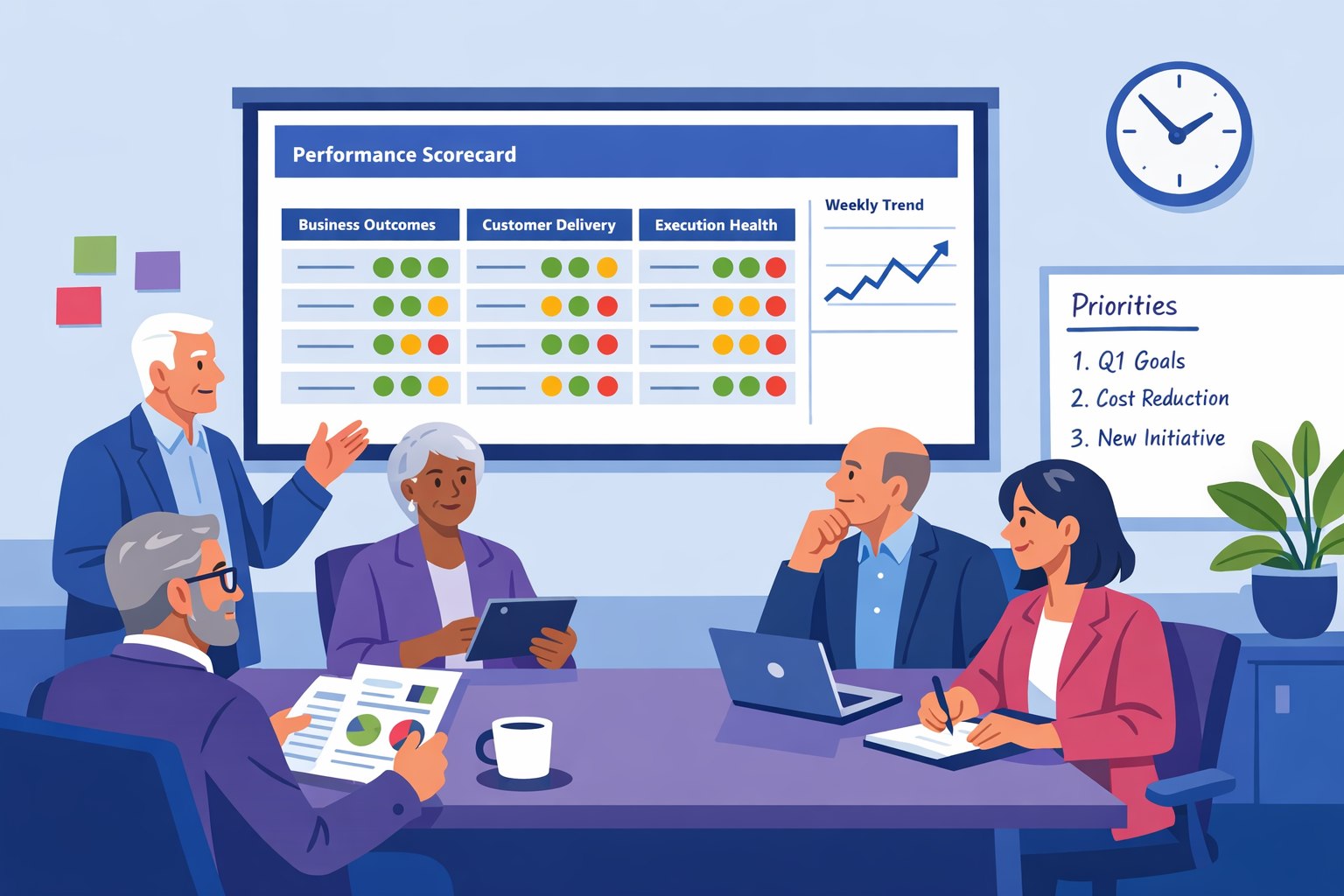
Leadership Scorecards That Actually Improve Team Performance
You already have a scorecard. It is just informal, inconsistent, and running on gut feel.
Every leader says they want accountability. What they often mean is they want people to “just get it done” without needing to manage the work. So they ask for KPIs, dashboards, OKRs, traffic lights, a weekly report. The organisation obliges. And then nothing changes.
Here is the brutal truth. Most leadership scorecards fail because they measure what is easy, not what is important. They track outputs without leading indicators. They reward local optimisation. They create theatre, not performance.
This article shows you how to create a leadership scorecard for team performance that leaders will actually use. One that forces clarity, drives the right conversations, and surfaces problems early enough to fix them.
You will walk away with a practical design, the exact categories to include, example measures, targets, and a weekly operating rhythm that turns a scorecard into results.
Why most “team performance” scorecards are useless
Let’s call out the usual failure modes. If any of these feel familiar, your current scorecard is not a management tool. It is a comfort blanket.
1) It is a dump of metrics, not a decision tool
Leaders do not need more numbers. They need fewer numbers that force decisions. A scorecard is successful when it changes what the leadership team talks about, what they prioritise, and what they stop doing.
2) It measures outcomes only, so it is always late
Revenue, margin, NPS, delivery dates, and churn are outcomes. When they go red, you are already in trouble. A leadership scorecard must include leading indicators that tell you the outcome is about to go red.
3) It confuses activity with productivity
Busy is not productive. Meetings attended, emails sent, tickets closed, and hours logged can all increase while value creation collapses. If the scorecard rewards activity, you will get activity. Nothing else.
4) It gets gamed
People do what you measure. If your measures can be “hit” while performance declines, your scorecard will train the organisation to lie to you. Not always intentionally. Often simply by optimising to survive.
5) It lacks ownership and cadence
A metric with no owner is a decoration. A metric reviewed monthly is a historical artefact. Team performance is a weekly sport.
What a leadership scorecard is actually for
A leadership scorecard is not a reporting mechanism. It is a leadership mechanism.
Done properly, it creates three outcomes:
- Alignment: everyone can see what matters now, and what “good” looks like.
- Accountability: owners are clear, follow-up is automatic, and excuses do not survive contact with data.
- Early warning: leading indicators trigger intervention before performance collapses.
If your scorecard is not producing these outcomes, redesign it.
The PerformanceNinja big-picture lens: the 6Ps
When scorecards fail, it is often because leadership tries to measure performance without acknowledging what creates performance. Team performance is an outcome of a system.
At a high level, that system can be viewed through the 6Ps:
- Purpose: do people understand what winning means?
- People: do we have the capability and behaviours required?
- Proposition: are we delivering value that customers actually want?
- Process: can we execute reliably, repeatedly, and at scale?
- Productivity: are we choosing the right work and finishing it?
- Potential: are we building tomorrow while delivering today?
You do not need a dozen measures for each P. But if your scorecard ignores one of these areas entirely, you will get blindsided.
The design rules: non-negotiables
Before we get into the template, set the rules. This is where most leaders get sloppy.
Rule 1: One page, maximum
If you need scrolling, it will not get used. The scorecard must fit on one screen or one printed page.
Rule 2: 8 to 12 measures total
More measures create noise and political bargaining. If everything is important, nothing is.
Rule 3: Every measure has an owner
Owner means: accountable for explaining movement, initiating corrective actions, and escalating blockers. Not “the person who reports it”.
Rule 4: Measures must be controllable
Teams should not be held accountable for metrics they cannot influence. Use outcome measures for context, but anchor accountability in leading indicators and controllable drivers.
Rule 5: Targets must be explicit
No “improve”, no “as soon as possible”, no “keep an eye on it”. Use thresholds. Use dates. Be uncomfortably specific.
Rule 6: Data freshness is part of the metric
A weekly scorecard with monthly data is self-deception. If the data cannot be refreshed weekly, it does not belong on the weekly scorecard.
The scorecard structure that works
Use four sections. This is the simplest structure that still covers the system.
- Business outcomes (2 to 3 measures)
- Customer value and delivery (2 to 3 measures)
- Execution health (2 to 3 measures)
- People and capability (2 to 3 measures)
That is it. You are not building a data warehouse. You are building leadership clarity.
Step-by-step: how to create a leadership scorecard for team performance
Step 1: Define “winning” in one sentence
If your leadership team cannot describe success in one sentence, your scorecard will become a battlefield of opinions.
Use this format:
- We win when [customer] gets [value] in [timeframe] with [quality], and the business achieves [commercial outcome].
Example:
- We win when mid-market clients get implementations live in under 30 days with minimal rework, and we grow recurring revenue without burning out the team.
Step 2: Select 2 to 3 outcome measures (context, not control)
Pick outcomes that matter to the organisation. Keep them few. These are the scoreboard, not the playbook.
Common examples:
- Revenue growth (weekly trend, monthly close)
- Gross margin (trend, by segment where possible)
- Client retention (logo retention, renewal rate)
- Cash conversion (DSO, cash runway for smaller firms)
Make sure at least one is a quality-of-revenue measure. Revenue alone can hide a lot of damage.
Step 3: Choose leading indicators that drive those outcomes
This is the heart of the scorecard. Leading indicators should be:
- Predictive: if this goes red, the outcome will follow.
- Actionable: the team can change it within a week or two.
- Hard to fake: it reflects reality, not narrative.
Examples of strong leading indicators by context:
- Sales: qualified pipeline coverage for the next 6 to 8 weeks, conversion rate between stages, time-to-first-response.
- Delivery: on-time milestone hit rate, rework percentage, number of blocked items older than 7 days.
- Support: first contact resolution, time to resolution by severity, backlog age profile.
- Product: cycle time from “ready” to “released”, escaped defects, adoption of top 3 features.
A useful rule: for every outcome, you need at least one “speed” driver and one “quality” driver.
Step 4: Add execution health measures (the system that produces results)
These measures sit in the Productivity and Process space. They make delivery reliable, not heroic.
Use 2 to 3 of the following, depending on your operating model:
- Plan reliability: % of committed work completed in the week (or sprint). Target: 80% to 90%. Less than 70% means planning is fiction.
- Work in progress: average number of active items per person or per team. Target should trend down, not up.
- Decision latency: time from decision request to decision made for cross-team dependencies. Target: 48 hours for routine decisions.
- Blocked work ageing: number of items blocked for more than 7 days. Target: near zero.
If you do not measure plan reliability or decision latency, do not be surprised when execution slips and everyone blames “priorities changing”.
Step 5: Add people and capability measures (without turning it into HR theatre)
Most leaders either ignore people metrics or drown in engagement surveys that arrive too late to act on. Keep it tight and operational.
Pick 2 to 3:
- Regrettable attrition: rolling 90-day count and trend. Target: explicitly stated.
- Leadership capacity: number of open leadership roles, span of control outliers, and “acting” roles older than 90 days.
- Capability coverage: top 5 critical skills, rated Red/Amber/Green with evidence (certifications, demonstrated delivery), not opinions.
- Burnout risk proxy: sustained overtime trend, on-call load, or leave balances not taken. Target: avoid chronic overload.
People problems rarely start as people problems. They start as system problems that people absorb until they cannot.
Step 6: Set thresholds, not vague targets
A target should trigger action. Use three bands.
- Green: within acceptable range.
- Amber: outside range, needs an intervention plan.
- Red: outside range and escalating, needs leadership attention now.
Example thresholds:
- Plan reliability: Green 80% to 90%, Amber 70% to 79%, Red below 70%.
- Blocked work ageing: Green 0 to 3, Amber 4 to 7, Red 8+.
- First response time: Green under 2 hours, Amber 2 to 6 hours, Red over 6 hours.
Do not set targets based on wishful thinking. Set them based on what “good” looks like in your context, then tighten them gradually.
Step 7: Assign owners and define the weekly question
Every metric needs a single named owner. Not a department. Not a committee.
And each metric needs a standard weekly question so the conversation is consistent. Examples:
- Pipeline coverage: “Are we covering next month’s target with enough qualified pipeline, or are we hoping?”
- Plan reliability: “Why did we miss what we committed to, and what will we change this week?”
- Rework %: “What is causing rework, and which fix removes the cause not the symptom?”
- Decision latency: “Which decision is stuck, who owns it, and what is the deadline?”
This prevents meetings becoming storytelling sessions.
Step 8: Build the scorecard in a format people will use
Use a simple table. No dashboards required. You can build it in Excel, Google Sheets, Notion, or your BI tool. The format matters more than the platform.
Minimum columns:
- Metric
- Definition (one line, no ambiguity)
- Owner
- Target (Green/Amber/Red thresholds)
- This week
- Last week
- Trend (up/down/flat)
- Comment (one sentence)
- Action (if Amber/Red, what is changing by when)
Keep comments brutally short. If it needs a paragraph, it belongs in an action plan, not on the scorecard.
A sample leadership scorecard (use this as your starting point)
Below is an example for a professional services or delivery-heavy organisation. Adapt it to your context, but keep the shape.
Business outcomes
- Revenue (rolling 4-week) | Owner: Commercial lead | Target: as per plan | Why: outcome context
- Gross margin % (rolling 4-week) | Owner: Ops lead | Target: Green 40%+, Amber 35% to 39%, Red below 35%
Customer value and delivery
- On-time milestone hit rate | Owner: Delivery lead | Target: Green 90%+, Amber 80% to 89%, Red below 80%
- Rework % (hours spent fixing avoidable issues) | Owner: Quality owner | Target: Green under 10%, Amber 10% to 15%, Red over 15%
- Client health (top 10 accounts Red/Amber count) | Owner: Account lead | Target: Green 0 to 1, Amber 2 to 3, Red 4+
Execution health
- Plan reliability (% committed work completed) | Owner: Team lead | Target: Green 80% to 90%
- Decision latency (median hours) | Owner: COO or equivalent | Target: Green under 48h
People and capability
- Regrettable attrition (rolling 90-day) | Owner: CEO or People lead | Target: explicit number
- Leadership capacity gaps (roles acting 90+ days) | Owner: CEO | Target: Green 0, Amber 1, Red 2+
This is nine measures. Notice what is not here: vanity metrics, “happiness” scores with no operational link, and arbitrary activity counts.
The operating rhythm: how to make the scorecard change behaviour
A scorecard without a cadence is a spreadsheet. The cadence is the mechanism.
The weekly 30-minute scorecard review (tight, disciplined)
Run it the same time every week. Same agenda. Same rules.
- 3 minutes: confirm outcomes (no discussion unless a major anomaly).
- 20 minutes: review leading indicators and execution health. Only discuss Amber/Red.
- 5 minutes: agree corrective actions, each with an owner and deadline.
- 2 minutes: confirm what will be communicated to the wider team.
Two rules that keep this meeting effective:
- No problem-solving in the room unless it is a fast fix. Identify the issue, assign the fix, set the deadline.
- No narrative without a number. If someone claims “it’s improving”, ask what metric shows that.
The monthly “system” review (60 to 90 minutes)
Weekly reviews keep the ship steady. Monthly reviews improve the ship.
Once per month, ask:
- Which metric has been persistently Amber/Red?
- What is the root cause, across the 6Ps?
- What structural change will remove the constraint? (process, role clarity, decision rights, tooling, capability)
This is where leadership earns its keep. Not by tracking work, but by removing systemic barriers.
Hard lessons: what to avoid when you build your scorecard
Avoid mixing individual performance with team performance
A leadership scorecard is for team performance. Individual performance management belongs in one-to-ones and role scorecards. Mixing them creates politics and defensive reporting.
Avoid a scorecard that depends on heroics
If your scorecard is green only when people work nights and weekends, you are not managing performance. You are consuming people. That bill always comes due.
Avoid letting “strategy” live outside the scorecard
If strategy is real, it shows up in measures. If it does not show up, it is theatre. Include one measure that reflects strategic progress, such as adoption of a new proposition, expansion into a target segment, or innovation throughput. Keep it measurable, not aspirational.
Avoid setting targets without definitions
“Client health” is meaningless without a definition. “Blocked” is meaningless unless you define what counts as blocked. Ambiguity is how scorecards get gamed.
A brief implementation plan (two weeks, not two quarters)
You do not need a transformation programme to implement this. You need decisiveness.
Week 1: Design
- Write the one-sentence definition of winning.
- Select 2 to 3 outcomes and 6 to 9 leading indicators.
- Define each metric in one line and set Green/Amber/Red thresholds.
- Assign owners.
Week 2: Run it for real
- Publish the first scorecard even if imperfect.
- Hold the first weekly review with strict timeboxing.
- Capture actions and follow-up the next week.
- At the end of week two, remove any metric that did not drive a useful conversation.
Your first version will not be perfect. That is fine. What is not fine is waiting for perfection while performance drifts.
The litmus test: does your scorecard force leadership?
A leadership scorecard is not there to make you feel informed. It is there to make you uncomfortable in the right way.
When it is working, you will notice:
- Fewer surprises at month end.
- Faster escalation of real blockers.
- Less “busy work”, more finished work.
- Cleaner handovers across teams.
- Clearer ownership and fewer circular debates.
If you do not get those outcomes, your scorecard is not a scorecard. It is a report.
Build the scorecard that tells the truth, every week. Your team will not always like it, but they will respect it. And your customers will feel the difference.
Next Steps
Want to learn more? Check out these articles:
Reduce Meeting Overload in Leadership Teams Without Losing Control
Cross-Functional Collaboration: Fix Friction, Speed Delivery, Build Trust
Build a Weekly Leadership Rhythm That Actually Drives Execution
To find out how PerformanceNinja could help you, book a free strategy call or take a look at our Performance Intelligence Leadership Development Programme.