
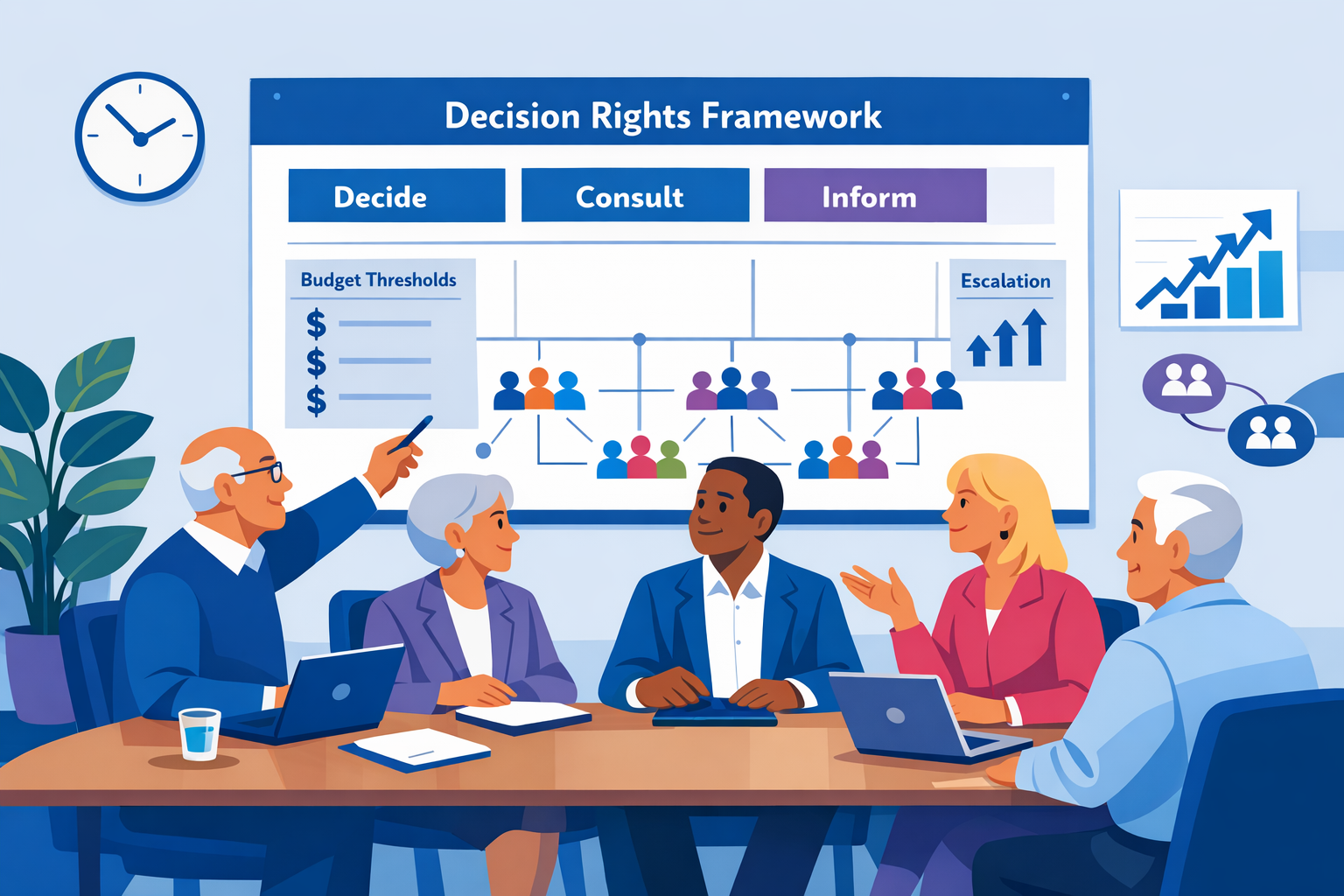
Decision Rights Frameworks for Growing Teams Without Bureaucracy
You do not have a decision-making problem. You have a decision rights problem.
In the early days, decisions happen by proximity. You are in the room, you know the context, you can pull the lever. Fast. Clean. Founder-led.
Then the team grows. More specialists. More managers. More “quick questions”. Suddenly every decision becomes a meeting, every meeting becomes a forum, and every forum becomes a slow-motion veto.
And here is the brutal truth.
If you do not explicitly define who owns which decisions, your organisation will default to the worst possible operating system:
- The loudest person wins
- The most senior person gets dragged in
- The most anxious person escalates
- The most political person stalls
- The most tired person says “fine”
A decision rights framework fixes that. Not with more process. With clarity. It is one of the highest ROI moves a growing leadership team can make because it removes ambiguity at the exact point where execution is born: the decision.
This article shows you exactly how to create a decision rights framework for growing teams, without turning your company into a bureaucracy factory.
What a decision rights framework actually is (and is not)
A decision rights framework is a written, shared agreement that defines:
- Which decisions matter (not every micro-choice)
- Who has the right to decide (the “D”)
- Who must be consulted (input that improves the decision)
- Who must be informed (to execute and align)
- How conflicts are resolved (when two owners collide)
It is not a giant RACI spreadsheet nobody reads. RACI can help, but most teams implement it backwards: they document tasks rather than decision points. That is why it becomes a painful admin exercise with no impact.
Decision rights is different. It is about control of levers, not assignment of labour.
Why growing teams choke on decisions
Decision speed drops as headcount rises because complexity rises faster than capability.
In small teams, coordination is informal. In bigger teams, informal coordination becomes:
- Meetings that replace ownership
- Slack threads that replace accountability
- “Alignment” that replaces judgement
Most senior leaders tell themselves a comforting lie: “We just need better communication.”
No. You need fewer people involved in decisions, with clearer authority, and a defined way to gather input without surrendering control.
The symptoms of broken decision rights (use this as your diagnostic)
If you recognise these, your decision rights are already broken. You are just calling it something else.
1) Everything escalates to the same few people
This is the classic founder bottleneck, or the “executive magnet” effect. Decisions get dragged upwards because nobody feels safe owning the call.
Root cause: people are accountable for outcomes but lack authority to decide.
2) You have more meetings, but execution keeps slipping
Meetings are not alignment. They are often a substitute for ownership.
Root cause: decisions are being socialised endlessly because there is no agreed decision owner.
3) People weaponise stakeholders
“We need to get Legal’s sign-off.” “Finance will never go for that.” “Ops needs to review.”
Sometimes that is true. Often it is a stall tactic.
Root cause: unclear consult vs approve boundaries.
4) Teams redo work because decisions are reversible, but treated as sacred
Many decisions should be fast and reversible. Yet teams treat them like constitutional amendments.
Root cause: no decision classification (one-way vs two-way doors).
5) Accountability is diluted
When ten people “own” a decision, nobody owns it. That is not collaboration. That is a liability shield.
Root cause: consensus culture masquerading as teamwork.
The principles: how to design decision rights without creating bureaucracy
You are trying to achieve two things that feel in conflict:
- Speed in day-to-day execution
- Control where risk, spend, brand, or people are involved
The answer is not more approvals. The answer is a system that allocates authority to the right level, with guardrails.
Principle 1: Assign decisions to roles, not people
People change. Roles persist.
Write: “Head of Sales decides discount policy within guardrails.” Not “Sarah decides”.
Principle 2: Use the minimum number of decision-makers
For most decisions, you need:
- One decider
- A small set of consulted experts
- A clear group to inform
If you have two deciders, you have a negotiation. If you have three, you have politics.
Principle 3: Separate “input” from “permission”
Being consulted does not mean having veto power.
This single distinction is where most growing companies collapse, because they confuse inclusion with safety.
Principle 4: Push decisions down, but keep escalation clean
Decisions should be made at the lowest competent level, with a defined escalation path for exceptions.
Exception handling is the safety valve that prevents bureaucracy.
Principle 5: Treat decision rights as an operating system, not a document
The document is the artefact. The real work is in:
- How decisions get prepared
- How fast decisions get made
- How decisions get communicated
- How decisions get executed and reviewed
The PerformanceNinja lens: decision rights sit inside Productivity
At PerformanceNinja, we look at organisational performance through six lenses: Purpose, People, Proposition, Process, Productivity, Potential.
Decision rights lives primarily in Productivity, because it is how you align and monitor what gets done. But it touches everything:
- Purpose: decisions must reinforce strategy, not personal preference
- People: capability determines how far down you can push authority
- Process: guardrails and workflows prevent chaos
- Potential: innovation needs fast, bounded decisions, not endless approval chains
This is why decision rights is not an HR exercise or a governance exercise. It is a performance exercise.
How to create a decision rights framework for growing teams
This is the method. It is practical, lightweight, and built for teams that need speed.
Step 1: Identify your “vital decisions” (20 is plenty)
Start by listing the decisions that:
- Consume the most leadership time
- Create the most conflict between teams
- Have the highest risk if wrong
- Are repeated often, meaning you keep re-litigating them
Do not document everything. That is how you create a compliance museum. Focus on the levers.
Examples of vital decisions in growing teams:
- Pricing and discounting boundaries
- Product roadmap trade-offs
- What qualifies as a “must-fix” incident
- Hiring approvals and headcount changes
- Client acceptance criteria and contract exceptions
- Marketing claims and brand positioning changes
- Tooling and platform choices
- What work gets deprioritised when capacity is hit
Step 2: Classify decisions by reversibility and risk
This prevents you from over-engineering low-risk calls.
Use a simple 2x2:
- Two-way door, low risk: decide fast, document lightly
- Two-way door, high risk: decide fast, but involve experts
- One-way door, low risk: rare, but still be deliberate
- One-way door, high risk: executive-level decision with prepared input
A one-way door decision is hard to reverse, like a major brand repositioning, a big platform migration, or a permanent policy that changes margins.
A two-way door decision is reversible, like testing a new onboarding email sequence or trialling a process for two weeks.
Step 3: Choose your decision model (use RAPID or “D/C/I”)
You need a consistent language.
Two options that work:
- RAPID (Recommend, Agree, Perform, Input, Decide): useful where cross-functional decisions are common
- D/C/I (Decide, Consult, Inform): simpler, faster, often enough for scale-ups
Most growing teams should start with D/C/I for speed and only upgrade to RAPID where “Agree” is legally or financially required.
Step 4: Define decision rights with guardrails, not handcuffs
Decision rights without guardrails is chaos. Guardrails without decision rights is bureaucracy.
Guardrails should be specific and measurable. Examples:
- Discounts up to 10%: Sales Manager decides. 10% to 20%: Head of Sales decides after consulting Finance. Above 20%: CFO decides.
- Hiring within approved headcount plan: functional leader decides. Headcount plan changes: CEO decides after consulting Finance.
- Product scope changes that impact launch date: Product Lead decides after consulting Engineering Lead and Customer Success Lead.
Notice what is happening here.
You are not adding approvals for everything. You are creating thresholds that only trigger escalation when the organisation is taking a real risk.
Step 5: Write the “decision record” format (one page)
The fastest teams do not just decide quickly. They also remember quickly.
Create a standard decision record template that lives in a shared place. Keep it short:
- Decision: what was decided, in one sentence
- Owner: who decided
- Date
- Context: what problem we are solving
- Options considered: 2 to 3 lines each
- Key trade-offs: what we are sacrificing
- Guardrails: boundaries and thresholds
- Next actions: who does what by when
- Review date: when we will evaluate outcomes
This removes the most common poison in growing teams: circular debates caused by missing context.
Step 6: Build the escalation path (and make it boring)
Your escalation path should not be emotional. It should be mechanical.
Define:
- What qualifies as an escalation (thresholds)
- Who it escalates to
- How fast the escalation must be resolved (SLA)
- What information must be provided to escalate
Example: “If two functional leads disagree and cannot resolve within 48 hours, it escalates to the COO with a one-page decision record and a recommended option from each lead.”
No drama. No endless meetings. No “let’s circle back”.
Step 7: Make it real with three high-friction decisions first
Do not roll this out as a grand governance initiative. That screams bureaucracy and people will resist.
Instead, pick three decisions that are currently painful, such as:
- Roadmap trade-offs
- Discounting
- Hiring priorities
Define rights, thresholds, consult lists, and escalation paths. Use them immediately. Then expand.
Decision rights examples you can copy and adapt
Below are practical patterns that show how this works in real organisations.
Example 1: Product roadmap trade-offs
- Decide: Product Lead
- Consult: Engineering Lead, Customer Success Lead, Head of Sales
- Inform: Marketing Lead, Support Lead
- Guardrails: must align to quarterly objectives, cannot exceed agreed capacity allocation without escalation
- Escalation: if scope change impacts committed delivery dates, COO decides
This prevents the roadmap from becoming a democracy while ensuring the right voices shape the call.
Example 2: Client contract exceptions
- Decide: Head of Commercial
- Consult: Legal, Finance, Delivery
- Inform: Account team, Ops
- Guardrails: liability caps above X, payment terms above Y days, or bespoke SLAs trigger CFO/CEO escalation
This protects margin and delivery capability without slowing every deal.
Example 3: Incident severity and customer comms
- Decide: Incident Commander (role)
- Consult: Engineering on-call lead, Support lead
- Inform: Customer Success, Marketing/Comms
- Guardrails: severity definitions are fixed, customer update cadence is defined by severity
This stops panic escalation and inconsistent messaging.
Common mistakes (and how to avoid them)
Mistake 1: Confusing “consult” with “agree”
If everyone must agree, you have built a veto machine.
Fix: explicitly state who has veto rights and why. Veto should be rare and tied to specific risks (legal, financial control, safety).
Mistake 2: Documenting everything
Over-documentation is a symptom of low trust.
Fix: start with vital decisions only. Expand based on pain, not ideology.
Mistake 3: Assigning decision rights to the most senior role by default
This creates bottlenecks and trains helplessness.
Fix: push down decisions that are repeatable and bounded by guardrails.
Mistake 4: Leaving decision rights out of team onboarding
New leaders will import decision habits from their last company. That creates inconsistency fast.
Fix: include decision rights and escalation paths in leadership onboarding and team charters.
Mistake 5: Not reviewing decisions after the fact
A framework without feedback becomes dogma.
Fix: add review dates for major decisions and do short retrospectives: did we decide fast enough, and did we decide well?
A brief implementation plan (high-level, no fluff)
You can implement this in 30 days without derailing delivery.
Week 1: Diagnose and select vital decisions
- Run a 60-minute leadership session to list decision bottlenecks
- Select the top 10 to 20 vital decisions
- Classify each as one-way or two-way door
Week 2: Define rights and guardrails
- Assign D/C/I (or RAPID) for each vital decision
- Define thresholds for escalation
- Create the one-page decision record template
Week 3: Pilot on three decisions
- Use the framework for three real decisions immediately
- Time the decisions from start to finish
- Capture confusion points and adjust
Week 4: Roll out and operationalise
- Publish the framework in your operating handbook
- Train leaders in a single 45-minute session
- Add a monthly review of decision health (speed, quality, escalation volume)
If you cannot make it work in 30 days, your issue is not the framework. It is leadership alignment and willingness to let go.
How to know it is working
Do not rely on vibes. Track simple signals:
- Decision cycle time: time from problem surfaced to decision made
- Escalation rate: number of escalations per week, and why
- Rework rate: decisions reversed due to missing input
- Execution throughput: commitments delivered on time
- Meeting load: meetings created purely to “align”
When decision rights clicks, you will feel it immediately. Less noise. Fewer pings. Cleaner handoffs. More momentum.
The punchline: clarity is not control, it is freedom
Growing teams do not fail because people are incompetent. They fail because the organisation refuses to choose.
A decision rights framework is your way of choosing, on purpose:
- Who decides what
- How input is gathered
- When escalation is required
- How you move fast without breaking things that matter
If you want agility, stop worshipping “alignment” and start engineering authority.
Write the rights down. Put thresholds around risk. Make escalation boring. Then let your leaders lead.
Next Steps
Want to learn more? Check out these articles:
Map the Flow of Work: A Leader’s Blueprint for Speed
Stop Alignment Drift: Cross-Team Clarity, Rhythm, Ownership
Decision Rigour: Make Fewer, Faster, Better Calls That Stick
To find out how PerformanceNinja could help you, book a free strategy call or take a look at our Performance Intelligence Leadership Development Programme.