
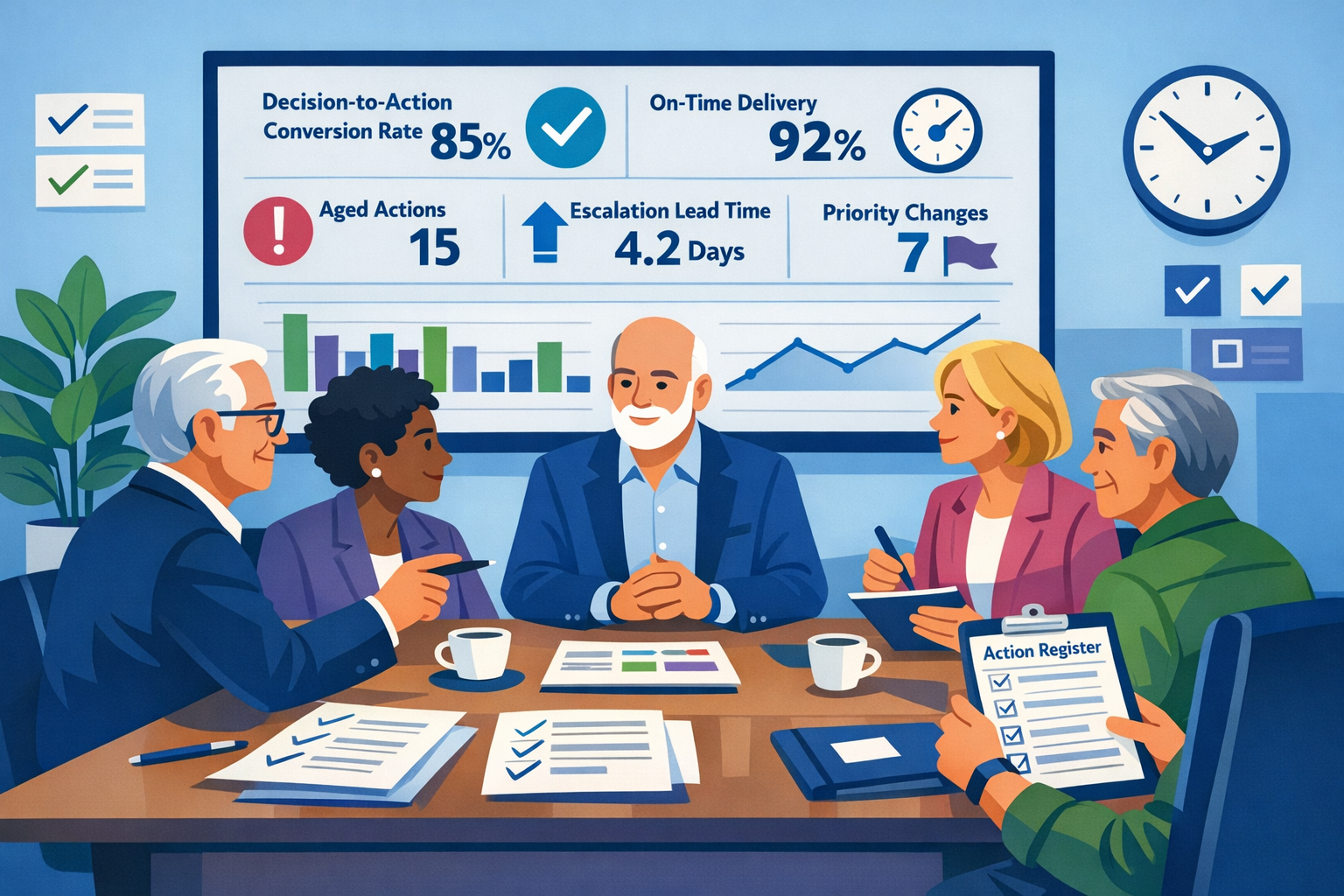
How to Measure Execution Discipline in Leadership Teams
Most leadership teams think they have an execution problem.
They do not.
They have a measurement problem. They are judging “discipline” by vibes, anecdotes, and the emotional weather in the weekly meeting. Then they act surprised when delivery slips, priorities drift, and “strategic” work becomes an unpaid overtime hobby.
Execution discipline is not a personality trait. It is an observable operating standard.
And if you cannot measure it, you cannot manage it. You will default to what most organisations do.
More meetings. More trackers. More urgency theatre.
This article shows you exactly how to measure execution discipline in a leadership team using a practical scorecard, clear definitions, and behavioural signals you can audit. No fluffy maturity models. No performative “accountability culture” posters. Just metrics that expose the truth and force better leadership.
What execution discipline actually is (and what it is not)
Execution discipline is the leadership team’s ability to repeatedly convert decisions into outcomes, with minimal leakage between intent and action.
It is not:
Working hard
Being busy
Having lots of initiatives
Hitting a number once through heroic effort
It is:
Making clear decisions
Assigning single-point ownership
Delivering on time and to the agreed definition
Following up without drama
Escalating early when reality changes
Killing or pausing work when priorities shift
If you want a blunt test, ask this.
When your leadership team leaves a meeting, does the organisation become more aligned, or just more informed?
Alignment produces execution. Information produces noise.
Why leadership teams lose execution discipline as they scale
Execution discipline fails for predictable, boring reasons. The bigger the organisation gets, the more these dynamics compound.
1) Decision volume outgrows decision quality
Senior leaders start making too many decisions in too little time, with too little clarity. The outcome is “decisions” that are really suggestions.
2) Ambiguity becomes socially acceptable
People stop asking “who owns this?” because it feels confrontational. So ownership becomes shared, which means it becomes fictional.
3) Meetings become a substitute for management
Leaders confuse discussion with progress. The calendar fills, delivery does not.
4) Trade-offs become politically expensive
As functions grow, saying “no” creates conflict. So leaders say “yes” and pay later in missed deadlines and burnt teams.
5) Nobody measures the actual operating system
Most organisations measure results. Few measure the system that produces results. When results dip, they panic. When results rise, they get complacent. Either way, they never build discipline.
So measure the operating system.
The Execution Discipline Scorecard (what to measure)
You need a scorecard that covers the full chain.
Decision quality → commitment quality → delivery reliability → follow-through → learning.
Use the measures below as a baseline. Then tune thresholds to your context.
Measure 1: Decision-to-Action Conversion Rate (DACR)
What it tells you: whether leadership decisions result in real, owned actions.
How to calculate it:
In each leadership meeting, count “decisions” made.
Count how many decisions were converted into a documented action with owner, deadline, and definition of done within 24 hours.
DACR = (Decisions with complete actions / Total decisions) × 100
Benchmarks:
90 to 100%: disciplined
70 to 89%: inconsistent
Below 70%: your meetings are largely performative
Brutal truth: if a “decision” does not produce a named owner and a date, it is not a decision. It is a conversation.
Measure 2: Single-Point Ownership Rate
What it tells you: whether your team is serious about accountability.
How to calculate it:
Review all actions created by the leadership team in a month.
Count actions with exactly one accountable owner (not a committee, not “Ops”, not “we”).
Ownership Rate = (Actions with one owner / Total actions) × 100
Benchmark: 95%+.
Shared ownership is fine for execution support. It is catastrophic for execution accountability.
Measure 3: On-Time Delivery Rate (OTD) with a real definition of “done”
What it tells you: whether your leadership team keeps commitments.
How to calculate it:
Track commitments made by the leadership team and its direct reports.
Count what was delivered by the committed date.
Only count it as delivered if it meets the agreed definition of done.
OTD = (On-time deliveries / Total due deliveries) × 100
Important: “Done” must be explicit. “Reviewed”, “progressed”, “socialised”, and “in motion” are not deliverables. They are coping mechanisms.
Benchmark guidance:
80 to 90%: strong in complex environments
60 to 79%: execution is fragile
Below 60%: commitments are not real, and everyone knows it
Measure 4: Replan Integrity (how often deadlines are moved)
What it tells you: whether your team plans honestly and adapts responsibly.
How to calculate it:
Count the number of times due dates are changed after commitment.
Track the reason code for each change.
What “good” looks like:
Deadlines move sometimes because reality changes.
Deadlines do not move casually because leaders overpromised.
Reason codes you should use:
New external constraint (customer, regulator, supplier)
Dependency slipped (name the dependency)
Scope increased (who approved)
Capacity misestimated (what assumption was wrong)
Priority changed (who changed it)
If “capacity misestimated” dominates, you have a planning and honesty problem, not an effort problem.
Measure 5: Aged Actions (work that rots in the system)
What it tells you: whether the leadership team closes loops or leaves a trail of half-decisions.
How to calculate it:
Define “aged” as actions overdue by 14 days (or one cadence cycle).
Count the number of aged actions and the proportion of total open actions.
Benchmark: aged actions should be rare and aggressively managed. If your list is full of stale actions, your leadership team is teaching the organisation that deadlines are optional.
Measure 6: Escalation Lead Time (how early bad news travels)
What it tells you: whether leaders surface risk early or hide it until it explodes.
How to calculate it:
For each missed commitment, identify when the owner first knew it was at risk.
Identify when it was first escalated to the leadership team.
Escalation Lead Time = Escalation date minus first-known-at-risk date
Benchmark: the best teams escalate within days, not weeks. Fast escalation is not negativity. It is professionalism.
Measure 7: Meeting-to-Outcome Ratio
What it tells you: whether your leadership time produces outcomes or just talk.
How to calculate it:
Track total hours spent by the leadership team in recurring execution-related meetings each month.
Track the number of completed outcomes (delivered commitments) created by those meetings.
Analyse outcomes per meeting hour.
No single benchmark fits every business. But trends matter. If meeting hours rise and outcomes per hour fall, your operating system is degrading.
Measure 8: Strategic Focus Integrity (the “stop starting” index)
What it tells you: whether the leadership team can hold focus long enough to win.
How to measure it:
Count active “must-win” priorities for the quarter.
Count priority changes mid-quarter (additions, removals, major redefinitions).
Rules of thumb:
Most leadership teams can execute 3 to 5 true priorities at once.
If you have 12, you have none.
If priorities change weekly, execution discipline is impossible because leadership is destabilising the system.
What to measure inside the leadership team, not just around it
Many leaders try to measure “execution” only through project status. That is lazy. You also need to measure leadership behaviours that predict delivery.
Behavioural signal 1: Clarity at the point of commitment
Audit a sample of leadership actions each month and score each action (0 or 1) on whether it includes:
Clear outcome (what will exist when done)
Single accountable owner
Due date
Dependencies named
Success metric or acceptance criteria
This is not admin. This is discipline.
Behavioural signal 2: Trade-off language
Disciplined leadership teams speak in trade-offs. Undisciplined teams speak in hopes.
Listen for:
“If we do X, we are explicitly not doing Y this quarter.”
“To fund this, we will stop Z.”
“The constraint is capacity, so we are reducing scope.”
If your leaders cannot say what they are stopping, they are not prioritising. They are accumulating.
Behavioural signal 3: Clean handoffs and closed loops
Disciplined leaders do not throw work over the fence.
They:
Confirm understanding
Confirm resourcing assumptions
Set review points
Close the loop when complete
You can measure this via action ageing, rework frequency, and the number of “clarification” cycles required per action.
The root causes your measurements will reveal (and what to do)
Metrics are only useful if they force decisions. Here is what your scorecard will typically expose and how strong leadership teams respond.
If DACR is low: you have decision fog
Symptoms: “Let’s see”, “We should”, “Can we”, and “Someone should look at” dominate your meeting notes.
Fix: redefine what counts as a decision. Use three decision types only:
Commit (we will do this, by this date, owned by this person)
Defer (we are not deciding now, we will decide on this date with these inputs)
Decline (we are not doing this)
Everything else is discussion. Treat it that way.
If OTD is low but effort is high: you have unrealistic planning
Symptoms: constant late nights, heroic saves, rising burnout, and still missed commitments.
Fix: stop asking for estimates, start asking for options:
Option A: full scope, later date
Option B: reduced scope, original date
Option C: same scope and date, but we drop this other commitment
Leaders must choose. Do not let teams absorb leadership indecision as personal stress.
If aged actions are high: you have weak follow-through norms
Symptoms: action lists that look like graveyards, with the same items appearing for months.
Fix: implement a zero-tolerance rule for stale work:
If overdue, the owner must do one of three things in the next meeting: deliver, re-commit with a new date and reason code, or kill it.
Silence is not an option.
If escalation lead time is slow: you have fear and politics
Symptoms: surprises, last-minute scrambles, and leaders “finding out” after it is too late.
Fix: create an explicit escalation standard:
Escalate when risk is above an agreed threshold (for example, more than 20% chance of missing date or outcome).
Escalation must include a proposal, not just a problem.
Disciplined teams normalise early warning. Undisciplined teams punish it.
If focus integrity is low: you have leadership thrash
Symptoms: constant new priorities, shifting narratives, and teams that stop believing any priority will last.
Fix: cap priorities and enforce a change control rule:
Any new “must-win” priority requires one existing priority to be paused or killed.
Priority changes must be documented with rationale and impact.
This is where the big picture matters. Using PerformanceNinja’s 6Ps lens, execution discipline usually fails at the intersection of Purpose (unclear strategic intent) and Productivity (weak alignment and follow-up mechanisms), and it is then amplified by Process issues (unclear decision rights, messy handoffs) and People patterns (conflict avoidance, low ownership).
Do not “fix execution” by shouting. Fix the system that makes execution predictable.
Build your execution discipline dashboard (simple and ruthless)
You do not need an enterprise tool. You need a standard and a cadence.
Build a one-page dashboard with these sections:
Commitment Health: OTD, aged actions, replan count
Decision Health: DACR, ownership rate
Risk Health: escalation lead time, top risks with owners
Focus Health: active priorities, mid-cycle changes
Review it every week in 15 minutes. Not as a status update. As a leadership mirror.
The point is not to look good. The point is to get better.
A brief implementation plan (30 days to measurable discipline)
Week 1: Define standards and instrument the system
Agree definitions: what counts as a decision, what counts as done, what counts as escalation.
Create a single action register used by the leadership team.
Start tracking DACR, ownership rate, OTD, aged actions.
Week 2: Enforce commitment hygiene
Introduce reason codes for replans.
Ban vague actions.
Make owners state dependencies and success measures.
Week 3: Install follow-through norms
Run a weekly 15-minute execution review.
For every overdue item, force: deliver, re-commit with rationale, or kill.
Week 4: Fix the biggest constraint you uncovered
If planning is the issue, reduce scope and cap WIP.
If decision fog is the issue, tighten decision rights and meeting structure.
If fear is the issue, mandate early escalation with proposals.
After 30 days, your numbers will tell you if discipline is improving. Not your feelings. Not your intent. Not your story.
The leadership reality nobody wants to say out loud
Execution discipline is a leadership attribute before it is an organisational attribute.
If the leadership team regularly:
makes ambiguous decisions
assigns fuzzy ownership
tolerates overdue commitments
changes priorities without trade-offs
then the rest of the organisation will follow that example perfectly.
Not because your people are bad.
Because your system is teaching them what “normal” looks like.
Measure the discipline. Expose the gaps. Fix the operating system. Then watch execution stop being a drama and start being a capability.
Next Steps
Want to learn more? Check out these articles:
Diagnose Business Barriers Before Growth Stalls: A Leader’s Guide
Quarterly Business Reviews for Scaling Teams That Actually Work
Execution Discipline in Scaling Teams: How to Fix Slippage Fast
To find out how PerformanceNinja could help you, book a free strategy call or take a look at our Performance Intelligence Leadership Development Programme.