
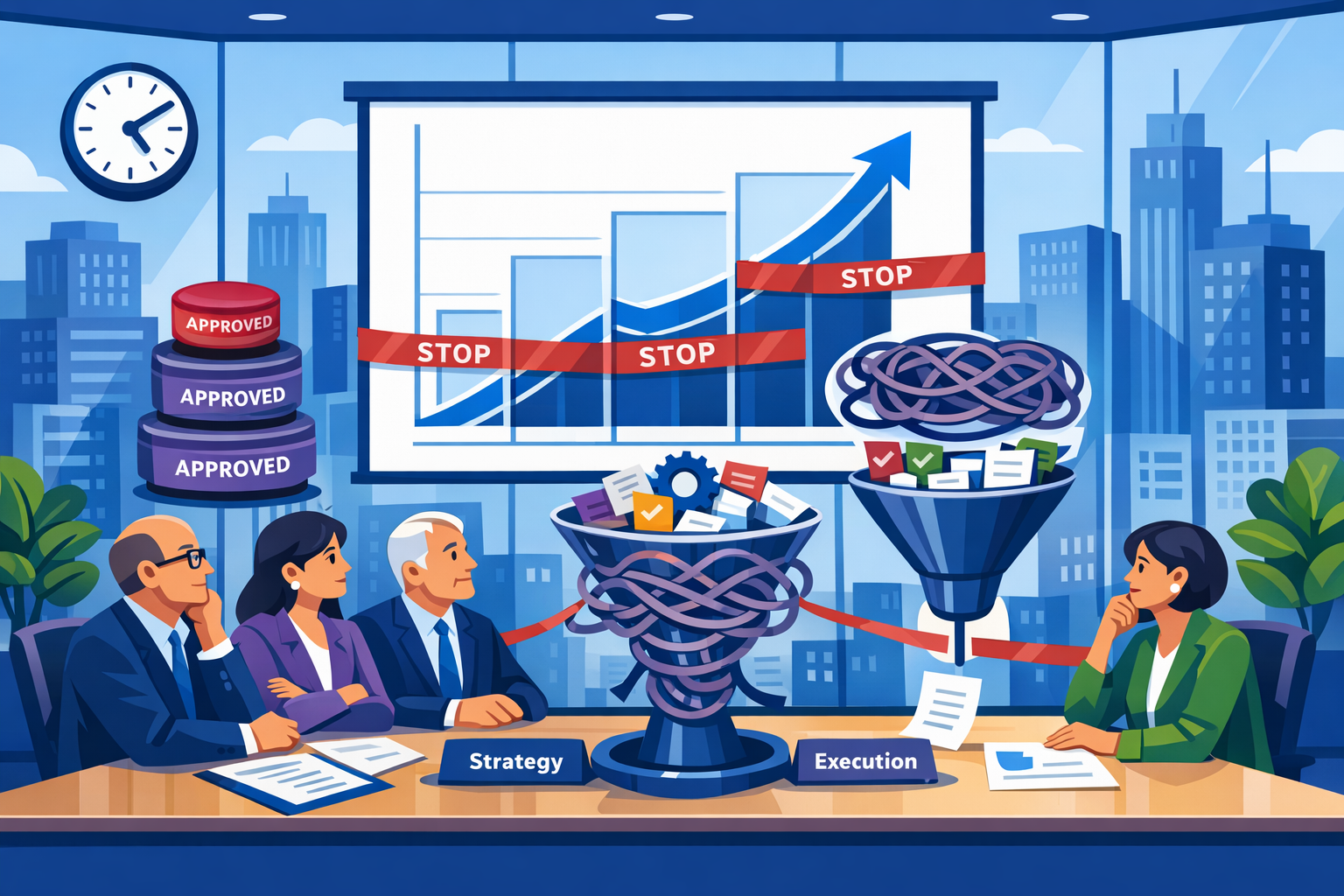
How Leadership Teams Create Hidden Barriers to Business Growth
Your growth problem is probably not the market.
It is not your product. Not your pricing. Not even your competitors.
It is your leadership team. Not because they are incompetent, but because they are human. They build systems to cope. They create rules to reduce risk. They make compromises to keep the peace. Then they call it “maturity”.
From the outside, it looks like a sensible organisation.
On the inside, it feels like moving through wet concrete.
This is how leadership teams create hidden barriers to business growth: not through one big bad decision, but through dozens of small, reasonable choices that quietly strangle speed, accountability, and customer obsession.
This article will show you where those barriers hide, how to spot them fast, and what to do about them without triggering a political war at the top.
The brutal truth: growth slows when leadership gets “busy”
When a business is small, growth is a contact sport. Customers shout, leaders hear it, and decisions happen quickly. When the business grows, leaders get “busy” and start managing abstractions instead of outcomes. They talk about “alignment” while avoiding hard choices. They create governance instead of clarity.
Most growth barriers built by leadership teams come from three instincts:
- Risk avoidance disguised as “due diligence”.
- Harmony seeking disguised as “collaboration”.
- Status preservation disguised as “strategy”.
You do not fix this with another offsite. You fix it by designing leadership behaviours and operating rhythms that force the truth to surface.
Hidden barrier #1: Priority soup (everything matters, so nothing moves)
If you have more than five “top priorities”, you have none. Leadership teams often create a long list because it feels inclusive and safe. Nobody has to lose. Nobody has to say no.
The result is predictable:
- Teams start too many things.
- Nothing finishes.
- Work in progress piles up.
- Delivery slows, quality drops, and people burn out.
And then leadership says, “We need to execute better.” No, you need to choose better.
How to spot it
- Every department has a different view of “the priorities”.
- Senior leaders routinely introduce new initiatives mid-quarter.
- Your roadmap is a wishlist, not a commitment.
- People say, “We are juggling a lot right now” as if it is a virtue.
What to do instead
Force trade-offs at the top, in public, and in writing.
- Set 3 enterprise priorities for the next 90 days. Not themes. Outcomes.
- Define what you will not do. A stop-doing list is not optional.
- Assign a single accountable owner per priority. One throat to choke, one person to empower.
- Cap work in progress. If you cannot finish, you cannot start.
This is not motivational. It is mechanical. It changes behaviour because it changes constraints.
Hidden barrier #2: Decision theatre (meetings replace decisions)
Leadership teams love meetings because meetings create the illusion of progress. People talk, slides move, everyone is “consulted”. Then nothing happens because nobody actually decided.
Decision theatre is what happens when leaders confuse discussion with commitment.
It creates two toxic outcomes:
- Decisions slow down, so teams stall or make local decisions that later get overturned.
- Trust erodes, because people learn that leadership “says yes” but does not back it with action.
There is strong evidence that decision effectiveness is a major differentiator of organisational performance, with faster and higher quality decision processes linked to better outcomes (for example, McKinsey research on decision making effectiveness).
How to spot it
- Meetings end with “let’s take that offline”.
- Actions are vague and unowned.
- Decisions get revisited repeatedly with the same participants.
- Leaders privately complain about decisions they publicly agreed to.
What to do instead
Install a decision system that makes ambiguity painful.
- Use explicit decision types. Is it a recommendation, a commitment, or a ratification?
- Define decision rights. Who decides, who must be consulted, who must be informed.
- Write decisions down in a single log. Date, decision, owner, rationale, constraints, review trigger.
- Timebox reversibility. If it is reversible, decide fast. If it is irreversible, decide carefully once.
Most leadership teams do not have a decision problem. They have a decision design problem.
Hidden barrier #3: False alignment (agreement in the room, sabotage outside it)
Some leadership teams are “high alignment” only inside the meeting. The moment people leave, they re-litigate the decision with their own teams. They leak doubt. They add conditions. They delay.
It is not always malicious. Often it is cowardice.
Leaders avoid healthy conflict in the room, so the conflict simply moves into the corridor.
Research by Lencioni and many others on team dysfunctions is clear on the pattern: absence of trust drives fear of conflict, which drives artificial harmony, which drives weak commitment.
How to spot it
- Decisions are constantly “misunderstood” by different departments.
- Middle managers ask, “Is this really happening?” after leadership announcements.
- Leaders use phrases like “I hear you” instead of taking a position.
- There is a strong blame culture but weak direct debate.
What to do instead
Make commitment observable.
- End key meetings with a commitment round. Each leader states what they will do, by when, and what they will communicate.
- Require dissent in the room. If nobody disagrees, you are not thinking hard enough.
- Use “disagree and commit”. Once decided, leaders stop lobbying and start executing.
- Inspect communication. Ask teams what they heard. If it differs, fix it immediately.
Alignment is not a feeling. It is a set of actions that can be verified.
Hidden barrier #4: The accountability vacuum (ownership is blurry by design)
In many leadership teams, accountability is avoided because it feels “too harsh”. So work is assigned to committees, shared ownership, or cross-functional groups with no real authority.
This produces a vacuum. Work floats. Nobody drives it. Everyone is busy.
Meanwhile, your best people learn a lesson: performance does not matter, politics does.
How to spot it
- Projects have steering groups but no empowered owner.
- Delivery dates slip without consequence.
- Leaders say, “It is complex” when asked who is accountable.
- There is lots of reporting but little corrective action.
What to do instead
Reintroduce crisp accountability without becoming punitive.
- Name a DRI (directly responsible individual) for every strategic initiative.
- Separate “help” from “own”. Contributors support, the owner delivers.
- Run weekly execution reviews. Focus on commitments, blockers, next actions.
- Apply consequences. Not drama. Consequences like de-scoping, reassigning ownership, or stopping work.
If your operating system cannot hold a missed commitment, it is not an operating system. It is a diary.
Hidden barrier #5: Customer distance (leaders stop hearing reality)
Growth stalls when leadership teams lose direct contact with customers and frontline work. Leaders start believing their own narratives. They talk about “value” while customers talk about pain.
This happens subtly:
- Sales and service become “the customer people”.
- Product and ops report through layers.
- Leadership metrics become internal rather than external.
Once that happens, leaders over-invest in internal optimisation and under-invest in what customers will actually pay for.
How to spot it
- Senior leaders cannot describe your top five customer objections.
- Customer feedback is summarised, filtered, and sanitised.
- NPS or satisfaction is tracked, but churn reasons are vague.
- Leaders are surprised by lost deals.
What to do instead
Force leadership to confront customer truth on a schedule.
- Mandate customer contact. Each executive does a minimum number of customer calls per month.
- Listen to raw data. Actual call recordings, verbatim survey comments, real emails.
- Track “customer promises”. What did we commit to, did we deliver, what broke.
- Build a closed-loop learning system. Insight leads to a change in proposition, process, or people capability.
The fastest way to improve strategy is to improve what leaders pay attention to.
Hidden barrier #6: Process creep (bureaucracy as a substitute for leadership)
Process is not the enemy. Unowned complexity is.
As organisations scale, leadership teams often respond to mistakes by adding steps, approvals, and forms. It feels responsible. It also quietly kills speed.
Every new gate is a tax on growth.
How to spot it
- Approvals multiply, but risk does not drop.
- People spend more time explaining work than doing work.
- “Compliance” becomes a default reason to delay.
- High performers complain they cannot get anything done.
What to do instead
Design process like an engineer: minimum viable control.
- Audit approvals. List every approval required for key workflows. Remove at least 30%.
- Push authority down. Set guardrails, then let teams decide within them.
- Standardise only what repeats. Do not standardise exception handling.
- Measure cycle time. Track how long work takes from request to delivery, then optimise.
Bureaucracy is often just leadership refusing to make clear calls about acceptable risk.
Hidden barrier #7: Talent compression (leaders hoard decisions and starve successors)
Many leadership teams claim they want empowerment. Then they behave like everything important must go through them.
This creates talent compression:
- Middle leaders cannot grow because they cannot decide.
- Senior leaders become the bottleneck.
- The business becomes dependent on a few people.
It feels like control. It is actually fragility.
How to spot it
- Senior leaders routinely “fix” problems their teams should own.
- Escalations are constant and celebrated.
- High potential leaders leave due to lack of autonomy.
- Leadership says, “Nobody else can do it like us.”
What to do instead
Build leaders, not followers.
- Define delegation levels. Recommend, decide with sign-off, decide autonomously.
- Train for judgement. Do not just delegate tasks. Delegate decisions and the context behind them.
- Protect decision space. If someone makes a reasonable call, back them even if it is imperfect.
- Hold leaders accountable for successor capability. If your bench is weak, that is leadership work not HR work.
Your growth ceiling is often your leadership capacity ceiling.
Hidden barrier #8: Innovation theatre (lots of ideas, no pipeline)
Leadership teams often say they want innovation. Then they treat it like a side project. They run hack days, collect ideas, and celebrate creativity. But there is no pipeline, no funding model, and no clear criteria for scaling or killing initiatives.
So innovation becomes noise. Worse, it distracts from core delivery.
How to spot it
- Many initiatives start, few reach customers.
- There is no definition of what “good” looks like for innovation.
- Teams argue about priorities between core work and new bets.
- Innovation relies on heroic individuals, not a system.
What to do instead
Create a simple innovation operating model.
- Define three horizons. Core improvements, adjacent extensions, new bets.
- Set explicit funding bands. Small experiments do not need executive-level approval.
- Use kill criteria. If the hypothesis fails, stop quickly and learn.
- Assign product ownership. Every innovation effort needs a clear owner and a path to scale.
Innovation is not inspiration. It is disciplined throughput.
The big picture: where the 6Ps framework helps
When leadership teams create hidden barriers, they rarely appear in one place. They show up as cross-contamination across the organisation.
The fastest diagnostic is to examine the system through six lenses:
- Purpose: Is the leadership narrative clear enough to drive trade-offs, or vague enough to justify anything?
- People: Do leaders have the skills and behaviours to debate, decide, and execute without politics?
- Proposition: Is the customer value sharp, or are you internally focused and feature-led?
- Process: Are systems enabling throughput, or creating drag through approvals and handovers?
- Productivity: Do you have a real execution rhythm, or a calendar full of status updates?
- Potential: Is innovation a managed portfolio, or a collection of pet projects?
You do not need a massive transformation programme. You need a clear view of where the friction is being manufactured, and the courage to remove it.
A brief implementation plan (30 days to start removing barriers)
If you want momentum quickly, do this in the next month. It is high-level by design, but not optional.
Week 1: Expose reality
- Run a leadership barrier audit: top 10 blockers to growth, written, ranked, owned.
- Map decision flow for three critical decisions (pricing, hiring, customer escalation). Identify delays and rework.
- Collect frontline truth: 10 customer complaints, 10 lost deal reasons, 10 internal frustrations unfiltered.
Week 2: Install constraints
- Set three 90-day enterprise priorities with owners and measurable outcomes.
- Create a stop-doing list and announce it.
- Start a decision log and publish it internally.
Week 3: Build the execution rhythm
- Run a weekly exec execution review focused on commitments, not updates.
- Define decision rights for your top recurring decision types.
- Remove at least 30% of approvals from one core workflow.
Week 4: Lock in behaviour change
- Mandate customer contact for every executive and report learnings.
- Introduce a commitment round in leadership meetings.
- Reassign ownership for any initiative without a single accountable owner.
This is how you break the pattern: you change the system the leadership team operates inside, so different behaviour becomes the path of least resistance.
Final word: the barrier is rarely “out there”
Senior teams love to talk about external constraints: the economy, competitors, talent shortages, regulation.
Yes, those matter.
But the hidden barriers that kill growth are usually internal, and leadership-made:
- Too many priorities.
- Too few decisions.
- Too much process.
- Too little truth.
If you want growth, stop looking for the next clever strategy. Start removing the friction your leadership team has normalised.
Because nothing is more expensive than a leadership team that accidentally builds a business designed not to grow.
Next Steps
Want to learn more? Check out these articles:
Remove Barriers to Business Growth in Scaling Teams Fast
Build a Leadership Cadence That Scales Teams Without Chaos
Scale-Ready Structure: Build Clarity, Flow and Resilience
To find out how PerformanceNinja could help you, book a free strategy call or take a look at our Performance Intelligence Leadership Development Programme.