
Build a Leadership Cadence That Scales Teams Without Chaos
Introduction
If your team is scaling, your calendar is already telling you the truth.
You have more meetings than ever, yet fewer decisions stick. Work is “busy”, but delivery is slipping. People are unclear on priorities, but nobody wants another alignment session. Managers are promoted, but they are not leading. They are forwarding messages and running interference.
That is not a motivation problem. It is a cadence problem.
A leadership cadence is not “more meetings”. It is the operating rhythm that turns strategy into execution, keeps accountability clean, and stops the organisation from fragmenting into well-intentioned silos.
If you do not design it, you will get one by default. It will be noisy, reactive, political, and exhausting.
This article shows you how to create a leadership cadence for scaling teams that is fast, disciplined, and scalable. No theatre. No corporate fog. Just a system senior leaders can run.
What “leadership cadence” actually means (and what it is not)
A leadership cadence is a deliberately designed set of recurring forums, decision rules, and information flows that:
- Align leaders on what matters now
- Convert priorities into owned deliverables
- Surface risks early
- Make decisions at the right level
- Reinforce culture through consistent behaviours
A cadence is not:
- A meeting schedule that grows like mould
- Weekly “updates” where everyone performs competence
- A PMO forcing templates on leaders who do not trust it
- A substitute for strategy
When scaling teams, cadence becomes the organisation’s nervous system. If it is weak, every problem takes longer to detect and longer to fix.
The scaling trap: why execution collapses as headcount grows
Scaling breaks the assumptions that made the early team effective.
At 10 people, alignment is ambient. Everyone hears everything. Decisions travel instantly. At 30, you can still brute-force communication. At 80, brute force becomes bureaucracy.
Here is what actually changes:
- Communication paths explode. Every new team creates new interfaces where things can drop.
- Context fragments. People are working hard, but on different interpretations of “the plan”.
- Decision latency rises. Simple calls wait for the “right meeting”.
- Accountability blurs. Work becomes shared, which often means owned by nobody.
- Culture dilutes. Not because people are bad, but because reinforcement is inconsistent.
A strong cadence is how you replace ambient alignment with engineered alignment.
The outcomes your cadence must produce (or it is pointless)
Before you design forums, be brutal about what you need the cadence to deliver. For scaling teams, your cadence must produce these outcomes every week and every month:
- One set of priorities that leaders can repeat without improvising.
- Fast decisions with clear decision owners and deadlines.
- A single source of truth for commitments, risks, and progress.
- Clean escalation paths so problems move up quickly without creating drama.
- Stable execution where delivery does not depend on heroic individuals.
If you cannot point to where each outcome happens in your operating rhythm, you do not have a cadence. You have meetings.
Design it using the 6Ps lens (big picture, not bureaucracy)
PerformanceNinja’s 6Ps framework is useful here, not as a checklist, but as a way to ensure your cadence is not lopsided.
- Purpose: Are leaders repeatedly connecting work to the why and the non-negotiables?
- People: Are managers being developed through the cadence, or just dragged through it?
- Proposition: Are you reviewing customer value, not just internal activity?
- Process: Are handovers and dependencies being actively managed?
- Productivity: Are priorities, decisions, and follow-up being forced into clarity?
- Potential: Are you protecting innovation from being suffocated by delivery pressure?
Most scaling organisations over-index on Productivity and ignore Potential until growth stalls. A good cadence prevents that.
The core rule: separate forums by purpose, not by seniority
Most leadership teams fail here. They build a cadence around who attends, not what the forum is for.
Your cadence must separate:
- Execution review (are we delivering what we said?)
- Decision making (what must we decide now?)
- Strategic thinking (what must change in the plan?)
- People and culture (are we building the leadership capacity we need?)
When you mix these, you get the worst of all worlds:
- Execution gets hand-wavy
- Decisions get deferred
- Strategy gets rushed
- People issues become gossip
The minimum viable leadership cadence for scaling teams
You do not need 14 forums. You need a small set that leaders treat as sacred.
Below is a proven “minimum viable cadence” that scales from 30 to 300 people with sensible adjustments.
1) Daily: Team-level 10 minute stand-up (execution only)
Purpose: Maintain momentum and surface blockers fast.
Rules:
- Same time, same place, 10 minutes.
- Three questions only: What did I deliver? What will I deliver next? What is blocked?
- No problem solving in the stand-up. Blockers are taken offline.
Output: A visible blocker list owned by the team lead.
2) Weekly: Functional leadership huddle (45 minutes)
Purpose: Run the function, not talk about running it.
Attendees: Head of function plus direct reports.
Agenda:
- Commitments due this week (5 minutes)
- Metrics and leading indicators (10 minutes)
- Top risks and cross-team dependencies (15 minutes)
- Decisions required and owners (10 minutes)
- Comms cascade and key messages (5 minutes)
Non-negotiables:
- Every action has one owner and a due date.
- If it is not written down, it does not exist.
3) Weekly: Cross-functional delivery meeting (60 minutes)
Purpose: Resolve dependencies and unblock delivery across teams.
This is where scaling teams either become a machine or become a mess.
Attendees: Owners of the key workstreams plus an empowered chair.
Focus areas:
- Dependencies: what needs something from another team this week?
- Trade-offs: what must be de-scoped or delayed to protect the critical path?
- Decision log: what decisions are needed, by when, and by whom?
Rule: This meeting is not a status parade. It is a dependency resolution engine.
4) Weekly: Senior leadership priorities review (60 to 90 minutes)
Purpose: Keep the top of the house aligned and accountable.
Inputs required:
- A single page scorecard
- A list of priorities (no more than 5)
- A decision queue
- A risk register (top 10 only)
Agenda:
- Scorecard and signals (15 minutes)
- Priority progress and slippage (20 minutes)
- Decisions and trade-offs (20 minutes)
- Risks and escalations (15 minutes)
- Message for the organisation (10 minutes)
Hard truth: If your senior team spends less time deciding than reporting, you are running a theatre troupe.
5) Fortnightly or monthly: 1:1s for leaders (45 to 60 minutes)
Purpose: Develop leaders and prevent people problems from becoming operational failures.
Structure:
- Performance: outcomes, commitments, gaps
- Capability: what the leader must learn next
- Capacity: what to stop, what to delegate
- Team health: conflict, engagement, retention risk
This is where you stop promoting great individual contributors into failing managers.
6) Monthly: Strategy and resource review (2 to 3 hours)
Purpose: Adjust direction and resourcing based on reality.
Topics to cover:
- What is changing in the market and customer feedback?
- What is now the constraint: sales, delivery, quality, recruitment, cash?
- Are we investing in the proposition or just servicing the backlog?
- What should be stopped?
A scaling business that never stops anything is a business that will eventually stop everything.
7) Quarterly: Offsite for strategic choices (half day to two days)
Purpose: Make the hard calls you avoid in weekly meetings.
This is where you:
- Re-confirm Purpose and the few strategic bets
- Rebalance the portfolio between core delivery and Potential
- Stress-test the operating model
- Make leadership and organisation design changes
If you do not create a forum for real choices, you will make those choices accidentally, through neglect.
The artefacts that make cadence work (without bureaucracy)
A cadence fails when it relies on memory, charisma, or “good communication”. You need light but firm artefacts.
The four artefacts you need
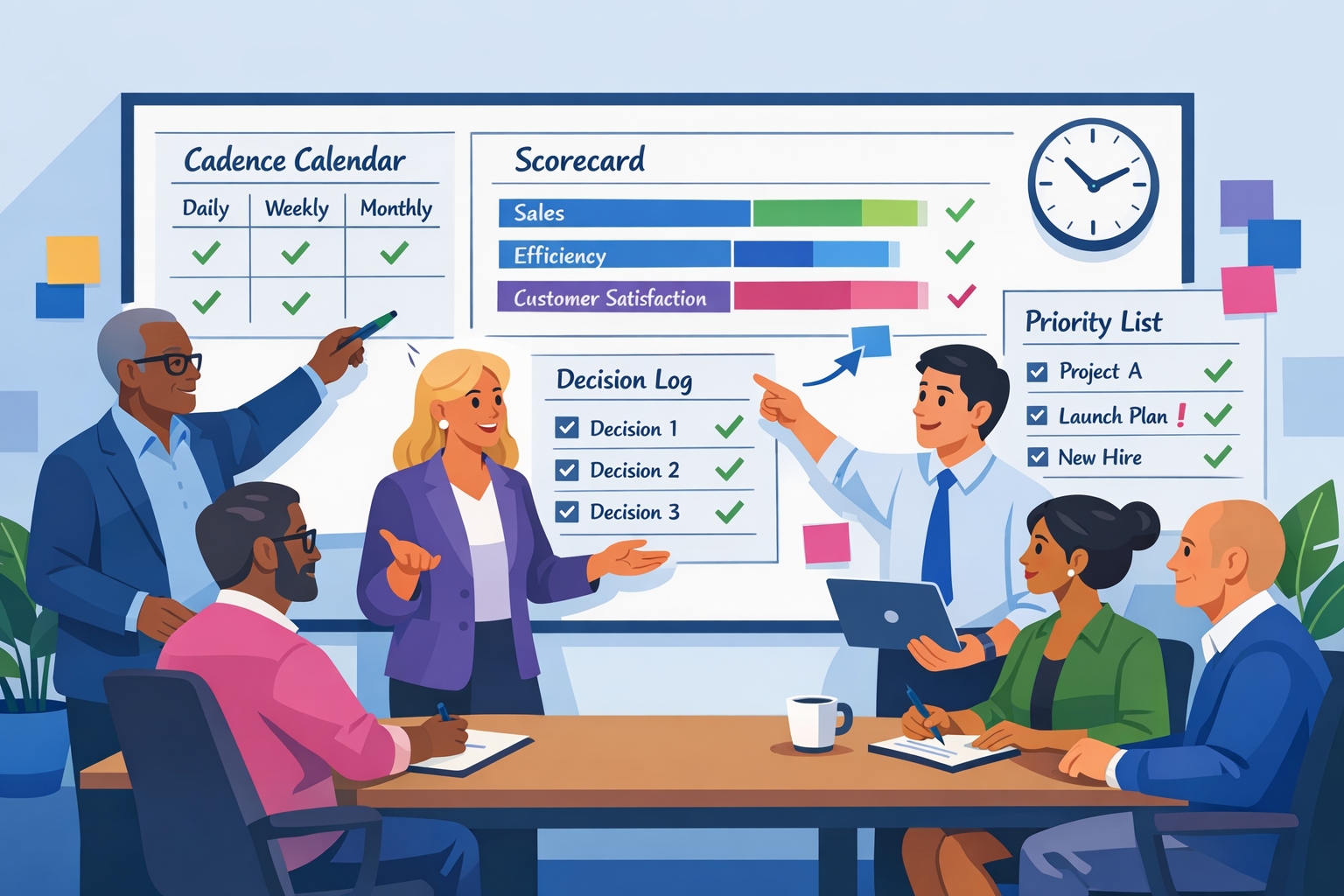
- Scorecard (one page): 8 to 12 metrics total.
- Priority list: maximum 5 enterprise priorities, each with an owner and measurable outcome.
- Decision log: decision, owner, deadline, status, date made.
- Commitment tracker: action, owner, due date, proof of done.
That is it.
If your leadership team cannot run the business with these, the issue is not the tool. It is the lack of discipline.
Decision rights: the fastest way to remove politics
Scaling teams suffer when decisions are escalated by default. Leaders either micromanage or abdicate. Both are lethal.
You need explicit decision rights.
Use three levels of decisions
- Level 1: Team decisions (local, reversible, low risk)
- Level 2: Cross-team decisions (dependencies, sequencing, shared resources)
- Level 3: Enterprise decisions (strategy, budget shifts, major hires, customer commitments)
Then set two rules:
- Decisions are made at the lowest competent level.
- If a decision is escalated, it must come with options and a recommendation.
This one move reduces meeting load and improves leadership maturity.
The meeting behaviours that separate serious leaders from busy leaders
A cadence is only as strong as the behaviours inside it. These are the behaviours to enforce.
Start on time, end on time, every time
If you cannot run a 60 minute meeting properly, you cannot run a scaling organisation properly.
Red equals help, not punishment
If leaders hide slippage because they fear judgement, you will discover problems late when they are expensive.
Create a norm: red status triggers support and trade-offs, not blame.
No vague language
Ban phrases like:
- “We are nearly there”
- “We should be able to”
- “It is in progress”
Replace with:
- “Done means X and it will be done by Friday 16:00”
- “Blocked by Y, needs a decision from Z by Tuesday”
Every meeting ends with a written output
If the output is not visible, the meeting did not happen.
How to cascade the cadence without turning into a bureaucracy factory
Senior leaders often design a cadence that works for them and breaks everyone else.
A scalable cadence is a set of nested rhythms:
- Enterprise rhythm sets priorities and constraints
- Functional rhythms translate into team plans
- Team rhythms drive execution and feedback
The cascade rule
Every level must answer three questions after the senior leadership priorities review:
- What does this mean for our top priorities this week?
- What are we stopping or de-prioritising?
- What risks must we escalate back up?
This is how you keep alignment without endless all-hands.
Common failure modes (and the fix)
You can avoid most cadence failures if you name them early.
Failure mode 1: Too many priorities
Symptom: Everything is “critical”. Teams thrash.
Fix: Cap enterprise priorities at five. If leaders cannot choose, they are not leading.
Failure mode 2: Meetings become updates
Symptom: People talk, nothing changes.
Fix: Separate asynchronous updates from synchronous decisions. Pre-read required. Meetings are for decisions, trade-offs, and unblocking.
Failure mode 3: No follow-up system
Symptom: The same issues repeat weekly.
Fix: Commitment tracker with owners and due dates. Review it first in every forum.
Failure mode 4: Leaders override the system
Symptom: Side deals, hallway decisions, constant exceptions.
Fix: Decision log. If it matters, it is logged. If it is not logged, it is not real.
Failure mode 5: Innovation dies quietly
Symptom: Potential work gets crowded out by delivery.
Fix: Protect an explicit innovation capacity allocation and review it monthly. If you do not schedule it, you will not do it.
A brief implementation plan (two weeks to launch, six weeks to stabilise)
This is not a transformation programme. Treat it like installing critical infrastructure.
Week 1: Design
- Define enterprise priorities and success metrics.
- Choose the minimum forums and assign chairs.
- Agree decision levels and escalation paths.
- Create the four artefacts (scorecard, priorities, decision log, commitment tracker).
Week 2: Launch
- Start with the weekly senior leadership priorities review.
- Launch cross-functional delivery meeting.
- Require functional huddles to mirror the outputs.
Weeks 3 to 6: Stabilise
- Audit meeting effectiveness weekly.
- Remove any forum that does not create decisions or unblock work.
- Coach leaders on clarity: owners, deadlines, definitions of done.
If you are not willing to delete meetings, do not pretend you are serious about scaling.
The real payoff: a cadence buys you trust at speed
A leadership cadence is not about control. It is about trust.
When leaders repeatedly do what they say they will do, with visible commitments and fast decisions, teams stop guessing. They stop hedging. They execute.
Scaling does not have to mean chaos. It just means your leadership system has to be as engineered as your product, your service, or your operations.
Design the rhythm. Enforce the behaviours. Keep the artefacts light. Make decisions faster than your problems grow.
That is how you scale teams without losing the plot.
Next Steps
Want to learn more? Check out these articles:
Scale-Ready Structure: Build Clarity, Flow and Resilience
The Necessity of Scale Up Coaching for Businesses [2025 Insights]
Understanding Scale-Up Coaching: Expanding Your Business Horizons
To find out how PerformanceNinja could help you, book a free strategy call or take a look at our Performance Intelligence Leadership Development Programme.