
Remove Barriers to Business Growth in Scaling Teams Fast
Growth does not usually die because your market disappears.
It dies because your organisation becomes hard to run.
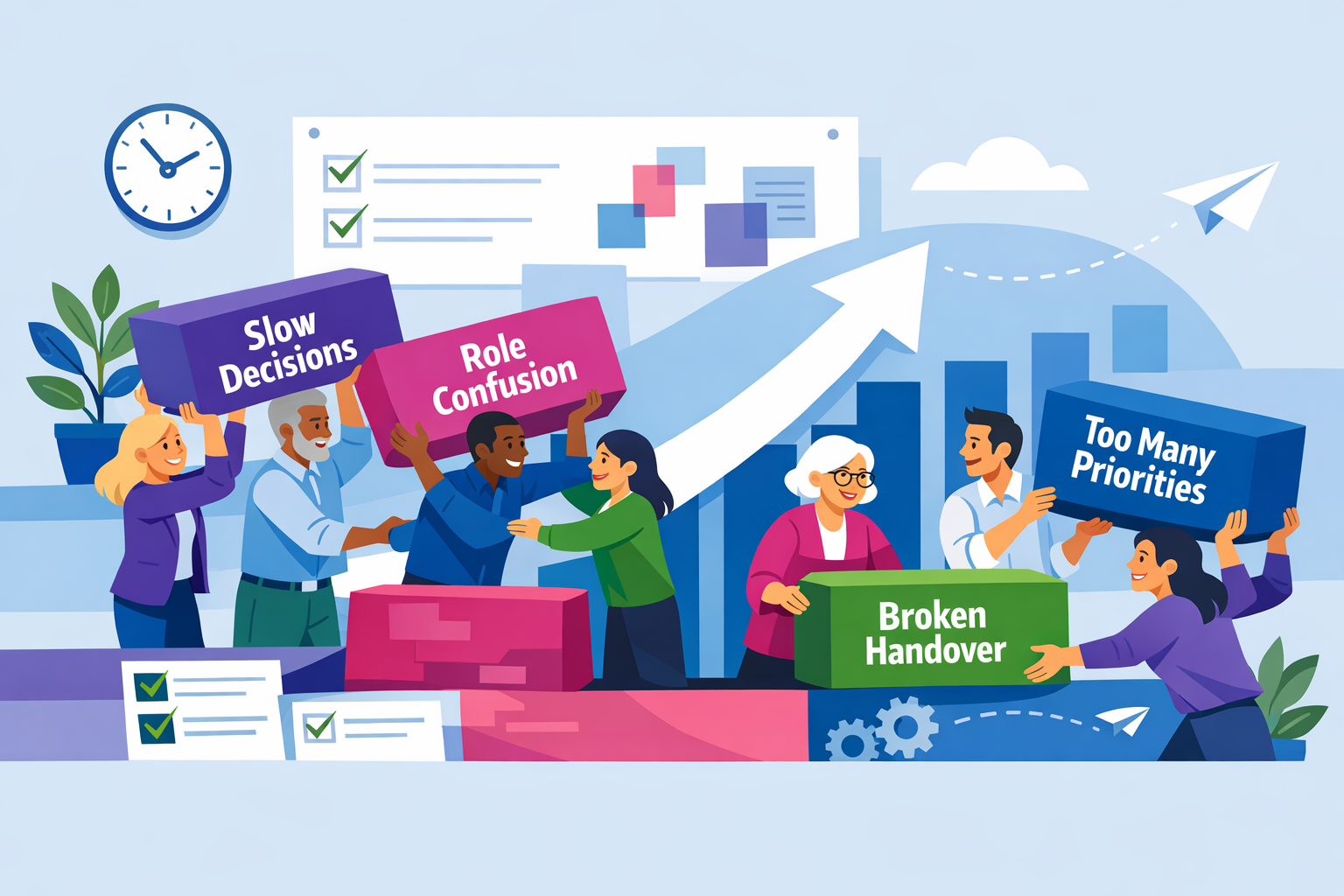
Scaling teams do not fail from lack of effort. They fail from friction. Decisions that take too long. Priorities that change too often. Roles that are unclear. Work that bounces between departments. Meetings that replace momentum. “Busy” becoming the new religion.
And the worst part is this: most leadership teams misdiagnose the problem.
They hire more people when the constraint is decision-making. They buy more tools when the constraint is process discipline. They push for “accountability” when the constraint is a broken operating rhythm. They demand innovation when the constraint is overloaded capacity.
This article is a practical guide on how to remove barriers to business growth in scaling teams. No slogans. No vague advice. You will get a clear way to diagnose the real constraint, then remove it with specific actions across purpose, people, proposition, process, productivity, and potential.
First, accept this: growth creates the barriers
Early-stage teams win by improvisation. Everyone talks to everyone. The founders are the strategy, the culture, and the QA function. That works until it does not.
Scaling introduces complexity faster than most leaders realise:
- More people means more interfaces, and interfaces create misunderstanding.
- More customers means more exceptions, and exceptions break informal processes.
- More products means more trade-offs, and trade-offs demand decisions.
- More managers means more interpretation, and interpretation creates inconsistency.
The barrier is rarely “not enough talent”. The barrier is the operating system that talent is trapped inside.
The brutal truth: barriers hide in plain sight
Most barriers are socially acceptable. They look like normal work.
Here is how they show up in scaling teams:
- Decision constipation. Everything escalates. Leaders become a bottleneck without noticing.
- Priority thrash. Projects start, stall, restart, then get renamed. Delivery slips and everyone blames capacity.
- Role fog. People duplicate work, step on toes, or avoid ownership because it is unclear who has the pen.
- Process by personality. Outcomes depend on who is involved, not on a repeatable method.
- Invisible work. “Keeping the lights on” swallows the week, leaving no room for improvement or innovation.
- Meeting debt. Coordination becomes the job. Progress becomes the side hustle.
These are not cultural quirks. They are growth killers.
Diagnose the constraint before you “fix” anything
If you want to remove barriers, you must identify the dominant constraint. Otherwise you will spend money and political capital on the wrong lever.
Use this simple constraint scan. Pick the statement that is most true right now.
- Purpose constraint: teams are busy but not aligned. Success looks different depending on who you ask.
- People constraint: you have capability gaps, leadership gaps, or behavioural issues that keep repeating.
- Proposition constraint: growth is possible, but product value, targeting, or differentiation is unclear.
- Process constraint: work fails in handovers, quality is inconsistent, and delivery relies on heroics.
- Productivity constraint: priorities are unclear, decisions are slow, and execution tracking is weak.
- Potential constraint: innovation is chaotic, distracting, or absent, and the roadmap is political not strategic.
You can have multiple issues. But you always have a dominant one. Fix that first or nothing sticks.
Barrier 1: misalignment masked as “autonomy”
Autonomy without alignment is not empowerment. It is organisational randomness.
When teams scale, leaders often avoid sharp choices because they want people to feel trusted. The result is a portfolio of disconnected work streams that do not compound.
What to do instead: make alignment non-negotiable
Put alignment into artefacts that do not rely on charisma or memory.
- Define a single growth thesis. One paragraph: where you will win, for whom, and why now. If you cannot state it clearly, you do not have it.
- Translate strategy into 3 to 5 measurable outcomes for the next 90 days. Not activities. Outcomes.
- Publish trade-offs. A visible list of what you will not do this quarter. This reduces political lobbying.
- Make priorities comparable. Force every initiative to state expected impact, cost, risk, and confidence in a consistent format.
This is where most scaling teams get honest. Not because they are brave, but because they cannot hide behind vague language anymore.
Barrier 2: leaders who cannot scale themselves
Your best individual contributors become managers. Some thrive. Many quietly struggle. They keep doing the work because it is safer than leading through others.
This creates a predictable mess:
- Managers become the bottleneck for decisions and approvals.
- Teams wait, then rush, then burn out.
- High performers leave because they are micromanaged or under-challenged.
McKinsey and others have long highlighted leadership quality as a differentiator in performance. In scaling environments, it becomes a constraint.
What to do instead: codify what “good leadership” means here
Do not run leadership development as an optional perk. Treat it like an operational control.
- Write a leadership standard. 6 to 10 behaviours that are observable. Example: “Makes decisions within 48 hours when the cost of delay exceeds the cost of being wrong.”
- Train for the moments that matter. One-to-ones, delegation, feedback, priority setting, and decision-making under uncertainty.
- Stop promoting on technical excellence alone. Require evidence of coaching, influence, and ownership.
- Install consequences. If someone repeatedly breaks the leadership standard, you address it. Directly. Fast.
If you do not define leadership, you get random leadership. Random leadership is a growth barrier disguised as “different styles”.
Barrier 3: the accountability trap (and why it backfires)
When execution slips, leadership teams often respond with louder accountability.
More status meetings. More reporting. More escalations.
This is how bureaucracy is born. Not from laziness, but from fear.
What to do instead: build a real execution system
You need a lightweight operating rhythm that makes delivery obvious.
- One owner per outcome. Not “shared”. Not “supported”. One name.
- Weekly execution review. 45 minutes. Only three questions: what moved, what is stuck, what decision is needed.
- A visible commitments board. A single source of truth for priorities, owners, due dates, and status. Keep it current or kill it.
- Decision log. Record key decisions, who made them, and why. This prevents circular debates and organisational amnesia.
Research on execution disciplines repeatedly points to clarity and cadence as multipliers of performance. The point is not the research. The point is the leverage.
Barrier 4: roles and structure that do not match reality
Most scaling teams have an org chart that reflects history, not strategy.
They have:
- Roles created to keep people happy rather than to solve a real need.
- Managers with unclear spans, unclear authority, and unclear outcomes.
- Teams organised around functions even when the work requires cross-functional speed.
This is why handovers are painful and customer experience becomes inconsistent.
What to do instead: design around value flow
Organisation design is not a theory exercise. It is a delivery tool.
- Map your value stream. From lead to cash, or from idea to shipped product. Identify where work waits.
- Assign end-to-end ownership. Give someone responsibility for the full customer outcome, not just a slice.
- Clarify decision rights. Use a simple model: who decides, who advises, who executes, who must be informed.
- Limit spans of control where work is complex. Too many direct reports destroys coaching time and quality control.
If your structure creates delay, your growth rate will pay the tax.
Barrier 5: process chaos disguised as “startup speed”
In early stages, process feels like the enemy. In scaling, lack of process becomes the enemy.
Here is the line: process is only bureaucracy when it does not reduce risk, time, or variation.
What to do instead: standardise the 20% that drives 80% of outcomes
You do not need process everywhere. You need it where failure is expensive or frequent.
- Define “critical few” processes. Sales handover, client onboarding, delivery quality assurance, incident management, hiring, and performance management.
- Document in one page. Purpose, inputs, steps, outputs, owner, service-level expectation.
- Use checklists for quality. Not to insult professionals, but to reduce avoidable errors. Aviation did not add checklists because pilots were stupid.
- Install feedback loops. Every process has a monthly review of defects, rework, and cycle time.
Process should make it easier to do the right thing. If it makes it harder, delete it or redesign it.
Barrier 6: collaboration that collapses under growth
Collaboration breaks when teams grow because informal coordination no longer scales.
You see it when:
- Clients get different answers from different departments.
- Internal teams argue about who owns what.
- Work is “thrown over the wall” with missing context.
What to do instead: engineer your cross-team interfaces
Think like an engineer. Most failures happen at the interface, not inside the component.
- Set explicit service agreements. Response times, handover requirements, quality expectations.
- Create a single client narrative. A shared view of what “good” looks like for the customer journey.
- Run joint retrospectives. Not blame sessions. Interface improvement sessions with actions and owners.
- Appoint interface owners. People accountable for the health of key handovers, such as Sales to Delivery.
When interfaces work, collaboration feels effortless. When they do not, even brilliant people look incompetent.
Barrier 7: innovation that either hijacks focus or never happens
Scaling teams often swing between two failure modes:
- Innovation theatre. Lots of ideas, hackathons, and pilots. Very little shipped value.
- Innovation starvation. Delivery consumes everything, and the future is postponed indefinitely.
Both are barriers to sustainable growth.
What to do instead: separate explore from exploit
You need a deliberate system for potential, not an emotional one.
- Create an innovation portfolio. 70% core improvements, 20% adjacencies, 10% bets. Adjust based on risk tolerance.
- Use tight stage gates. Problem validation, solution validation, small-scale pilot, then scale. Kill fast when evidence is weak.
- Protect capacity. Allocate a fixed percentage of time and budget. If it is not protected, it will be eaten.
- Measure learning velocity. Not just outputs. How fast are you turning uncertainty into decisions?
Innovation should be a pipeline, not a distraction.
The “barrier removal” playbook for scaling leaders
If you want a repeatable way to remove barriers to business growth in scaling teams, use this sequence. It is designed to create momentum, not paperwork.
Step 1: run a 2-hour friction audit
Get your leadership team in a room. No presentations. No performance. Just truth.
- List the top 10 points where work slows down or breaks.
- Quantify the cost where possible: delay, churn risk, rework, missed revenue.
- Identify the dominant constraint: purpose, people, proposition, process, productivity, or potential.
- Pick the top 3 friction points to fix in the next 30 days.
Step 2: assign one owner per friction point
No committees. One accountable owner with authority to change how work is done.
Step 3: fix the system, not the symptom
Use this diagnostic lens for each friction point:
- Is the problem unclear outcomes?
- Is the problem missing decision rights?
- Is the problem capability or behaviour?
- Is the problem a broken handover?
- Is the problem lack of operating rhythm?
Then apply the minimum effective change.
Step 4: lock the gain with cadence
Most improvements die because nobody protects them.
- Review progress weekly for 4 weeks.
- Measure cycle time, defect rate, and decision time.
- Document the new standard in one page.
- Train the team once, then reinforce in real work.
Common mistakes that keep barriers in place
If you recognise yourself here, good. It means you can change it.
- Mistake: hiring as the first response. People do not fix broken prioritisation. They multiply it.
- Mistake: confusing motion with progress. If nothing ships, nothing matters.
- Mistake: tolerating role ambiguity. It feels kind. It is not. It creates conflict and waste.
- Mistake: letting meetings replace decisions. Meetings should produce decisions, not comfort.
- Mistake: treating culture as vibes. Culture is behaviour you tolerate and reward.
What “good” looks like when barriers are gone
You will know you have removed the right barriers when you see these signals:
- Decisions happen fast, close to the work, with clear escalation paths.
- Teams can state priorities without checking slides.
- Execution is predictable. Not perfect, but reliable.
- Customers experience consistency across touchpoints.
- Managers coach more than they rescue.
- Innovation runs as a pipeline with clear bets, not random acts of creativity.
This is not about becoming corporate. It is about becoming scalable.
A brief implementation plan (30 days)
If you want a practical starting point, do this over the next month.
- Week 1: friction audit, choose top 3 barriers, assign owners, define success measures.
- Week 2: clarify decision rights and priority outcomes, establish a single commitments board.
- Week 3: standardise one critical process end-to-end, implement checklist and handover rules.
- Week 4: run retrospectives, lock changes into the operating rhythm, remove one recurring meeting.
Do not try to fix everything. Fix what is truly constraining growth, then repeat.
The closing point most leaders avoid
Removing barriers to business growth in scaling teams is not about working harder. It is about removing the friction that steals your best people’s time and attention.
The organisations that scale are not the ones with the most talent. They are the ones that turn talent into throughput.
If your growth is stalling, assume the barrier is internal. Then prove it. Then remove it.
Next Steps
Want to learn more? Check out these articles:
Build a Leadership Cadence That Scales Teams Without Chaos
Scale-Ready Structure: Build Clarity, Flow and Resilience
The Necessity of Scale Up Coaching for Businesses [2025 Insights]
To find out how PerformanceNinja could help you, book a free strategy call or take a look at our Performance Intelligence Leadership Development Programme.