
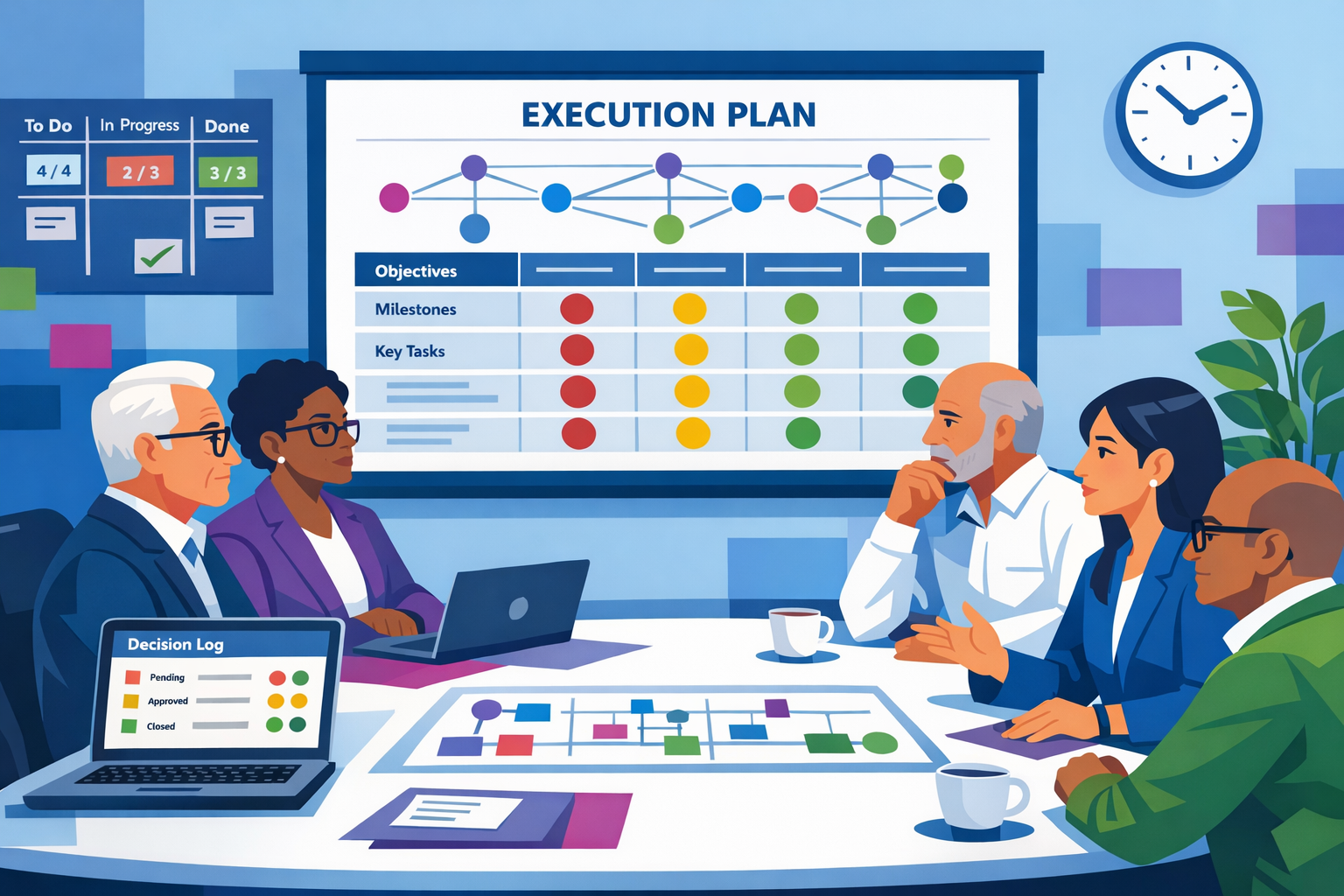
Execution Discipline Examples That Scale Leadership Teams Fast
The uncomfortable truth about scaling
Most leadership teams do not fail because they lack intelligence, experience, or ambition.
They fail because they cannot execute consistently once the organisation gets bigger.
In the early days, execution is informal. You shout across the room. You fix problems in real time. You make decisions fast because everyone is in your head.
Then you scale.
Suddenly, your calendar is full, priorities are muddy, accountability is “shared”, and delivery slips in slow motion. Nobody panics because everyone is busy. That is the trap.
Execution discipline is the way out. Not more hustle. Not another strategy deck. Not “better communication”. Discipline: clear choices, clear owners, short feedback loops, and a system that makes slippage visible before it becomes failure.
This article gives you practical execution discipline examples for scaling leadership teams. These are not theories. They are operational behaviours and meeting mechanisms you can install with minimal drama. Use them to protect focus, speed up decisions, and stop the leadership team from becoming the bottleneck.
Why execution breaks when leadership teams scale
Execution usually breaks in predictable ways. If you can name the failure mode, you can fix it.
1) The leadership team becomes a committee
As headcount grows, leaders start “representing” functions instead of leading the organisation. Meetings become negotiations. Decisions become compromises. Accountability becomes blurry.
The result is a leadership team that talks a lot and ships little.
2) Priorities multiply, but trade-offs do not
Scaling introduces more opportunities and more stakeholders. Without explicit trade-offs, everything becomes “important”. When everything is important, nothing is executed well.
3) You lose the tight feedback loop
In a small team, you feel execution problems instantly. In a larger organisation, bad news travels slowly. By the time the leadership team sees the reality, it is too late or expensive to correct.
4) Good people hide inside complexity
Scaling creates complexity. Complexity is the perfect hiding place for underperformance. Leaders can look busy while outcomes drift.
If you want an execution culture, you must design it. It will not emerge by accident.
The PerformanceNinja big picture: discipline is a system
Execution discipline is not a motivational speech. It is an organisational system.
At a high level, you are balancing:
- Purpose: what matters and what does not.
- People: leaders who can own outcomes, not just tasks.
- Process: how work moves, and how decisions get made.
- Productivity: how you align, track, and correct delivery.
Most leadership teams over-invest in Purpose and under-invest in Productivity. They talk about strategy while execution decays. Discipline closes that gap.
Execution discipline examples for scaling leadership teams
Below are execution discipline mechanisms you can implement. Each one includes what it is, why it works, and how to do it without turning your company into a bureaucracy factory.
1) The “One Page Plan” that actually governs work
What it is: A single page that contains your top priorities, success measures, owners, and the next milestone for each priority.
Why it works: People do not execute a 40-page strategy. They execute what they can see weekly. Cognitive load matters. A one-page plan forces trade-offs and clarity.
How to implement:
- Limit to 3 to 5 organisation-level priorities for the next 90 days.
- Each priority has one accountable owner from the leadership team. Not a department. A person.
- Define a measurable outcome and a leading indicator (something you can track weekly).
- Add a next milestone date within 2 to 4 weeks, not “end of quarter”.
Execution discipline rule: if it is not on the one-page plan, it is not leadership work. Park it, delegate it, or kill it.
2) A decision log that kills re-litigation
What it is: A simple log of significant decisions, including the decision, date, owner, context, and review trigger.
Why it works: Scaling leadership teams waste huge time re-arguing old decisions. This usually happens because decisions were never made cleanly, or because nobody can point to what was agreed.
How to implement:
- Create a shared decision log (Confluence, Notion, Google Sheet).
- Log decisions that change direction, policy, investment, resourcing, or customer impact.
- Include: What we decided, why, who owns it, what “good” looks like.
- Add a review trigger, for example “review if churn rises above X” or “review in 60 days”.
Execution discipline rule: you can challenge a decision only if you bring new data, or the review trigger is hit. Otherwise, execute.
3) Weekly leadership WIP limits
What it is: A hard cap on how many major initiatives are allowed “in flight” at once.
Why it works: Most delivery slippage is not effort. It is too much work started, not enough finished. Limiting Work In Progress is basic flow engineering.
How to implement:
- Define what counts as a “major initiative” (cross-team, material risk, or meaningful cost).
- Set a WIP cap, for example no more than 7 major initiatives across the organisation at once.
- If a new initiative enters, an existing one must pause or stop.
- Review the WIP list weekly, not monthly.
Execution discipline rule: starting is easy. Finishing is leadership.
4) The “red, amber, green” standard that cannot be gamed
What it is: A consistent definition of status that applies across all priorities.
Why it works: Leaders lie to themselves with vague statuses. “On track” becomes an emotional statement. You need a mechanical definition.
How to implement:
- Green: next milestone will be met without heroics, with current plan and resources.
- Amber: risk exists, mitigation is defined, owner can still recover.
- Red: milestone will be missed without a change in scope, resourcing, or approach.
- Require every amber or red to include: the specific blocker, the decision needed, by when.
Execution discipline rule: red is not punished. Red is respected. Hidden red is punished.
5) A weekly “Blockers and Decisions” meeting, not a status meeting
What it is: A 45 to 60 minute weekly leadership meeting focused on unblock and decision, not updates.
Why it works: Status meetings scale badly. They become theatre. Execution meetings scale well because they convert time into decisions.
How to implement:
- Prep: owners update the one-page plan status before the meeting.
- Open: quick scan for reds and ambers only.
- Focus: pick the top 2 to 4 blockers that threaten milestones.
- Decide: make the call in the room, log it, assign next action.
- Close: confirm who is doing what by when.
Execution discipline rule: no verbal updates. If it is not written in advance, it does not exist.
6) Single-threaded ownership for critical outcomes
What it is: For any critical outcome, one leader owns the result end-to-end, even if multiple teams contribute.
Why it works: “Shared accountability” is corporate fiction. Shared accountability produces shared excuses. Amazon popularised this idea for a reason: it cuts through organisational fog.
How to implement:
- Identify 3 to 5 outcomes that matter most (revenue, retention, delivery, quality, cost).
- Assign one accountable leader per outcome.
- Clarify the support roles explicitly: who provides input, who executes components, who approves.
- Give the owner authority to make trade-offs within an agreed boundary.
Execution discipline rule: if two leaders think they own it, nobody owns it.
7) A “no surprises” operating rule with escalation triggers
What it is: A behavioural standard supported by explicit escalation thresholds.
Why it works: Surprises kill trust. Scaling organisations often develop a culture where bad news is delayed until it becomes a fire.
How to implement:
- Set escalation triggers, for example:
- Any milestone at risk by more than 1 week.
- Any customer impact that could cause churn or reputational damage.
- Any budget variance above 10%.
- Any dependency blocked for more than 5 working days.
- Define where escalation goes first (direct manager, initiative owner, leadership team).
- Teach leaders to escalate with a proposed option, not just a problem.
Execution discipline rule: surprises are a process failure first, a people failure second.
8) A cadence of outcomes: weekly leading, monthly lagging
What it is: A measurement rhythm where you track leading indicators weekly and lagging results monthly.
Why it works: Most leadership teams stare at lagging metrics and act too late. Leading indicators give you steering control.
How to implement:
- For each priority, define:
- Lagging result: the final outcome (revenue, NPS, churn, cycle time).
- Leading indicator: the controllable input (sales calls, defect rate trend, time-to-first-response).
- Weekly meeting: review leading indicators and milestone progress.
- Monthly review: compare lagging results to target and adjust priorities.
Execution discipline rule: if you cannot name a leading indicator, you do not understand the work well enough to scale it.
9) Role clarity contracts for first-time leaders
What it is: A short written agreement for leaders transitioning from individual contributor to manager, clarifying expectations and decision rights.
Why it works: Scaling teams often promote strong doers into leadership without resetting what “good” looks like. Then they keep doing the job themselves, and their team stalls.
How to implement:
- Create a one-page role contract:
- Core outcomes they own.
- What they must stop doing personally.
- Decisions they can make without approval.
- How they will be measured (3 to 5 metrics).
- Expected leadership behaviours (feedback cadence, planning rhythm).
- Review it at 30, 60, 90 days.
Execution discipline rule: if you promote people and do not re-contract expectations, you are gambling with execution.
10) A brutal priority filter for “good ideas”
What it is: A simple, repeatable filter to reject or defer initiatives that do not fit the current focus.
Why it works: Scaling organisations are flooded with good ideas. Most should be killed, not because they are bad, but because focus is a weapon.
How to implement:
- Every new initiative must answer:
- Which priority does this support on the one-page plan?
- What will we stop or pause to make room?
- What is the measurable outcome and by when?
- What is the smallest test to validate it?
- If it fails any question, defer to a backlog with a review date.
Execution discipline rule: the leadership team’s job is not to collect initiatives. It is to curate them.
What execution discipline looks like in real leadership behaviour
Mechanisms matter, but scaling leadership teams fail when leaders do not behave consistently inside the mechanism.
Here are the behavioural standards that separate disciplined teams from “busy” teams:
- They speak in outcomes, not activities. “We will reduce onboarding time from 14 days to 7” beats “we are improving onboarding”.
- They name the trade-off. “Yes, but what do we stop?” is a standard question, not a rude one.
- They clarify ownership in the room. No follow-up email. No ambiguity.
- They escalate early. Not as drama, as professionalism.
- They protect focus even when influential stakeholders push for exceptions.
This is where culture is created. Not in values posters. In repeated, observable behaviour.
Common traps that destroy discipline (and how to avoid them)
Trap 1: Turning discipline into surveillance
If your tracking system feels like policing, leaders will game it. You will get “green theatre”.
Fix: make tracking about learning and unblocking. Reward early transparency. Treat red as valuable signal.
Trap 2: Over-engineering the process
Some leaders respond to chaos by building a process cathedral. It looks impressive and kills speed.
Fix: start minimal. One-page plan, weekly unblock meeting, decision log. Add only what removes friction.
Trap 3: Confusing alignment with consensus
Consensus is slow and often dishonest. Alignment means people commit even if they disagree, once a decision is made.
Fix: use clear decision owners. Invite debate before the call. Demand commitment after.
Trap 4: Promoting doers who cannot delegate
This is one of the most expensive scaling mistakes. Execution bottlenecks move from the founder to the new managers.
Fix: role clarity contracts, coaching, and forcing delegation through explicit “stop doing” lists.
A brief implementation plan (30 days)
You do not need a transformation programme. You need a clean installation and ruthless consistency.
Week 1: Install the minimum viable operating system
- Create your one-page plan with 3 to 5 priorities, owners, measures, next milestones.
- Create a decision log.
- Define red, amber, green standards.
Week 2: Start the weekly execution meeting
- Run the “Blockers and Decisions” meeting.
- Ban verbal status updates.
- Log decisions live.
Week 3: Enforce WIP limits and trade-offs
- Build the list of major initiatives in flight.
- Set the WIP cap.
- Pause or stop work until you are under the cap.
Week 4: Harden accountability
- Assign single-threaded owners for critical outcomes.
- Introduce escalation triggers and “no surprises” expectations.
- Write role clarity contracts for any first-time leaders.
After 30 days, do not add more. Run it for 60 days and refine based on friction points.
The standard you should hold as a senior leader
If you are scaling a leadership team, your job is not to be the smartest person in the room.
Your job is to build an execution environment where:
- priorities are few and explicit
- decisions are fast and logged
- ownership is real
- delivery is visible weekly
- problems surface early
This is not glamorous work. It is the work that separates organisations that scale from organisations that stall.
Execution discipline is not a personality trait. It is a design choice. Make it, then enforce it.
Next Steps
Want to learn more? Check out these articles:
Build an Execution Discipline Checklist Leaders Actually Use
Execution Discipline Framework to Scale High-Performing Leadership Teams
How to Measure Execution Discipline in Leadership Teams
To find out how PerformanceNinja could help you, book a free strategy call or take a look at our Performance Intelligence Leadership Development Programme.