
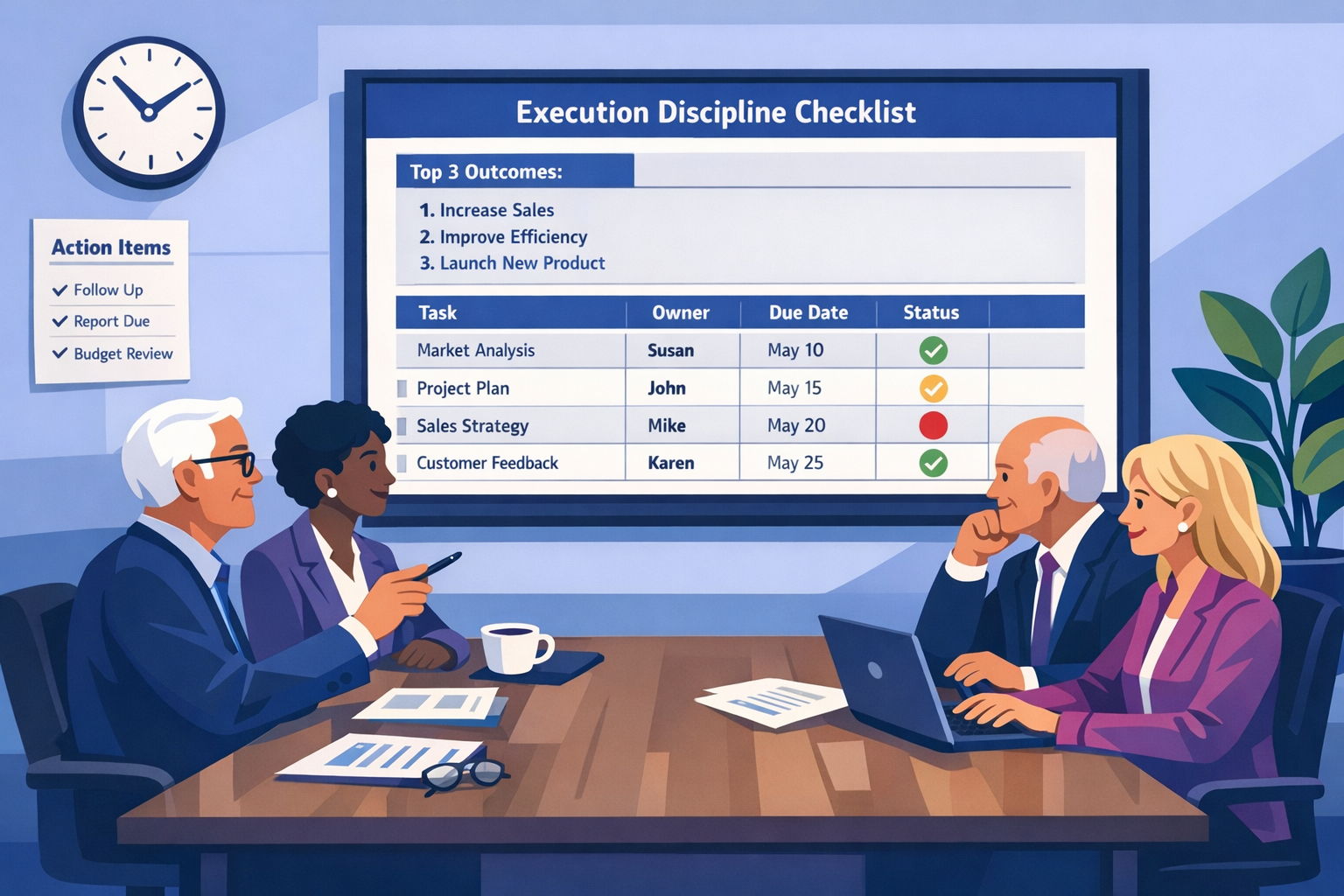
Build an Execution Discipline Checklist Leaders Actually Use
Most leadership teams do not have an execution problem. They have a discipline problem.
They confuse activity with progress. They approve projects they cannot staff. They hold meetings that create decisions, then fail to create follow through. They tolerate “we’re working on it” as if it is a status update, not a warning.
If that sounds harsh, good. Because your competitors are not losing to you on ideas. They are beating you on disciplined, repeatable execution.
This article shows you how to create an execution discipline checklist for leadership teams that gets used every week, not filed away in your operating manual. It is practical, specific, and designed for senior leaders who are tired of chasing actions and tired of being surprised.
What “execution discipline” really means (and what it is not)
Execution discipline is a system of behaviours that makes delivery inevitable. It turns leadership intent into coordinated action, week after week, with minimal drama.
It is not:
- More meetings
- More dashboards
- More project plans that no one reads
- A heroic COO who “holds it all together” through brute force
It is:
- Clarity on what matters now
- Explicit ownership of outcomes, not tasks
- A visible, shared method to track commitments
- Fast escalation when reality deviates from plan
- Routine review, not sporadic “big updates”
Discipline is boring by design. That is the point. You are trying to remove the need for constant leadership adrenaline.
Why leadership teams fail at execution (the brutal truth)
Leadership teams fail at execution because they tolerate ambiguity and call it empowerment.
The usual failure pattern looks like this:
- A strategic priority is declared.
- Ten “supporting initiatives” are added to the list.
- Ownership is shared, which means ownership is missing.
- Progress is reported as effort, not outcomes.
- Trade offs are avoided until the organisation hits a wall.
- Deadlines slip. Everyone is “busy”. The priority quietly dies.
You do not fix this with motivation. You fix it with a checklist that forces the right conversations at the right time.
What makes an execution checklist actually work
If your checklist becomes another document, you have failed. A useful execution discipline checklist has four qualities:
1) It is short enough to run weekly
If it takes more than 20 minutes to run, it will be skipped under pressure. Then you will need it most, and it will be missing.
2) It is binary
Checklist items must be answerable as yes or no. Not “kind of”, not “in progress”, not “we think so”. Binary questions expose weak ownership and fuzzy definitions.
3) It triggers action, not commentary
The checklist is not a scorecard for shame. It is a mechanism to decide what to do next.
4) It is owned by the leadership team, not “Ops”
If execution discipline lives in one person’s head or one function’s admin, it will collapse when things get complex. Leadership must own the system, not outsource it.
The Execution Discipline Checklist (copy this)
Use the checklist below as your baseline. Then tailor it to your organisation’s maturity and complexity. Run it weekly in the same leadership meeting, at the same time, with the same rules.
A) Direction and priorities (Purpose and Proposition)
This section prevents the most common leadership sin: pretending you have priorities while funding everything.
- Are this quarter’s top three outcomes written in plain language? If someone cannot repeat them in 10 seconds, they do not exist.
- Are the top three outcomes measurable with a single metric each? Not a bundle of metrics. One primary measure of success per outcome.
- Have we explicitly said what we will not do this quarter? If “not doing” is not stated, it is not real.
- Do all executives agree these outcomes outrank their functional goals? Agreement must be explicit, not assumed.
- Has any new request entered the system without removing or rescoping something else? If yes, you are lying about capacity.
B) Ownership and commitments (People)
This section kills the disease of shared accountability.
- Does every key outcome have a single accountable owner? One name. Not two. Not “the team”.
- Do owners have the authority to make the decisions required? If they need permission for every move, they are not owners.
- Are success criteria defined in deliverables and dates? “Improve” is not a deliverable. “Launch X by 30 June” is.
- Is there a named deputy for each outcome owner? Execution cannot stall because someone is on leave.
- Have we identified the one capability gap that will hurt delivery most? Then decide: train, hire, contract, or cut scope.
C) Operating system and follow up (Process and Productivity)
This section is where most leadership teams either become professional, or stay chaotic.
- Is there one source of truth for commitments? One list. One tool. One version. If you have multiple, you have none.
- Is every commitment written as “Who will do what by when”? If any of those elements are missing, it is not a commitment.
- Are statuses updated before the meeting? Meeting time is for decisions, not reading.
- Do we review commitments in order of business importance, not who shouts loudest? Priority drives airtime.
- When a deadline slips, do we capture the reason in a standard category? Use categories like: unclear scope, dependency, capacity, decision delay, quality issue, external blocker.
- Do we have a defined escalation path for blockers within 48 hours? If a blocker sits for a week, your system is broken.
- Do we close loops? Every action is either completed, rescheduled with a new date, resourced differently, or killed. Nothing lingers.
D) Decisions and trade offs (Productivity)
This section prevents your leadership team from becoming a debate club.
- Are the week’s decisions listed at the start of the meeting? If decisions are not declared, discussion will expand to fill the time.
- Is every decision assigned a decision owner? Someone drives it to closure.
- Do we use a consistent decision method? For example: consult, then decide. Or vote. Or leader decides. Ambiguity creates politics.
- Are trade offs documented immediately? If you add something, what is reduced, delayed, or removed?
- Are decision deadlines real? If a deadline slips twice, it was never a deadline.
E) Cross functional coordination (Process)
This section prevents “handoff hell” and client experience fractures.
- Have we identified the top three cross functional dependencies this week? If you do not name them, they will surprise you.
- Is each dependency owned by one person on each side? Named sender, named receiver.
- Do we have service standards between teams? Example: response times, definition of ready, definition of done.
- Are we tracking impact on the customer for any internal change? Internal efficiency that damages customer experience is not progress.
F) Risks, learning, and innovation control (Potential)
This section keeps innovation healthy without letting it hijack focus.
- Are the top five risks to this quarter’s outcomes written and reviewed? Risks not discussed are risks you have accepted.
- Is each risk owned with a mitigation action and date? Risks without mitigations are just anxiety.
- Do we have a controlled innovation pipeline? A visible list of experiments with a clear budget, timebox, and success metric.
- Are we killing experiments fast when evidence is weak? If nothing gets killed, you are not experimenting, you are accumulating.
- Have we captured one execution lesson this week? One. Not a retrospective theatre session. A real lesson that changes behaviour.
How to implement the checklist without creating more bureaucracy
If you simply paste this into a document and ask people to “use it”, it will fail. Execution discipline is a behaviour change. Here is a brief, high level implementation plan that works.
Step 1: Choose your cadence and meeting container (Week 0)
- One weekly execution meeting, 45 to 60 minutes, same day and time.
- No presentations. No slide decks.
- Pre-read updates are mandatory.
- Attendance is not optional for outcome owners.
Step 2: Set up one source of truth (Week 0)
- Pick a tool your team will actually open. It can be simple, but it must be shared.
- Create a single commitments register with: outcome, owner, deliverable, date, status, blockers.
- Lock the format. Consistency beats creativity.
Step 3: Run the checklist as a script (Weeks 1 to 3)
- Assign a facilitator to keep it moving and enforce binary answers.
- Start with priorities, then commitments, then blockers, then decisions.
- Stop discussions that are not driving a decision or removing a blocker.
Step 4: Add consequences and rewards (Week 2 onwards)
- If updates are late, the item is assumed at risk until proven otherwise.
- If a deadline slips, the owner proposes the recovery plan, not excuses.
- Publicly recognise teams who close loops and kill low value work.
Step 5: Tune the checklist (Week 4)
After four runs, remove anything that does not change behaviour. Add only what catches real failure modes in your organisation. Keep it lean.
The meeting agenda that makes the checklist unavoidable
Most leadership meetings are designed to feel productive, not to produce outcomes. Use this agenda as your default.
- 5 minutes: Reconfirm top three outcomes and “not doing” list
- 15 minutes: Commitments review Only red and amber items, plus any due this week
- 15 minutes: Blocker removal and escalations Decide who does what by when to unblock
- 10 minutes: Decisions Decide, assign, document
- 5 minutes: Risks and one execution lesson
This agenda forces the team to operate like a leadership team, not a collection of functional representatives.
Common traps (and how to avoid them)
Trap 1: Turning the checklist into a reporting ritual
If people speak in paragraphs, you are drifting into theatre. Require updates in this structure:
- Status: green, amber, red
- What changed since last week: one sentence
- Blocker: yes or no
- Decision needed: yes or no
Trap 2: Too many priorities
If you have more than three true priorities, you have none. Teams can progress many tasks, but only a few outcomes.
Trap 3: Confusing delegation with abdication
Leaders delegate outcomes, then disappear until the deadline. Discipline requires routine inspection. Not micromanagement. Inspection.
Trap 4: Letting “dependencies” become an excuse
Dependencies are real, but they are also a hiding place. If a dependency is blocking progress, assign a named person to resolve it within 48 hours, or formally replan.
Trap 5: Allowing low performers to poison the system
If one executive consistently breaks commitments, your checklist will not save you. Execution discipline requires trust, and trust requires reliability. Address the person problem directly.
How to know it is working (fast signals)
You will feel the change before you see it in the numbers. Look for these signals within 30 days:
- Fewer “surprise” escalations because risks surface earlier
- Shorter meetings with more decisions
- Clearer trade offs when new work appears
- Less reliance on heroics to hit deadlines
- More confidence in forecasts and delivery dates
And yes, you should see measurable improvements too. But the early wins are behavioural.
The bigger picture: execution discipline sits inside the 6Ps
Execution discipline does not exist in isolation. It is the bridge between what you say matters and what actually happens.
If your checklist keeps failing, do not just “try harder”. Use it as a diagnostic:
- Purpose is weak when priorities change weekly and no one can explain why.
- People is weak when ownership is unclear, capability gaps are ignored, or leaders cannot have hard conversations.
- Proposition is weak when teams execute perfectly on the wrong work.
- Process is weak when handoffs break, standards vary, and work is constantly reworked.
- Productivity is weak when decisions stall and follow up is inconsistent.
- Potential is weak when innovation is either chaotic, or dead.
The checklist is not just a tool. It is a mirror.
What to do next
If you want this to change, do not start by rewriting your strategy deck. Start by changing what your leadership team does every week.
Take the checklist above. Put it into your one source of truth. Run it for four weeks without exception. Then tighten it.
Execution discipline is not inspirational. It is operational. And it is the difference between leadership teams that talk, and leadership teams that deliver.
Next Steps
Want to learn more? Check out these articles:
Execution Discipline Framework to Scale High-Performing Leadership Teams
How to Measure Execution Discipline in Leadership Teams
Diagnose Business Barriers Before Growth Stalls: A Leader’s Guide
To find out how PerformanceNinja could help you, book a free strategy call or take a look at our Performance Intelligence Leadership Development Programme.