
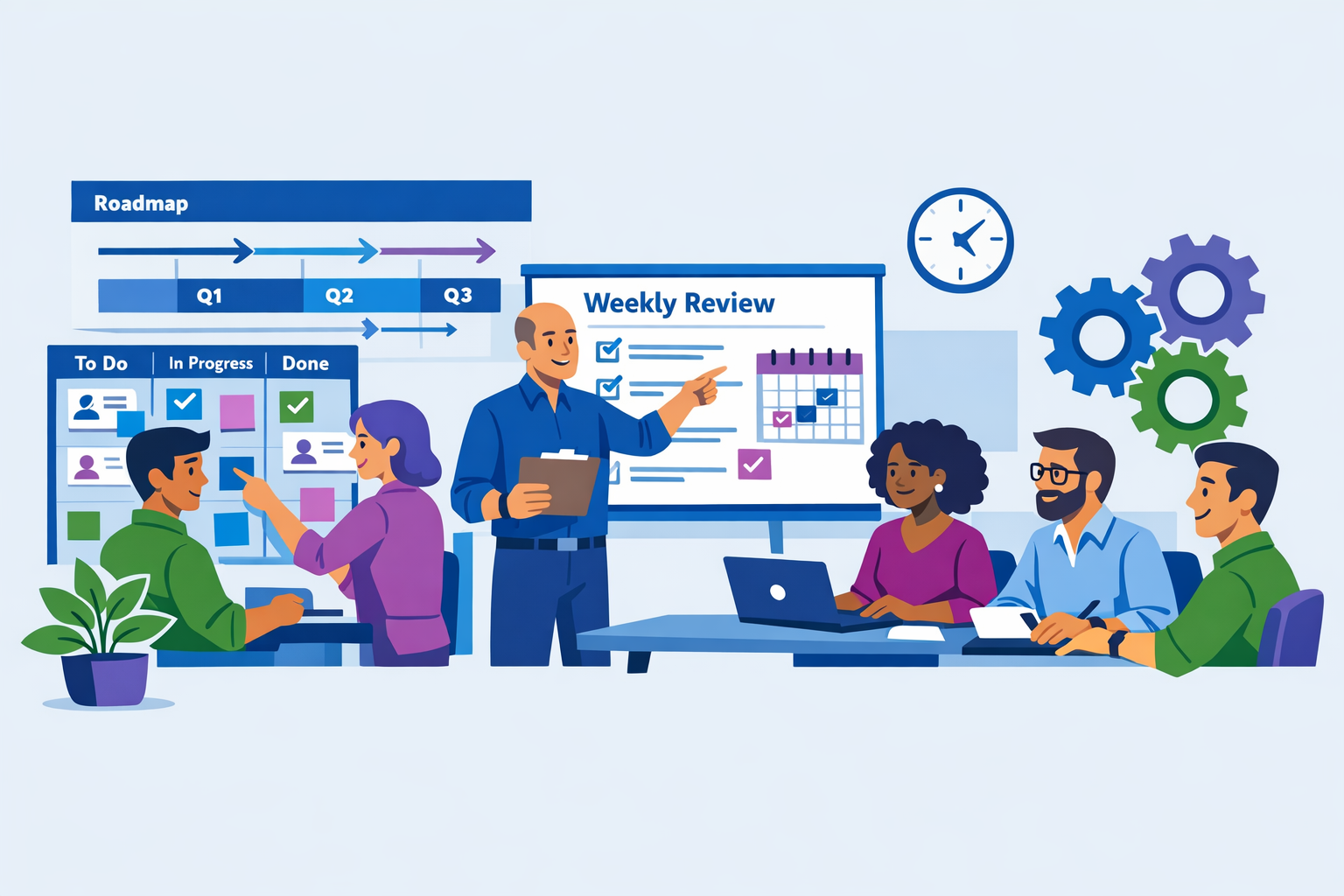
Build a High Performance Culture in Growing Teams Now
The brutal truth about “culture” in a growing team
High performance culture does not “scale” on its own.
In a small team, culture is mostly proximity. People sit near each other, hear the same conversations, watch the founders make decisions, and copy what gets praised. It feels effortless.
Then you grow. You hire fast. You split into functions. You add layers. Suddenly, culture becomes a rumour. It varies by manager, by office, by Slack channel, by who joined in which wave. The original DNA gets diluted, then distorted.
If you are serious about performance, you need to stop treating culture like vibe and start treating it like an operating system.
This article shows you exactly how to build a high performance culture in growing teams without turning your company into a policy factory.
What “high performance culture” actually means (and what it does not)
High performance culture is not:
- Long hours and heroic effort
- “Family” language that excuses poor boundaries
- Relentless positivity while delivery slips
- Perks, slogans, or values posters
High performance culture is:
- Clarity on what matters and what good looks like
- Accountability without politics or blame theatre
- Capability that keeps pace with growth
- Consistency in decisions, standards, and behaviours
- Continuous improvement driven by evidence, not opinions
It is the environment where good people can do great work repeatedly, without burning out, and without needing a founder to referee every decision.
Why growing teams lose performance (even with smart people)
Most performance problems in growth are not effort problems. They are design problems.
Here is what usually breaks first:
- Priorities multiply and no-one can tell what is truly important
- Decisions slow down because authority is unclear
- Execution slips because follow-up is informal and inconsistent
- Quality varies because “standards” live in someone’s head
- Managers are accidental because great individual contributors get promoted without support
- Truth disappears because people learn it is safer to say “fine” than to surface issues
This is why high performance culture must be engineered. Not over-engineered. Engineered.
The PerformanceNinja big picture: the 6Ps that shape culture
Culture is an output. It is produced by your system. When leaders ask for “a better culture” but keep the same system, they are asking for magic.
At a big-picture level, culture is shaped by six levers:
- Purpose: what you exist to do and the trade-offs you will make
- People: who you hire, promote, and tolerate
- Proposition: what you promise customers and how you win
- Process: how work moves and where friction lives
- Productivity: how you decide, align, and track outcomes
- Potential: how you innovate without breaking focus
If any one of these is weak, culture compensates in unhealthy ways. People start working around the system, which looks like “initiative” until it becomes chaos.
Step 1: Define performance in plain English (so you can manage it)
You cannot build a high performance culture on ambiguity. Start by defining performance in a way that can be observed.
Write a one-page “performance standard” for your organisation
Keep it brutally simple. Include:
- The outcomes that matter: 3 to 5 measurable business outcomes for the next 6 to 12 months.
- The non-negotiable behaviours: 5 to 7 behaviours that are required to deliver those outcomes in your environment.
- The quality bar: what “done” means in your context, including basic definitions for speed, accuracy, customer impact, and risk.
Examples of non-negotiable behaviours in growing teams:
- We escalate risks early, with evidence and options.
- We disagree directly, then commit fully.
- We document decisions that affect other teams.
- We finish what we start or we consciously stop it.
- We do not ship avoidable defects to customers.
If you cannot write these down, you cannot expect consistency across a growing organisation.
Step 2: Make accountability a system, not a personality trait
Most leaders say they want accountability. Many actually want obedience. The difference matters.
Accountability is not “being tough”. It is making commitments visible, reviewing them consistently, and responding when reality diverges from the plan.
Install a weekly execution cadence that forces clarity
Use a simple rhythm:
- Monday alignment (30 to 45 minutes per team): confirm priorities, owners, and measures of success.
- Mid-week check (15 minutes): surface blockers and make fast decisions.
- Friday review (30 minutes): what shipped, what slipped, why, and what changes next week.
Non-negotiables for the cadence:
- Named owners for every deliverable.
- Explicit due dates, not “ASAP”.
- Clear acceptance criteria so “almost done” stops being a status.
- Blockers logged with the decision required to unblock.
This is how you fix slipping execution without micromanaging. You do not need more pressure. You need a tighter feedback loop.
Separate “missed commitment” from “bad intent”
When something slips, leaders must diagnose, not accuse. The root cause is usually one of these:
- Unclear priority or competing demands
- Underestimated effort or hidden complexity
- Dependencies unmanaged
- Capability gap
- Quality standard unclear
- Too much work in progress
Handle each cause differently. Treating all misses as a character flaw is how you create fear, not performance.
Step 3: Build managers, not supervisors (because growth creates distance)
In a team of 10, founders can compensate for weak management. In a team of 50, weak management becomes a growth ceiling.
Most growing organisations promote strong individual contributors into management and then act surprised when:
- They keep doing the work themselves
- They avoid hard conversations
- They do not set standards
- They cannot coach performance because they were never coached
Give every manager a basic operating manual
Within 30 days of promotion, every manager should be trained and assessed on:
- One-to-ones: weekly, structured, with performance and development both covered.
- Goal setting: outcomes, measures, and scope boundaries.
- Feedback: specific, timely, behaviour-based, and documented.
- Performance intervention: how to act early, not after resentment builds.
- Hiring: structured interviews and evidence-based selection.
If you do not teach this, you will get random management. Random management produces random culture.
Standardise the hard conversations
High performance cultures do not avoid discomfort. They systemise it.
Give managers scripts and structure. For example, a simple feedback pattern:
- Context: “In yesterday’s client call…”
- Behaviour: “You committed to a delivery date without checking with delivery.”
- Impact: “We created a dependency we cannot meet and damaged trust.”
- Standard: “We confirm delivery feasibility before committing.”
- Next: “In the next call, pause and ask delivery to confirm before we commit.”
This is not corporate. It is professional.
Step 4: Hire and promote for trajectory, not just talent
In growth, hiring is culture design. Every hire either strengthens the system or introduces new entropy.
Define what “good” looks like in each role level
Create a role scorecard for each critical role that includes:
- Outcomes: what they must deliver in 90 days and 12 months
- Competencies: the skills required in your context
- Behavioural expectations: the non-negotiables from your performance standard
- Anti-patterns: what looks impressive but is destructive here
Examples of anti-patterns in scaling teams:
- Brilliant but toxic
- Fast but sloppy
- Always “busy” but never shipping
- Great in meetings, weak in execution
- Deflects responsibility with politics
Make values measurable in interviews
Stop asking “Do you value teamwork?” Everyone will say yes. Ask for evidence:
- “Tell me about a time you disagreed strongly with a peer. What did you do next?”
- “What is the hardest feedback you have given someone? How did you say it?”
- “Tell me about a time your work caused a customer problem. What did you change?”
Culture is what people do under pressure. Interview for pressure.
Step 5: Reduce bureaucracy by designing clean interfaces
Most bureaucracy in growing teams is not caused by “process people”. It is caused by unclear interfaces between teams.
When handovers are messy, leaders add approvals. When approvals increase, work slows. Then people bypass the system, quality drops, and leaders add more controls. That cycle kills performance.
Create explicit team charters and interfaces
For each team, define:
- Mission: why the team exists
- Inputs: what the team needs to operate
- Outputs: what the team produces and the quality standard
- Service levels: response times and escalation paths
- Decision rights: what they can decide without permission
This does two things:
- It reduces the need for meetings to clarify who owns what.
- It prevents duplicate work and “shadow teams”.
Use “minimum effective process”
Process should exist to prevent predictable failure, not to make leaders feel safe.
A simple rule: for any process you add, you must answer:
- What failure does this prevent?
- How often does that failure occur?
- What is the cost of the failure?
- What is the cost of the process?
If you cannot justify it, remove it.
Step 6: Make priorities scarce and visible (or everything becomes urgent)
Growing teams drown in work because leadership does not make hard trade-offs. Saying “this is important” is not prioritisation. Prioritisation is saying “this is not important right now”.
Run a single quarterly prioritisation event
Once per quarter, senior leaders must leave with:
- 3 to 5 company priorities that will receive resources and attention
- A stop list of what will not be done this quarter
- Resourcing decisions that match the priorities
- Clear owners and measurable outcomes
If you do not produce a stop list, you are not prioritising. You are negotiating.
Translate strategy into team-level commitments
Every team should be able to answer, without hesitation:
- What are our top three outcomes this quarter?
- How do they connect to the company priorities?
- What are we not doing so we can do this?
- How will we measure progress weekly?
This is where high performance cultures separate themselves. Not in intent. In alignment.
Step 7: Build a truth-telling environment (or you will fly blind)
As organisations grow, leaders become insulated. People stop telling the truth because it feels risky, pointless, or exhausting.
Then leaders make decisions on filtered information and wonder why execution fails.
Install mechanisms that make truth normal
Use simple practices that force signal to the surface:
- Red flag reporting: every team must report top risks weekly, with probability, impact, and mitigation.
- Pre-mortems: before major launches, ask “How could this fail?” and list the top ten failure modes.
- Decision logs: record key decisions, assumptions, and owners so reality can be compared later.
- Blameless incident reviews: focus on system fixes, not scapegoats.
Research on psychological safety popularised by Amy Edmondson shows teams speak up when they believe it is safe to do so. Leaders create that safety through their responses, especially when the news is bad.
The test is simple: when someone brings you a problem, do you punish the messenger with irritation, interrogation, or dismissal? If yes, you are training silence.
Step 8: Protect innovation without wrecking execution
High performance cultures do not choose between delivery and innovation. They separate them so both can thrive.
Ring-fence innovation capacity
Pick one:
- Fixed capacity: for example, 10% of engineering capacity for validated experiments.
- Fixed timeboxes: innovation sprints quarterly, with clear entry and exit criteria.
- Dedicated pods: a small team focused on experimentation with strict success measures.
Then set hard governance:
- Experiments must have a hypothesis, success metric, and kill criteria.
- Innovation work must not steal capacity from critical delivery without explicit trade-offs.
- Decisions to scale or stop must be made quickly.
This is how you maintain a healthy pipeline without turning innovation into distraction theatre.
What leaders must stop doing (if they want high performance)
If your culture is underperforming, look at leadership habits first. These are common failure modes in growing teams:
- Rewarding heroics instead of fixing broken systems
- Tolerating high-performing toxicity because “they deliver”
- Changing priorities weekly and calling it agility
- Holding people accountable for outcomes while denying them decision rights
- Hiring fast without defining role scorecards and standards
- Letting meetings replace decisions
High performance culture is not built through motivation. It is built through design and discipline.
A brief implementation plan for the next 30 days
You do not need a year-long culture programme. You need a focused reset.
Week 1: Clarity and standards
- Write the one-page organisational performance standard.
- Define 3 to 5 outcomes for the next quarter.
- Create a visible stop list.
Week 2: Execution cadence
- Install the weekly alignment, mid-week check, and Friday review rhythm.
- Introduce a simple commitment tracker with owners, due dates, and acceptance criteria.
Week 3: Management uplift
- Standardise one-to-ones and feedback.
- Train managers on performance intervention and documentation.
Week 4: Interfaces and truth-telling
- Create team charters for your core functions.
- Start weekly red flag reporting and decision logs.
At the end of 30 days, measure:
- On-time delivery rate for top priorities
- Number of priorities in progress at once
- Cycle time from decision required to decision made
- Quality signals: defects, rework, customer escalations
- Employee signal: clarity of priorities and confidence in escalation
If those metrics improve, culture will improve because culture follows results and repeatable behaviours.
The final point: culture is what you permit and what you design
Growing teams do not fail because people stop caring. They fail because leaders keep running a small-company playbook in a larger system.
If you want a high performance culture, act like an engineer:
- Define the standard.
- Design the system.
- Measure the outputs.
- Correct fast.
Do this, and you will get a culture where high performance is normal, not heroic.
Next Steps
Want to learn more? Check out these articles:
Protect Culture Integrity as You Scale: A Leader’s Playbook
Post-merger Culture Codification: Protect Value In 100 Days
Revisiting Culture in 2026: Speed, Clarity, and Ownership
To find out how PerformanceNinja could help you, book a free strategy call or take a look at our Performance Intelligence Leadership Development Programme.