
Role Clarity in Scaling Teams: Stop Chaos, Start Delivery
The problem is not people. It is the gaps between people.
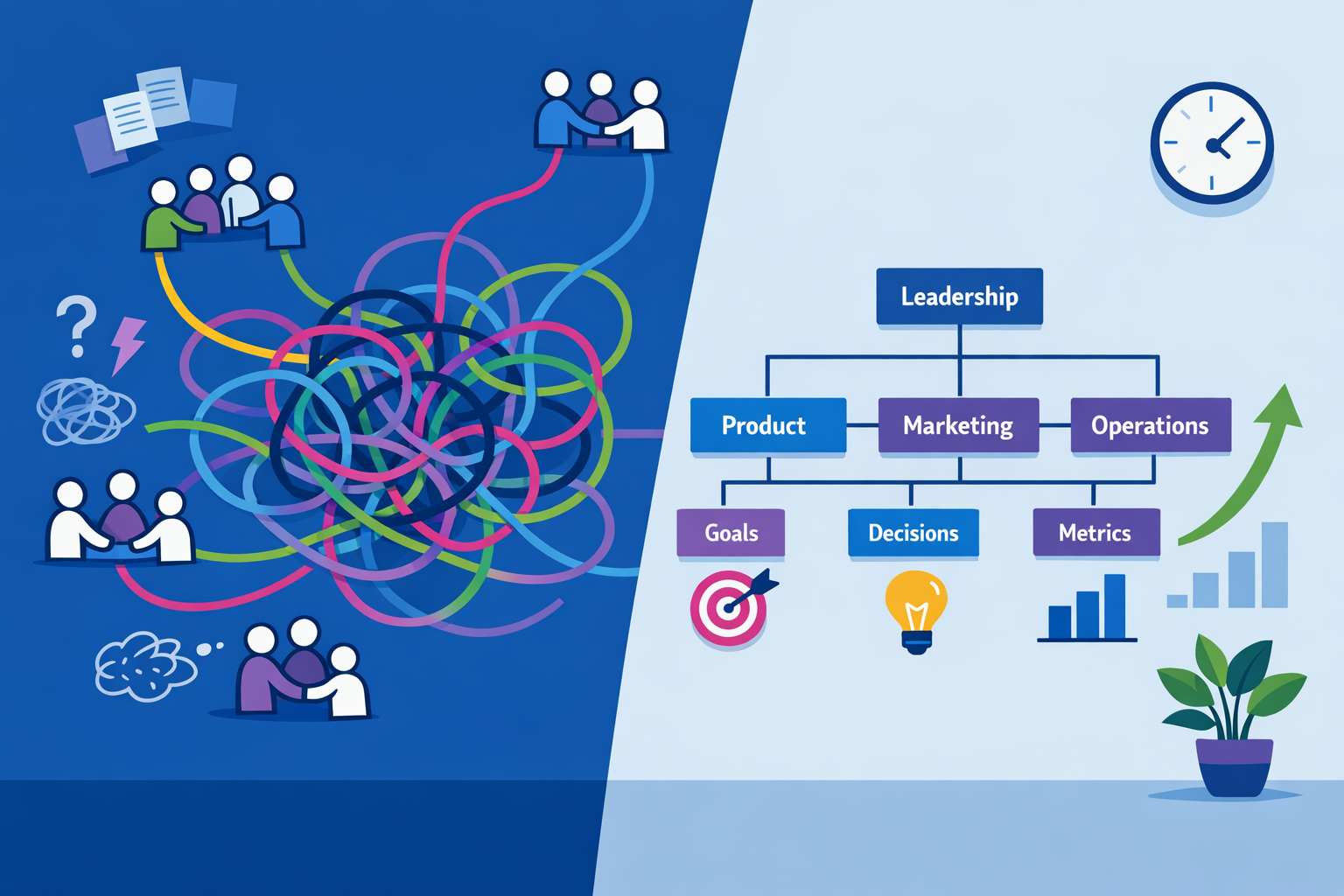
Role clarity collapses when teams scale. Not because your people got worse, but because the system that used to live in your head no longer fits in the room.
At 8 people, you can rely on trust, proximity, and “I’ll just handle it”. At 30, that becomes friction. At 80, it becomes failure.
You see it in the symptoms:
- Decisions slow down because nobody knows who has the call.
- Work gets duplicated because two teams think they own the same outcome.
- Critical work gets dropped because everyone assumed “someone else” had it.
- Strong performers burn out, carrying the invisible glue work.
- Meetings multiply to compensate for missing clarity.
Here is the harsh truth. You do not have an execution problem. You have an accountability design problem.
This article shows you how to create role clarity in scaling teams without drowning in bureaucracy. You will get practical tools, templates you can copy, and a high level plan that works whether you are 15 people or 150.
What role clarity actually means (and what it does not)
Role clarity is not a job description. Job descriptions are usually fluffy, outdated, and written to satisfy HR rather than delivery.
Role clarity is three things, written down and agreed:
- What outcomes a role owns. Not tasks. Outcomes.
- What decisions a role can make without permission. Decision rights.
- What interfaces a role must manage. Handoffs, dependencies, service levels.
If you only do (1), you will still get decision bottlenecks.
If you only do (2), you will get local optimisation and cross team collisions.
If you only do (3), you will get coordination theatre where nobody is accountable.
Real role clarity is a complete operating contract.
Why role clarity breaks specifically during scaling
Scaling creates more work than you can see. Not more “doing” work, more “alignment” work.
The failure modes are predictable.
1) Success promotes specialists into generalist leadership
Your best individual contributor becomes a team lead. They still do the work because it is faster, and because letting go feels risky.
Result:
- The team becomes dependent on one person
- Others stop owning outcomes
- Leadership capacity never actually gets created
2) The organisation outgrows informal agreements
Early stage teams run on unwritten rules.
- “Product decides priority.”
- “Sales can promise anything.”
- “Ops will catch it.”
When you double headcount, those rules fragment into tribal versions. People argue from memory and personal history, not from a shared system.
3) You add layers, but not clarity
You hire managers, but you do not redesign accountability.
So you end up with:
- A new layer that reports up
- The same ambiguity sideways
- Even slower decisions because everything routes through “management”
4) You confuse activity with ownership
When leaders feel the organisation slipping, they add:
- More meetings
- More reports
- More project tracking
None of that creates ownership. It just creates motion.
The scaling leader’s dilemma: clarity without bureaucracy
Senior leaders often avoid role clarity work because they fear red tape. That fear is rational.
Bad role clarity looks like this:
- 12 page job specs nobody reads
- Endless RACI charts that get argued into meaninglessness
- A process for every scenario
Good role clarity looks like this:
- A one page role scorecard per critical role
- A simple decision framework everyone can use
- Clear boundaries that reduce meetings, not create them
Your goal is not documentation. Your goal is speed with control.
Start with outcomes: build role scorecards, not job descriptions
If you want role clarity, you need one artefact that becomes the source of truth.
Use a Role Scorecard. One page. Maximum.
The Role Scorecard template (copy this)
For each role, document:
- Role purpose (one sentence)
- Why this role exists in the system
- 5 to 7 outcomes owned (measurable)
- Outcomes must be observable, not vague
- Key metrics (3 to 5)
- Lag and lead indicators
- Decision rights
- Decisions this role owns
- Decisions this role influences
- Decisions this role is consulted on
- Interfaces (top 5 relationships)
- What this role provides
- What this role needs
- Expected cadence and service level
That is it.
If it does not fit on one page, you are hiding confusion inside complexity.
Examples of strong outcomes vs weak outcomes
Weak outcome:
- “Support the sales team.”
Strong outcomes:
- “Sales proposals include validated delivery assumptions with less than 5% rework required by delivery.”
- “Sales commitments meet on time delivery targets at least 95% of the time.”
Weak outcome:
- “Manage the team.”
Strong outcomes:
- “Team delivers agreed quarterly plan with at least 85% completion and no critical priority drift.”
- “Team capability plan is executed with named successors for all key roles.”
Outcomes make accountability visible. Anything else invites debate.
Define decision rights: stop routing everything to the top
Decision ambiguity is the silent killer of scaling teams.
If your leadership team is constantly pulled into operational decisions, it is not because you have high standards. It is because you have not specified who decides.
Use a simple decision taxonomy
For each recurring decision, assign one of these:
- Decide: One role owns the call.
- Recommend: One role proposes and justifies.
- Input: Roles that must be consulted before the call.
- Execute: Roles accountable for implementation.
This is similar to RAPID style models, and it works because it separates “having a voice” from “having the vote”.
The 10 decisions you must clarify when scaling
Do not start by mapping everything. Start with the decisions that create the most friction:
- What gets built next (priority and sequencing)
- What gets fixed now (interrupt handling)
- What is considered “good enough” quality
- What a customer can be promised and by whom
- Pricing exceptions and discount authority
- Hiring approval and role design
- Performance management and promotions
- Tooling and systems changes
- Cross team dependencies and resourcing
- When to stop, pause, or kill a project
If you clarify these ten, you remove 80% of the organisational drag.
Map interfaces: most “people problems” are broken handoffs
In scaling teams, the mess is rarely inside a team. It is between teams.
That is where:
- priorities collide
- assumptions go untested
- ownership gets fuzzy
You need interface clarity, not just role clarity.
Build a simple “team API” for each function
Yes, like an engineering API. Because organisations are systems.
For each team, define:
- What we provide (services and outputs)
- Entry criteria (what must be true before work starts)
- Exit criteria (definition of done)
- Response times (service levels)
- Escalation path (who resolves disputes)
This prevents the classic scaling failure where every request becomes a negotiation.
Example: Sales to Delivery interface
- Provide: signed scope, validated requirements, delivery assumptions
- Entry criteria: scope signed, customer readiness confirmed, delivery capacity confirmed
- Exit criteria: handover completed, risks logged, timelines agreed
- Response times: handover within 5 working days of signature
- Escalation: Head of Sales and Head of Delivery resolve within 48 hours
You will notice this is not about feelings. It is about contractual clarity.
Use the PerformanceNinja 6Ps to diagnose where clarity is breaking
Role clarity does not exist in isolation. It is the downstream consequence of how the organisation is designed.
Use the 6Ps to locate the real cause:
- Purpose: Are we clear on the non negotiables and what winning looks like?
- People: Do we have leaders who can delegate outcomes, not just tasks?
- Proposition: Are we selling and delivering the same promise?
- Process: Do roles match the way work actually flows, or an org chart fantasy?
- Productivity: Do we have a cadence for prioritisation, commitments, and follow up?
- Potential: Are innovation efforts clearly owned, or treated as side quests?
If you try to fix role clarity without addressing these, you will be back in the same mess in six months.
The anti-patterns that destroy role clarity (even with good docs)
Most leaders do some role work, then sabotage it without realising.
Anti-pattern 1: “Everyone owns customer success”
No. Everyone contributes. Someone owns.
When everyone owns it, nobody is accountable for the outcome, and the strongest person becomes the default owner.
Anti-pattern 2: Matrix accountability without strong decision rights
Matrix structures can work. But only when decision rights are explicit and leaders are aligned.
If you have:
- dual reporting lines
- shared priorities
- unclear escalation
You have created an accountability fog.
Anti-pattern 3: Promoting without redefining the role
When a role changes, the scorecard must change.
Otherwise you keep measuring someone against the old job, and they keep behaving like they are still in it.
Anti-pattern 4: Using values to avoid hard boundaries
Values are not a substitute for accountability.
“Be collaborative” often becomes code for “let’s keep this vague so nobody gets upset”. That is leadership avoidance.
A practical method: the Role Clarity Sprint (2 weeks)
You do not need a six month org redesign programme to get traction. You need a short, intense push that produces real artefacts and decisions.
Here is a high level plan you can run internally.
Week 1: Diagnose and draft
- Pick the scope
- Choose one value stream or one business unit, not the whole company
- List the top 15 recurring friction points
- Use evidence: missed deadlines, escalations, customer issues
- Identify the critical roles
- Typically 8 to 15 roles in the scope
- Draft Role Scorecards
- Leader drafts, role holder reviews
Week 2: Decide and lock
- Run a decision rights workshop
- Focus on the top ten decisions
- Map the key interfaces
- Create team APIs for the main handoffs
- Publish the artefacts
- One source of truth, versioned
- Set the enforcement mechanism
- Weekly operating cadence checks role clarity breaches
Your output at the end of two weeks:
- Role scorecards that actually define ownership
- A decision map for high friction decisions
- Clear interface contracts between teams
This is enough to materially increase delivery speed.
How to embed role clarity so it survives growth
Role clarity is not a one off project. It is a system.
1) Tie role clarity to planning and prioritisation
Every quarter, when you plan:
- confirm the outcomes for each role still match the strategy
- remove outcomes that no longer matter
- add outcomes created by new priorities
If the plan changes but roles do not, you are setting people up to fail.
2) Use role scorecards in performance conversations
Stop reviewing people purely on effort or “being busy”. Review:
- outcomes delivered
- decisions made well
- how they managed interfaces
This reduces politics because the conversation is anchored to observable facts.
3) Create a single escalation rule
When two roles disagree, the escalation path must be explicit.
A simple rule:
- “If we cannot resolve in 24 hours, we escalate to the single leader accountable for the shared outcome.”
No more circular debates.
4) Onboard into the operating system, not just the company
Most onboarding focuses on culture and tools.
Scaling teams need onboarding that teaches:
- who owns what outcomes
- how decisions are made
- how work enters and exits teams
If new hires cannot explain the decision flow in their first month, you have failed onboarding.
What to do when two roles legitimately overlap
Overlap is not always bad. It can be deliberate redundancy or shared ownership at the edges.
But overlap must be explicit.
Use this simple rule:
- One role owns the outcome.
- Multiple roles can own tasks.
If you need shared ownership, define:
- what “shared” means in practice
- which leader breaks deadlocks
- what metrics prove it is working
Otherwise you get ambiguity disguised as collaboration.
The leadership standard: clarity is kindness, vagueness is negligence
Leaders often think role clarity is restrictive. It is the opposite.
Clarity gives capable people room to move without constantly seeking permission.
Vagueness creates:
- politics
- stress
- hidden work
- slow delivery
If your organisation is scaling and role clarity is not improving, you are accumulating organisational debt. Like technical debt, it compounds. And eventually it breaks the product, the culture, or both.
Your next step is not to run more meetings.
Your next step is to decide who owns what, who decides what, and how teams interact, then write it down and run the business against it.
That is how you create role clarity in scaling teams. Not as paperwork, but as an operating advantage.
Next Steps
Want to learn more? Check out these articles:
5 Critical Questions to Improve Any System
Transforming Company Culture: Leveraging Organisation Design for Strategic Change[Insights]
Maximising Team Performance with Strategic Organisational Structures [Expert Tips]
To find out how PerformanceNinja could help you, book a free strategy call or take a look at our Performance Intelligence Leadership Development Programme.