
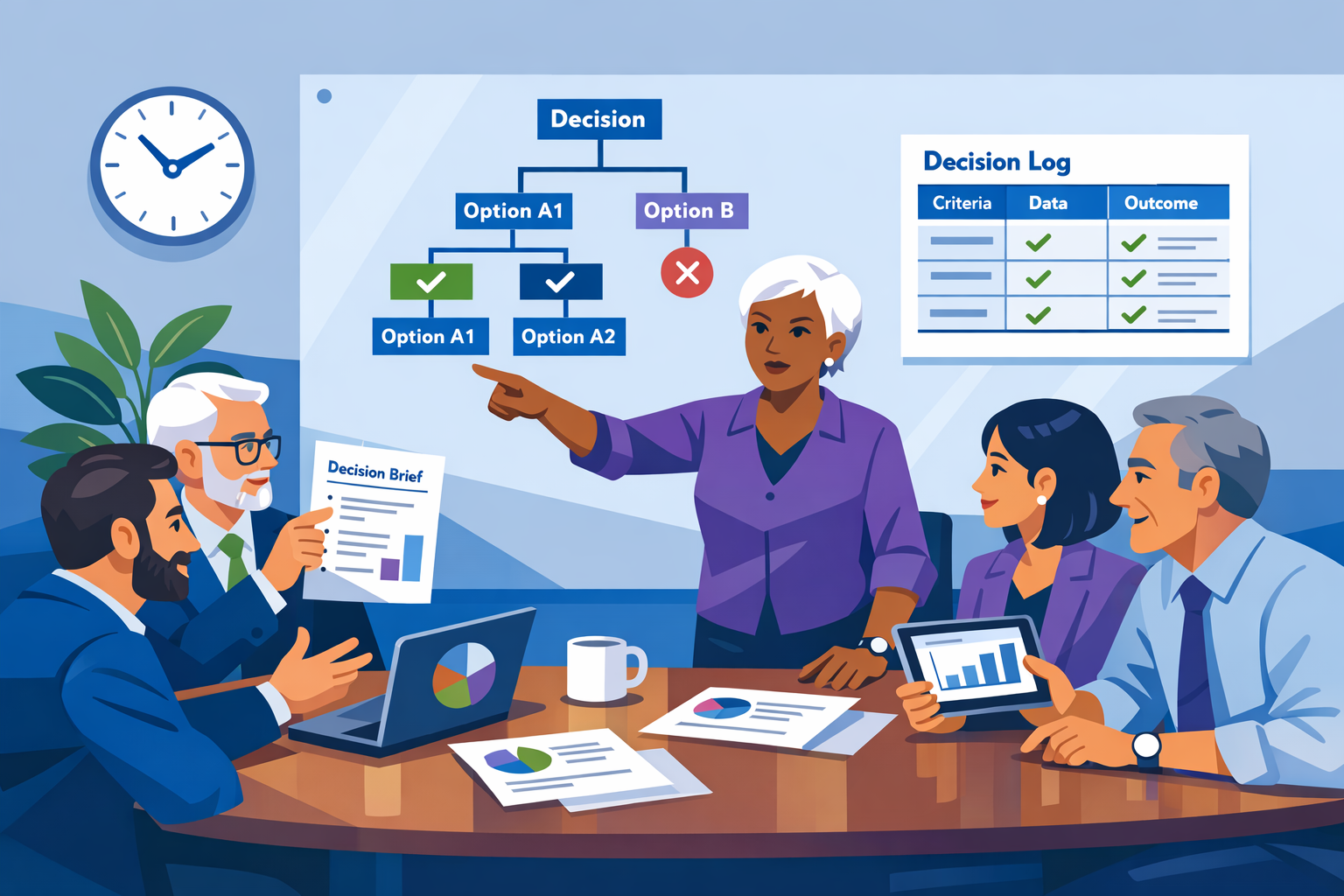
Improve Leadership Team Decision Quality Without More Meetings
Leadership teams do not have a decision problem. They have a decision system problem.
Most senior teams think their decisions are “fine”. They are not.
They are slow. They are vague. They are reversible but treated as irreversible. They are irreversible but treated as reversible. They are made with half the facts and twice the confidence. Then everyone leaves the room and interprets the outcome differently.
If this feels familiar, you are not dealing with a few “people issues”. You are staring at an operating system flaw.
Decision quality is not a personality trait. It is an engineered capability.
And if you do not engineer it, your organisation will pay in three currencies:
- Time wasted in circular alignment conversations
- Money burned on priority churn and rework
- Trust eroded because outcomes do not match promises
This article gives you a practical, no-nonsense playbook on how to improve leadership team decision quality without adding bureaucracy or scheduling more meetings.
What “high decision quality” actually means
Leadership teams confuse “a decision was made” with “a good decision was made”. These are not the same.
High decision quality has five non-negotiable traits:
- Clarity: everyone can state what was decided in one sentence
- Logic: the decision has explicit reasoning, assumptions, and trade-offs
- Speed: decisions are made at the last responsible moment, not after it
- Ownership: one person is accountable for the call and its outcome
- Execution linkage: the decision immediately converts into actions, measures, and follow-up
If you do not have all five, your “decision” is usually a discussion with a vague ending.
The brutal truth: your team is probably optimising for comfort
Most leadership teams unconsciously optimise for:
- Not upsetting each other
- Not looking stupid
- Not being blamed later
- Not confronting hard trade-offs
That optimisation creates the same predictable dysfunctions.
Symptom 1: You confuse consensus with quality
Consensus feels safe. It is also expensive.
When everyone must agree, you get the decision that offends nobody and solves nothing.
Symptom 2: You debate opinions because you did not define evidence
Without a shared definition of “what counts as truth”, the loudest person wins. Or the most senior. Or the most exhausted.
Symptom 3: You allow “drive-by decisions”
A senior leader drops a thought at the end of a meeting and it becomes gospel, without analysis, without ownership, without follow-up.
Symptom 4: You do not separate reversible from irreversible decisions
Some decisions should be fast, light, and tested. Others require rigour. Most teams apply the same weight to everything, which means:
- trivial choices take weeks
- existential bets get waved through
Symptom 5: You keep making the same decision again
If you are “revisiting” the same topic every month, you did not decide. You postponed.
The core principle: decision quality improves when you engineer constraints
The best leadership teams are not better because they are smarter. They are better because they run a tighter system.
Constraints create quality:
- clear roles reduce politics
- defined inputs reduce opinions
- timeboxes reduce spiralling
- explicit trade-offs reduce fantasy plans
This is productivity for leadership, not admin.
At PerformanceNinja we often zoom out using the 6Ps. Decision quality sits heavily in Productivity and Process, but it is downstream of Purpose and Proposition. If you are unclear on direction, no decision method will save you. It will just help you disagree faster.
Step 1: Classify decisions properly (or you will manage them wrong)
Every leadership team needs a shared taxonomy. Use this simple model.
Type A: One-way door decisions (hard to reverse)
Examples:
- acquiring a company
- entering a new market
- changing core pricing model
- redesigning the organisation structure
Rules:
- require explicit options and trade-offs
- require pre-mortem risk analysis
- require a named accountable owner
- require a decision record and a follow-up date
Type B: Two-way door decisions (easy to reverse)
Examples:
- running a three-week experiment
- trialling a new sales script
- piloting a new internal process
Rules:
- decide fast
- timebox the experiment
- measure outcomes
- kill or scale quickly
Your current problem is likely that you treat Type B like Type A, then you procrastinate. Or you treat Type A like Type B, then you gamble.
Step 2: Fix decision rights using one page, not a re-org
Ambiguity in decision rights creates three behaviours:
- people over-consult to avoid blame
- people under-consult to move fast
- people fight because boundaries are unclear
You fix this with a decision rights map.
The “Decision Owner” rule
For every decision that matters, assign:
- Decision Owner (one person) who is accountable for the call
- Contributors who provide specific inputs
- Approvers only if truly required
- Informed stakeholders who need the context
This is similar to a RACI, but with less theatre and more accountability.
Practical standard:
- If more than one person is “Accountable”, no one is.
- If everyone is a “Contributor”, you are inviting politics.
- If you need three “Approvers”, your org design is doing decision-making by committee.
Step 3: Standardise what “good input” looks like
Leadership teams drown in low-quality input. Slide decks stuffed with activity, not insight. Data with no interpretation. Risks with no mitigation.
Define a minimum viable decision brief.
The 6-box decision brief (fits on one page)
Require these six elements for Type A decisions and for any Type B decision that costs real money.
- Decision statement: what exactly are we deciding?
- Options: at least two viable paths, plus “do nothing”
- Recommendation: what does the Decision Owner propose?
- Evidence: the 3 to 5 facts that matter most
- Trade-offs: what gets worse if we do this?
- Reversibility and next review: how reversible is it and when do we review?
This forces rigour without slowing everything down.
Also: ban “information sharing” decks in leadership meetings. If it is not a decision, a risk, or a dependency, it should be written and read asynchronously.
Step 4: Run meetings like a decision factory, not a talking shop
Your leadership meeting should have one primary output: decisions that convert into execution.
A practical agenda that improves decision quality fast
Structure your weekly or fortnightly leadership meeting like this:
- Scoreboard (10 minutes)
- top 5 metrics
- what moved, what did not, why it matters
- Decision queue (60 minutes)
- 2 to 4 decisions only
- each has a Decision Owner and a brief
- Dependencies and commitments (15 minutes)
- who needs what from whom by when
- Risks and escalations (10 minutes)
- what could break execution in the next 30 days
- Close (5 minutes)
- restate decisions in one sentence each
- confirm owners and due dates
If your meeting has 12 agenda items, you are not leading. You are running a status carousel.
Use timeboxes aggressively
Timeboxes are not rude. They are respectful.
- If the team cannot decide in the timebox, the problem is either missing input or unclear decision rights.
- Park it, assign the missing work, bring it back properly.
Step 5: Make disagreement productive, not personal
High-performing teams are not low-conflict. They are high-trust and high-standards.
If your team avoids tension, you will pay for it in poor decisions.
Three rules that change the tone instantly
- Debate the trade-off, not the person
- “This option weakens margin” is acceptable
- “You always push for margin” is lazy and personal
- Steelman before you criticise
- restate the other view in a way they agree is fair
- then challenge it
- Disagree and commit is not optional
- after the decision, everyone backs it in public
- if you cannot commit, say so in the room and explain why
This is how you stop passive resistance, the silent killer of execution.
Step 6: Install a decision log, because memory is not a system
Most organisations have a graveyard of decisions that were never written down.
So later you get:
- “I thought we decided X”
- “No, we agreed Y”
- “Why are we doing this again?”
A decision log fixes this in a brutally simple way.
What to record (and what not to)
Record:
- decision statement
- date
- Decision Owner
- what was decided
- key assumptions
- success measures
- review date
Do not record:
- every comment from every person
- long meeting minutes nobody reads
A lightweight log creates organisational memory and reduces re-litigation.
Step 7: Link every decision to execution in the same hour
A decision that does not produce actions is theatre.
Before the meeting ends, convert decisions into:
- 3 to 7 concrete tasks
- one owner per task
- a due date that is actually a date
- a definition of done
Then follow up using a single mechanism. Not five. Not “we will just remember”.
Common failure mode: leaders assign tasks but do not create a follow-up rhythm, so delivery slips and people learn that commitments are optional.
If you want decision quality, you need consequence.
Step 8: Use pre-mortems to expose blind spots before reality does
Leadership teams are optimistic by design. That is why they are in charge. It is also why they walk into predictable disasters.
A pre-mortem is simple:
- assume the decision failed spectacularly 12 months from now
- list the reasons it failed
- design mitigations now
This approach is supported by decision science research popularised by Gary Klein, and it works because it bypasses ego. People find it easier to talk about “future failure” than “current flaws”.
Do this for Type A decisions. Every time.
Step 9: Audit decision quality like you audit financials
If you do not measure it, you are guessing.
A simple quarterly decision review
Pick the last 10 significant decisions and score them:
- Was the decision statement clear?
- Were options explicit?
- Was there a named Decision Owner?
- Were assumptions recorded?
- Did we execute on time?
- Did outcomes match intent?
- Did we review and learn?
Patterns show up fast. So do the root causes:
- unclear strategy (Purpose and Proposition problem)
- capability gaps (People problem)
- messy operating rhythm (Process and Productivity problem)
This is where senior leadership stops performing and starts improving.
The hidden killer: misaligned incentives inside the leadership team
You can install decision briefs and logs and still get poor decisions if leaders are protecting their function instead of the enterprise.
Warning signs:
- leaders argue for headcount, not outcomes
- decisions optimise departmental metrics at the expense of customer value
- “that is not my area” appears in leadership meetings
Fixes are not motivational posters. They are structural:
- align leadership scorecards to enterprise outcomes
- force shared metrics across functions (for example, revenue and margin together, not separately)
- make cross-functional initiatives have one accountable owner, not a committee
If incentives are misaligned, decision quality will be political.
A brief implementation plan (30 days, not 12 months)
You do not need a transformation programme. You need a reset.
Week 1: Make the rules visible
- agree the Type A vs Type B classification
- define Decision Owner, Contributors, Approvers, Informed
- introduce the one-page decision brief
Week 2: Change the meeting
- cut the leadership agenda to scoreboard, decision queue, dependencies, risks
- cap decisions per meeting at 4
- add timeboxes
Week 3: Install the memory
- start a decision log
- assign one person to maintain it (usually the ops lead or chief of staff)
Week 4: Tie decisions to delivery
- ensure every decision generates tasks, owners, due dates
- introduce a weekly follow-up mechanism that is non-negotiable
After 30 days, run a decision quality audit on the first month. You will see improvement immediately if you enforce the rules.
What great looks like
When leadership team decision quality improves, the organisation feels different.
- meetings get shorter and sharper
- priorities stop thrashing
- teams get clearer direction
- accountability becomes normal
- execution accelerates because ambiguity drops
This is not “soft stuff”. It is the hard edge of organisational performance.
If your organisation is growing, complexity will increase. The only question is whether your decision system is keeping up.
Because if it is not, the market will not wait for you to get better at meetings. It will simply select a competitor who already has.
Next Steps
Want to learn more? Check out these articles:
Build a Leadership Decision Log That Forces Accountability
How to Improve Goal Clarity in Leadership Teams Fast
Leadership Operating Principles: Scale Teams Without Chaos
To find out how PerformanceNinja could help you, book a free strategy call or take a look at our Performance Intelligence Leadership Development Programme.