
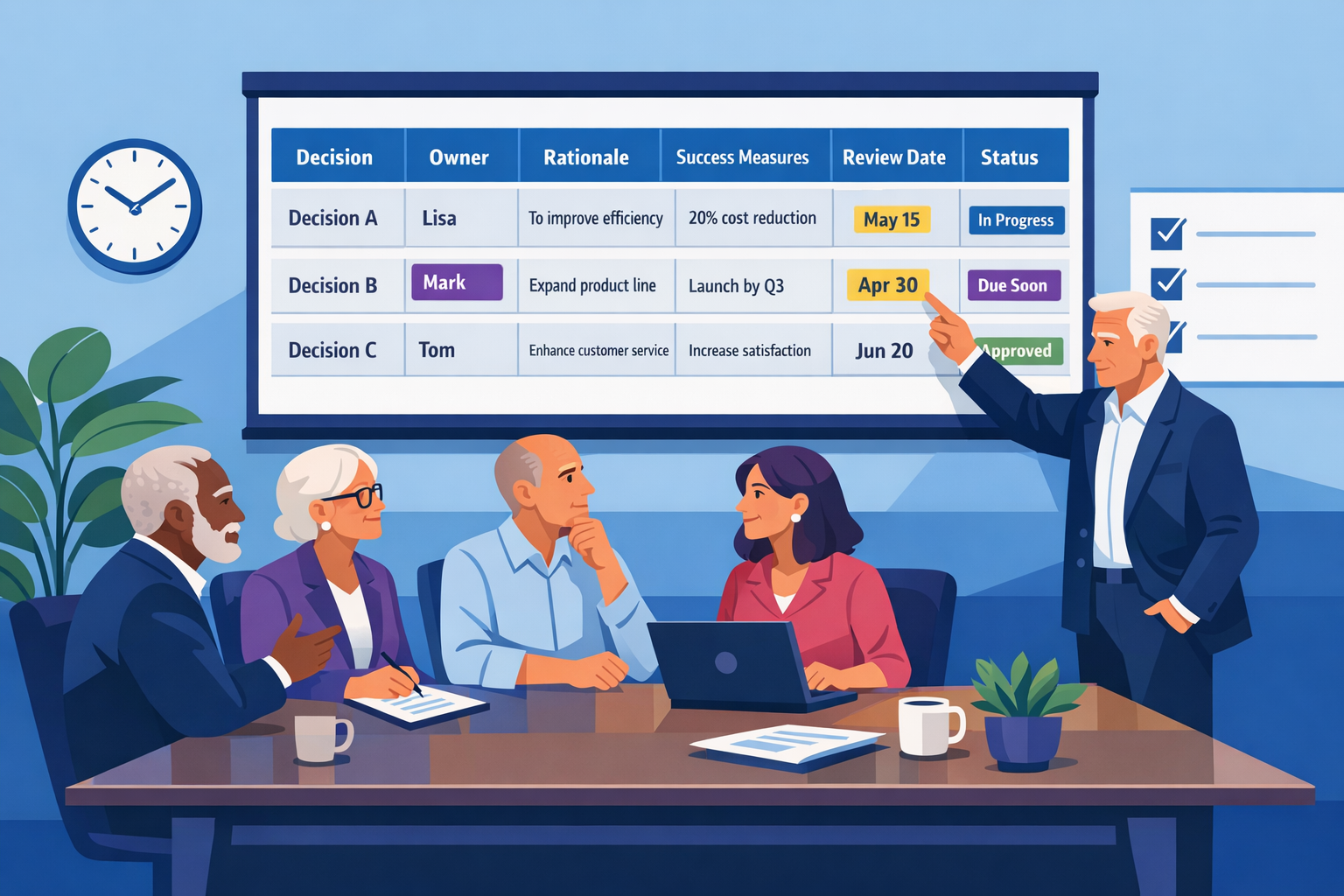
Build a Leadership Decision Log That Forces Accountability
Most leadership teams are not short on decisions. They are short on decisions that stick.
You have seen it. A decision gets made in a meeting. Everyone nods. Then two weeks later the same topic comes back like a bad debt, except now it is wrapped in confusion.
Who decided this?
Why did we do it?
What were we trying to achieve?
What assumptions did we make?
What changed?
This is not a communication problem. It is an accountability system problem.
A leadership decision log fixes that. Not a fluffy “notes” document. Not a graveyard of meeting minutes. A decision log is a deliberately designed mechanism that turns leadership intent into organisational memory, follow-through, and measurable outcomes.
Used properly, it does three brutal things that many leaders secretly avoid.
- It makes decisions traceable.
- It makes ownership undeniable.
- It makes reversal expensive (in the right way).
This article shows you exactly how to build a decision log that improves accountability, reduces re-litigating, and sharpens execution without adding bureaucracy.
Why leadership teams keep re-deciding the same things
If your team is re-deciding, you have one of these pathologies.
1) You confuse a conversation with a decision
Most leadership meetings produce lots of words and very few commitments. People leave with “alignment” that exists only in their own head. In practice, you have created plausible deniability.
A decision log draws a hard line between:
- Discussion (inputs and debate)
- Decision (the chosen path)
- Directive (who does what by when)
2) You outsource accountability to memory
Memory is a terrible system. It is emotional, biased, and vulnerable to status games.
Without a written record, the most confident person in the room often becomes the historian. That is how organisations drift.
3) You do not specify what “good” looks like
Many leadership decisions are framed as actions, not outcomes.
“Launch the new service line” is not a decision. It is a vague ambition. A real decision includes success measures and constraints.
4) You let decisions float without a review trigger
Some decisions should be revisited. Most should not be reopened every time someone new has an opinion.
A decision log gives you a review cadence and clear rules for when a decision can be challenged.
What a decision log is (and what it is not)
A leadership decision log is a single source of truth that captures the organisation’s most important decisions in a structured format, so that:
- People can execute without interpretation
- Leaders can inspect progress without micromanaging
- Teams can escalate issues without political theatre
- Future leaders can understand context, constraints, and trade-offs
It is not:
- A transcript of meetings
- A document for everything (only decisions that matter)
- A tool for blame
- A replacement for your project plan or OKRs
Think of it as your leadership team’s “flight recorder”. When performance dips, you can look back at what you decided, when, and why.
The accountability outcome you are actually aiming for
Accountability is not “people trying harder”. Accountability is a design problem.
A good decision log creates three concrete accountability effects.
Effect 1: Decision integrity
Once decided, the organisation behaves as if it is true until formally changed. That discipline alone eliminates enormous execution waste.
Effect 2: Role clarity
People know who owns the decision, who executes, who must be consulted, and who needs to be informed. The decision log makes this explicit.
Effect 3: Outcome pressure
Leaders stop celebrating activity and start tracking results. Each decision has success metrics, a check-in date, and an explicit “how we will know”.
If you want a quick diagnostic, ask this in your next exec meeting:
“Name the five most important decisions we have made in the last 60 days and the measurable outcomes we expect.”
If the room goes quiet, you need a decision log.
The minimum viable leadership decision log template
Keep the template simple. Complexity kills adoption. But do not make it so thin that it becomes meaningless.
Here is a minimum viable template that works across most leadership teams.
Decision log fields (use these as columns)
- Decision ID (unique reference, for example DL-2026-014)
- Date decided
- Decision statement (one sentence, unambiguous)
- Decision owner (single person, not a team)
- Decision type (strategic, policy, investment, priority, customer, people, risk)
- Context and problem (two to four lines, not a novel)
- Options considered (bullet list, include “do nothing”)
- Rationale (why this option won)
- Assumptions (what must be true for this to work)
- Constraints (budget, capacity, brand, compliance, time)
- Success measures (leading and lagging indicators)
- Actions and commitments (who does what by when)
- Review date (when we will inspect outcomes)
- Status (on track, at risk, off track, superseded)
- Links (to strategy doc, project plan, risk register, customer insight)
This structure is not theoretical. It forces clarity in exactly the places leadership teams tend to stay vague.
Examples of strong decision statements
- Weak: “We should improve customer onboarding.”
- Strong: “We will replace onboarding calls with a 14-day guided product tour for SMB customers, effective 1 September, to reduce time-to-value and free up 20 hours per week of CSM capacity.”
- Weak: “Let’s invest in sales.”
- Strong: “We will hire two enterprise AEs in Q3 with a combined OTE of £320k and a 9-month payback requirement, funded by pausing the APAC expansion workstream.”
If your decision statement cannot survive being read by someone who was not in the room, it is not yet a decision.
Which decisions belong in the log (and which do not)
If you log everything, you create noise. If you log nothing, you create chaos. You need a rule.
Use this filter.
Log it if it meets any of these criteria
- Material impact on revenue, cost, risk, brand, or customer outcomes
- Cross-team dependency where coordination failure is likely
- Irreversibility or high switching cost
- Policy-setting decisions that shape behaviour at scale
- Resource allocation decisions (budget, headcount, priority trade-offs)
- Strategic direction decisions that affect the organisation’s “why, how, what”
Do not log these
- Routine operational choices that are clearly within someone’s role
- Temporary one-off admin decisions
- Decisions that are actually tasks (unless they have material impact)
A good benchmark is 5 to 20 logged decisions per month for most mid-sized leadership teams. If you are logging 80, you are avoiding real prioritisation.
The brutal rule: one decision, one owner
A decision without a single accountable owner is theatre.
The owner is not the person who does all the work. The owner is the person who is accountable for:
- Getting the decision made
- Ensuring the decision is communicated
- Ensuring follow-through is tracked
- Bringing it back for review with evidence
If your culture avoids naming an owner because it feels “political”, you already have politics. You just have them without clarity.
How to design the log so people actually use it
Most decision logs fail because they are built like a compliance artefact. The team fills it in once, then forgets it exists.
Adoption is a design choice. Here are the non-negotiables.
1) Make it visible by default
Do not hide it in someone’s personal notes or a buried folder. Put it in a shared workspace where leadership already works.
- If you live in Microsoft 365, use a SharePoint list or Loop table.
- If you live in Google Workspace, use a Sheet with protected structure.
- If you are more operationally mature, use a lightweight tool like Airtable.
The platform matters less than visibility and consistent usage.
2) Make the log part of the meeting, not a by-product
The decision log must be updated live during the meeting. If you “capture later”, it will not happen, or it will be rewritten to match someone’s ego.
Assign a decision scribe. Rotate the role. It keeps everyone honest.
3) Time-box the writing, not the thinking
Leaders often resist documentation because they fear it will slow them down.
Good. Some decisions should be slowed down.
But the log should not become a writing exercise. Force brevity:
- Context: maximum 4 lines
- Rationale: maximum 3 bullet points
- Assumptions: maximum 5 bullets
If you cannot express it within those limits, you are not clear enough yet.
4) Add a “decision confidence” rating
This is a simple field that changes behaviour. Use a 1 to 5 rating.
- 1: Guessing
- 3: Reasonable confidence with known gaps
- 5: High confidence with strong evidence
Why it works: it makes uncertainty explicit without paralysing action. It also tells you which decisions need faster review.
Decision log governance: the rules that prevent chaos
You need clear rules so the log becomes a system, not a scrapbook.
Rule 1: Decisions are binding until superseded
If someone wants to change a decision, they must create a new log entry that references the old one and explains what changed.
This kills the destructive habit of “quiet reversal” through side conversations.
Rule 2: Every decision has a review date
No review date, no decision. It can be 2 weeks or 6 months. But it must exist.
This aligns with how effective organisations learn. Decisions are hypotheses. Review dates are how you validate them.
Rule 3: Disagree and commit is recorded
If there was material dissent, record it in one line, including who disagreed and the core concern.
This does two things:
- It reduces passive-aggressive sabotage because concerns were formally aired.
- It improves learning later because you can see what risks were anticipated.
This echoes a principle seen in high-performing teams. Psychological safety is not “being nice”. It is being able to tell the truth and still align on action.
Rule 4: The log is reviewed every leadership cadence
Weekly exec meeting? Review the log weekly.
Monthly governance meeting? Review monthly.
The point is consistency. Accountability dies when it is seasonal.
How a decision log connects to organisational performance
At PerformanceNinja we often zoom out using the 6Ps to see the whole machine. A decision log is not a standalone hack. It is a structural lever that ties together the system.
- Purpose: Decisions reference the “why” so trade-offs stay anchored.
- People: Ownership becomes explicit. Leadership expectations become measurable.
- Proposition: Product and market bets are recorded, so strategy does not drift.
- Process: Decision-making becomes a repeatable mechanism, not an art form.
- Productivity: Follow-through improves because commitments are visible and reviewed.
- Potential: Innovation bets are tracked with assumptions and learning cycles, not hope.
This is why a decision log is one of the simplest ways to reduce organisational entropy as you scale.
The most common mistakes (and how to avoid them)
If you implement a decision log and it does not change behaviour, you have likely fallen into one of these traps.
Mistake 1: Logging tasks, not decisions
If your log is full of “John to send proposal” you have built a to-do list. That is not leadership.
Fix: only log decisions with material impact and trade-offs.
Mistake 2: No success measures
This is the accountability killer. If you do not define success, you can always claim success.
Fix: use a two-layer approach.
- Leading indicators: early signals (adoption, cycle time, pipeline)
- Lagging indicators: outcome measures (revenue, churn, margin, NPS)
Mistake 3: Consensus addiction
Leadership teams that require everyone to agree produce slow, diluted decisions. Then they blame execution.
Fix: define decision rights. Who decides, who provides input, who is informed. If you want a simple model, borrow the spirit of RAPID decision roles. The goal is speed with clarity, not speed with chaos.
Mistake 4: A log that is not used to run the business
If the log is not referenced in meetings, it becomes a dead artefact.
Fix: make it the first agenda item in every exec meeting for 10 minutes.
- What decisions are due for review?
- What decisions are off track?
- What decisions are blocked because actions are not happening?
A simple implementation plan (high-level, fast)
You do not need a transformation programme. You need disciplined installation.
Week 1: Build and trial
- Create the template in your chosen tool.
- Agree the filter for what gets logged.
- Nominate an owner for the log itself (often Chief of Staff, COO, or Ops lead).
- Trial it in one leadership meeting and log 5 to 10 recent decisions retroactively.
Week 2 to 3: Make it a habit
- Update the log live in every exec meeting.
- Add review dates to every decision.
- Start the meeting with a 10-minute decision review.
Week 4: Tighten accountability
- Add success measures to all active decisions.
- Add status and escalation rules (on track, at risk, off track).
- Introduce the “superseded decision” rule to prevent silent reversals.
By the end of month one, you will feel a shift. Less noise. Fewer circular debates. More delivery.
Decision reviews: where the learning and accountability live
The log is not just for recording. The real power is in the review.
When the review date arrives, the decision owner must answer five questions with evidence.
- What did we expect to happen?
- What actually happened?
- What assumptions were wrong?
- What did we learn that changes our next decision?
- Do we continue, adjust, or reverse (with a new logged decision)?
This is how you build an organisation that gets smarter, not just bigger.
It also stops the most corrosive leadership behaviour of all: making bold decisions, then disappearing when consequences arrive.
The punchline: accountability is not a personality trait
Many leaders treat accountability like a moral virtue. It is not. It is an operating system.
If you want a team that executes, do not beg for “ownership”. Do not run another workshop on “communication”. Do not send another email summarising “what we agreed”.
Install a leadership decision log. Use it live. Review it relentlessly. Tie decisions to outcomes. Make reversals explicit. Name owners.
Then watch what happens.
- Meetings get shorter because you stop talking in circles.
- Execution gets sharper because commitments are visible.
- Politics reduce because the record is the record.
- Trust increases because decisions stop shifting under people’s feet.
Leaders do not need more charisma. They need more clarity, more follow-through, and a system that refuses to let them hide.
Next Steps
Want to learn more? Check out these articles:
How to Improve Goal Clarity in Leadership Teams Fast
Leadership Operating Principles: Scale Teams Without Chaos
Effective One-to-One Meetings: A Manager’s No-Nonsense Playbook
To find out how PerformanceNinja could help you, book a free strategy call or take a look at our Performance Intelligence Leadership Development Programme.