
Strategic Alignment in Scaling Teams: A Practical Playbook
Scaling does not break because you hired too fast.
Scaling breaks because your organisation starts behaving like a room full of people shouting “yes” while each building something different.
That is strategic misalignment. It is not a soft problem. It is an execution tax that compounds every week: duplicated work, conflicting priorities, surprise dependencies, political trade-offs, missed quarters, and leaders spending their lives “clarifying” what should already be obvious.
If you are leading a scaling team and you feel like you are constantly re-explaining the strategy, you are not failing at communication. You are missing the mechanisms that make alignment inevitable.
This article is a practical playbook for how to improve strategic alignment in scaling teams. No slogans. No vague “over-communicate” advice. Real systems you can implement with the team you have.
The brutal truth about alignment in scaling teams
In early-stage organisations, alignment is mostly accidental. Everyone sits close to the strategy because:
- Work is visible
- Decisions happen in one room
- The founder’s intent is the operating system
Then you scale. New layers appear. More specialists arrive. Work becomes parallel. Meetings multiply. And a deadly illusion shows up.
Leaders assume alignment is a message that can be broadcast. It is not. Alignment is a design problem.
Strategic alignment in a scaling organisation is the degree to which:
- People understand what matters now
- Teams are working on the highest-leverage outcomes
- Decisions are made using consistent rules
- Trade-offs are explicit and fast
When alignment is weak, you see the same symptoms everywhere:
- Priority soup: everything is “important”, so nothing is
- Local optimisation: departments win while the company loses
- False urgency: the loudest request becomes the plan
- Execution drift: work starts aligned and ends as “whatever we could ship”
- Decision debt: unresolved trade-offs pile up until they explode
You cannot fix this with more all-hands. You fix it with a small set of non-negotiable alignment mechanisms.
Diagnose the real cause: six places alignment leaks
At PerformanceNinja we use the 6Ps as a way to see the full system. Alignment usually leaks from one or more of these areas, and in scaling teams the leaks compound.
1) Purpose is vague, stale, or theatre
Most strategies fail because “strategy” is a poster, not a set of choices. If your purpose and direction cannot force trade-offs, it is not doing any work.
Watch for statements like:
- “We need to be best-in-class” (in what, for whom, compared to whom)
- “We are customer obsessed” (which customers, which problems, what do we stop doing)
- “We are growing fast” (at what cost, with what constraints)
2) People are capable, but not calibrated
Scaling often upgrades individual capability while downgrading collective clarity. You hire smart people, then fail to define how “good decisions” get made here.
That creates culture dilution and inconsistent judgement. Smart people then pull in different directions with full confidence.
3) Proposition is not explicit enough to steer the roadmap
If your value proposition is fuzzy, product, sales, and delivery will each invent their own version. That produces a pipeline full of the wrong work.
4) Process is improvised and role boundaries are unclear
As you scale, “collaboration” becomes a euphemism for chaos. Without clear interfaces between teams, work becomes a negotiation every time.
5) Productivity systems do not connect work to outcomes
This is the big one. Many teams track activity, not impact. They manage backlogs, not business objectives. You end up busy and behind at the same time.
6) Potential is unmanaged, so innovation becomes distraction
Innovation is essential, but in scaling teams it often becomes a backdoor priority system. Pet projects sneak in. Core delivery suffers. Everyone claims they are being “strategic”.
The Alignment Stack: the 7 mechanisms that make strategy real
If you want alignment, stop asking people to “buy in” and start giving them constraints that force coherence. Here is the Alignment Stack: seven mechanisms that work together. Miss one and alignment degrades.
Mechanism 1: Write a strategy that makes hard choices
A usable strategy is a decision-making tool. It must clearly state:
- Where to play: which markets, segments, use-cases you will prioritise
- How to win: the few advantages you will build and defend
- What you will not do: the explicit no list
- What must be true: assumptions that will be tested
Most scaling teams skip the “what we will not do” section because it feels risky. That is exactly why it works. It removes ambiguity, and ambiguity is what politics feeds on.
Tactical action this week:
- Draft a one-page strategy with the four elements above.
- Put it in front of your top team and force edits until every sentence can be defended.
- Publish it internally as the single source of truth.
Mechanism 2: Convert strategy into 3 to 5 outcomes, not 25 goals
Scaling leaders love comprehensive lists. Comprehensive lists kill alignment because they remove prioritisation.
You need a small number of outcomes that define success for the next planning horizon (usually a quarter, sometimes a half). Outcomes are measurable changes in the business, not tasks.
Examples of strong outcomes:
- Reduce onboarding time from 21 days to 7 days for the target segment
- Increase renewal rate from 82% to 88% in mid-market accounts
- Cut incident-related downtime by 40% while maintaining release cadence
Examples of weak outcomes:
- “Improve customer experience”
- “Launch new features”
- “Drive growth”
Tactical action this week:
- Pick your planning horizon.
- Write 3 to 5 outcomes with a metric and a deadline.
- For each outcome, write why it matters in one sentence.
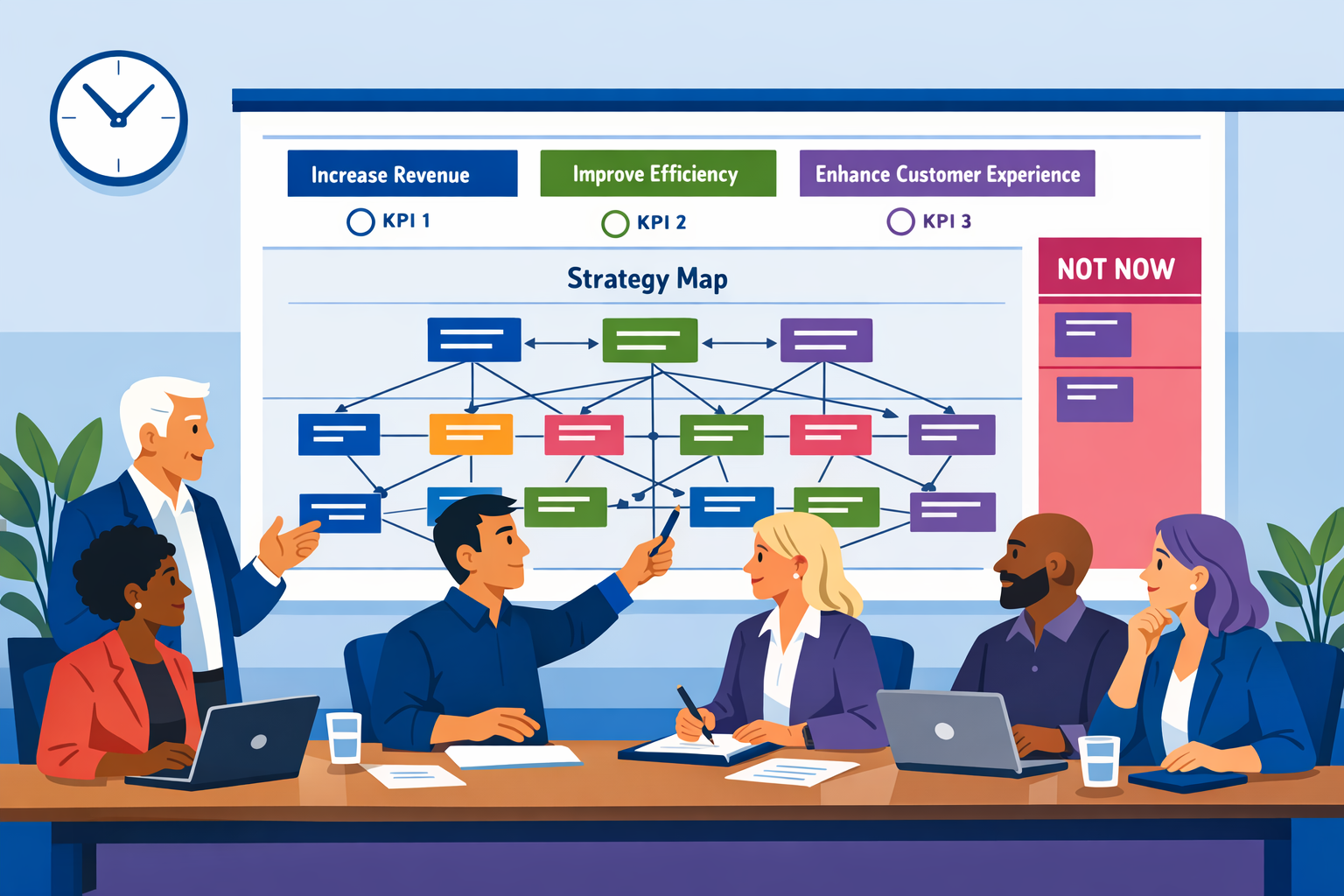
Mechanism 3: Create an alignment map that shows who owns what
Misalignment thrives in the gaps between teams. You need an explicit map connecting:
- Company outcomes
- Team outcomes (contributions)
- Key initiatives
- Single-threaded owners
- Dependencies and constraints
This is not bureaucracy. It is basic engineering. If you cannot trace work to outcomes, you are not managing the system.
A simple format that works:
- Outcome: what changes
- Owner: one accountable leader
- Contributors: teams that must deliver something
- Initiatives: 3 to 6 big bets only
- Dependencies: what could block us
- Measures: leading and lagging indicators
Tactical action this week:
- Build the alignment map in a shared document.
- Review it live with all functional leads.
- Do not leave the meeting until every initiative has a single owner and a clear link to an outcome.
Mechanism 4: Install decision rights, so decisions stop bouncing
Scaling organisations drown in “alignment conversations” that are really decision avoidance. If decisions are not getting made, it is often because nobody knows who has the right to decide.
Define decision rights for the decisions that create the most friction. Typical examples:
- What counts as a P0 priority
- Who can change scope once work has started
- What qualifies as a roadmap commitment
- Pricing and discount boundaries
- Hiring approvals and role design
Use a simple model such as:
- D: Decider (one person)
- R: Recommenders (input)
- I: Informed (no veto)
Then enforce it. Alignment improves when debate has an endpoint.
Tactical action this week:
- List your top 10 recurring decisions.
- Assign D, R, and I for each.
- Publish it and reference it every time a decision starts looping.
Mechanism 5: Run a weekly execution cadence that exposes drift early
If you only inspect alignment monthly, you are choosing to be surprised. Weekly is the right tempo for scaling teams because it is fast enough to correct course and slow enough to avoid thrash.
A tight weekly cadence looks like this:
- Metrics first: 10 minutes on the few measures that matter
- Progress by outcome: not by department updates
- Blockers and decisions: identify, assign, resolve
- Commitments: what will be true by next week
Rules that make it work:
- No slide decks
- No status theatre
- If it is off-track, you say it is off-track
- If a decision is needed, you name the decider and the deadline
Research on execution rhythms and goal systems consistently shows that frequent, specific check-ins improve follow-through because they reduce ambiguity and increase accountability. In practice, the mechanism is simple: problems surface earlier, while they are still cheap to fix.
Tactical action this week:
- Create a 45-minute weekly outcome review.
- Use a fixed agenda and a shared scorecard.
- Cancel it only if you have nothing important to deliver, which should worry you more than the meeting.
Mechanism 6: Make trade-offs visible with a ruthless “Not Now” list
Scaling teams do not struggle to generate ideas. They struggle to say no without creating resentment.
That is why you need a “Not Now” list that is public, maintained, and justified. It does two things:
- Protects focus
- Proves you are not ignoring requests, you are prioritising intentionally
Structure it like this:
- Item: request or initiative
- Requested by: person or team
- Decision: not now, with review date
- Reason: which outcome it does not support, or what it displaces
Tactical action this week:
- Create the list.
- Move at least 5 active “background priorities” onto it.
- Publish it and review it fortnightly.
Mechanism 7: Align incentives and performance conversations to outcomes
You get what you reward. If you say outcomes matter but you promote people for activity, you are training misalignment.
Make outcomes a formal part of:
- Leadership one-to-ones
- Team performance reviews
- Promotion criteria
- Recognition moments
This does not mean turning everything into a spreadsheet. It means you consistently ask the same hard question:
“What measurable outcome did your work move, and what did you stop doing to make it happen?”
Tactical action this week:
- Update your one-to-one template to include outcomes, not tasks.
- In your next leadership meeting, recognise a trade-off decision, not just hard work.
What leaders get wrong when they try to “improve alignment”
Most alignment efforts fail because they treat symptoms. Here are the common traps that keep scaling teams stuck.
Trap 1: You confuse alignment with agreement
Alignment is not consensus. It is coordinated action. You can have disagreement and still have alignment, as long as the decision is made and committed to.
Trap 2: You add process instead of clarity
When execution slips, leaders often add checkpoints. If the work is not connected to outcomes, extra checkpoints just create more meetings around the wrong work.
Trap 3: You ask middle managers to translate strategy without giving them tools
If your strategy is not operationalised into outcomes, decision rights, and an alignment map, your managers are forced to improvise. Then you blame them for inconsistency that you designed.
Trap 4: You treat cross-functional work like a moral issue
“We need to collaborate better” is usually nonsense. The issue is unclear interfaces, unclear ownership, and hidden dependencies. Fix the system and behaviour improves.
A high-level implementation plan (30 days to calmer execution)
You can implement the Alignment Stack without a transformation programme. Here is a high-level plan that fits into real leadership time.
Days 1 to 5: Make strategy usable
- Write the one-page strategy with explicit trade-offs
- Define 3 to 5 measurable outcomes for the next horizon
- Publish both internally as the source of truth
Days 6 to 15: Connect work to outcomes
- Build the alignment map with owners, initiatives, dependencies
- Create the “Not Now” list and move work onto it
- Define decision rights for the top recurring decisions
Days 16 to 30: Install cadence and accountability
- Launch the weekly outcome review with a shared scorecard
- Update one-to-ones to focus on outcomes and trade-offs
- Run a fortnightly dependency review across team leads
If you do only one thing: implement the weekly outcome review. It forces reality to surface, and reality is where alignment starts.
How to tell if alignment is improving (without kidding yourself)
You will know alignment is improving when the organisation starts behaving differently.
Look for these signals:
- Fewer priorities and faster delivery on the ones that remain
- Cleaner handoffs between teams, with fewer “urgent” surprises
- Decisions made once, not re-litigated in every meeting
- Managers escalating less because decision rights are clear
- Teams using the same language for outcomes and trade-offs
Also watch for a specific shift in leadership workload.
Misalignment forces senior leaders to spend their days translating, negotiating, and re-prioritising. Alignment gives them leverage. They spend more time on direction, capability, and building the next constraint in the system.
The point: alignment is a leadership system, not a leadership trait
Strategic alignment in scaling teams is not achieved by inspirational speeches or another offsite.
It is achieved by installing a small set of mechanisms that:
- Make strategy concrete
- Force trade-offs
- Connect work to outcomes
- Assign ownership
- Speed up decisions
- Expose drift early
If you are scaling and alignment feels like it is slipping through your fingers, that is normal. What is not acceptable is pretending it will fix itself.
Build the system. Then let the system do the heavy lifting.
Next Steps
Want to learn more? Check out these articles:
How Leaders Can Think Strategically: Blueprint for Success
To find out how PerformanceNinja could help you, book a free strategy call or take a look at our Performance Intelligence Leadership Development Programme.