
Key Leadership Skills for 2026: What To Master Next
Introduction
If 2024 felt busy and 2025 felt complex, 2026 will feel unforgiving. The economy will stay jittery. AI will accelerate the pace and volume of work. Bureaucracy will creep in as you scale. Your best people will not wait around for clarity or courage from the top. If you are a senior leader, here is the hard truth: the skills that got you here are not the skills that will keep you here.
This is a practical, hard-edged playbook of the key leadership skills for 2026. It names the pain, shows you where to focus, and gives you the moves. No fluff. No fads. Just the disciplines that build resilient, high-output, adaptable organisations.
The 2026 Reality You Must Lead In
We are operating in a VUCA context. Volatility, uncertainty, complexity and ambiguity are not slogans; they are the normal state of the market you sell into and the system you lead. That demands a different operating model and a different set of leadership muscles than the old command and control playbook can provide .
The most effective organisations are shifting from rigid hierarchies to empowered networks, with leaders acting as catalysts rather than controllers. Work becomes an evolutionary cycle of learning and adaptation, not a rigid plan you defend at all costs. This is the leadership shift we must master to win in 2026 .
Twelve Key Leadership Skills For 2026
These are not abstract virtues. Each one translates to concrete actions that increase performance.
1) Outcome Alignment and Execution Discipline
Busy is not progress. In 2026, the foundational skill is aligning work to outcomes and inspecting execution with rigor.
- Tie Objectives and Key Results directly to strategy. Avoid the classic traps that turn OKRs into theatre, such as fragmented setting, imposed cascading and setting-and-forgetting. Build an OKR system that keeps attention on outcomes and prevents misalignment .
- Convert tasks into clear deliverables. Make every commitment reviewable in a weekly rhythm. Inspect outputs, not activity .
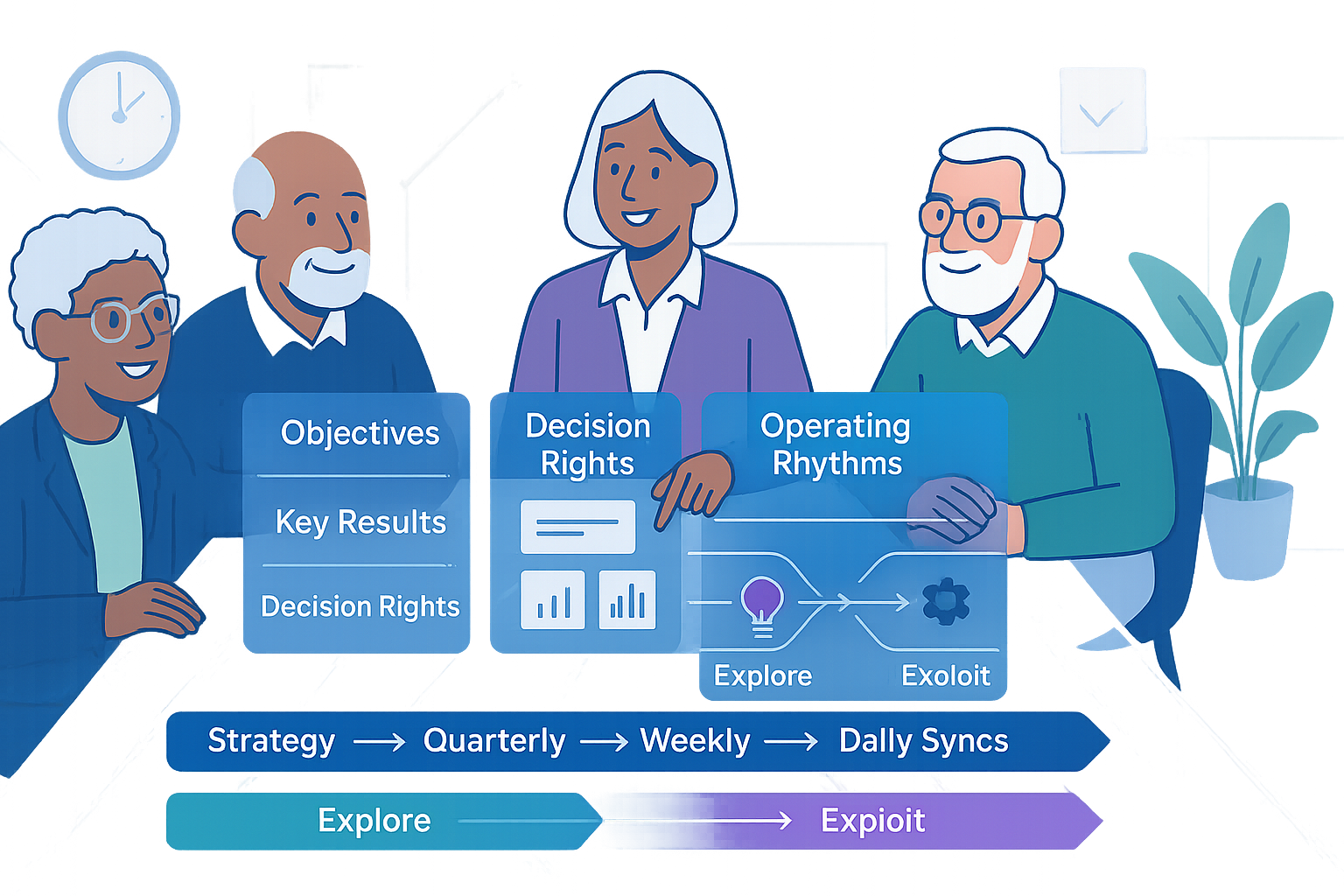
- Run a visible productivity cadence. Use a simple strategic-to-daily rhythm to keep everyone focused on the right things at the right time, every time .
2) Leader’s Intent and Decision-Rights Clarity
Your speed is capped by the clarity of decision rights.
- State Leader’s Intent for every priority: “I intend to… I’ve checked…” This simple ritual increases ownership, bias to action and safe empowerment .
- Codify decision rights. Decide who recommends, who decides, who performs, who gives input and who is informed. Stop debates by making authority visible and balanced with accountability .
3) Emotional Intelligence and Non‑Anxious Presence
People do not perform at their best when their leader is anxious, defensive or opaque.
- Strengthen self-awareness, self-regulation and empathy. High EQ is consistently linked with top performance and revenue outperformance. It remains a core differentiator in 2026, not a soft add-on .
- Practise a non-anxious presence. Stay connected without absorbing team anxiety. Confront reality with calm engagement. It improves thinking quality across the system when the stakes rise .
4) Psychological Safety and Candid Learning Loops
Innovation and speed die where people fear speaking up.
- Build psychological safety deliberately. It is the foundation for high learning-rate teams and is measurable. Pair it with blameless debriefs to compound learning after events .
- Use practical rituals: pre-mortems before big decisions, explicit requests for critique during reviews, and end every meeting with clear commit statements to remove ambiguity .
5) Operating Model Literacy
In 2026, your role is to architect a way of working that scales clarity and speed.
- Treat your organisation’s operating system as a product. Make decision protocols, communications, workflows, reporting, goal-setting and metrics explicit and inspectable .
- Think team-of-teams. Push decisions to the edge. Create shared consciousness and empowered execution so local knowledge is converted into action fast .
6) Data Fluency and Evidence-Led Calls
AI will flood you with signals. The leaders who win will cut through noise with disciplined data use.
- Design dashboards that support decisions. Start with the user, prioritise what matters and provide context over time, not vanity numbers. Choose visualisations deliberately and raise the bar for what gets on the page .
- Default to data over guesswork for risk, capacity and performance calls. Use micro dashboards for real-time scanning and scenario planning for the bigger bets .
7) Resilience as a Practised Skill
Resilience is not a poster value. It is a set of behaviours repeated until they become muscle memory.
- Institutionalise pre-mortems, red teaming and stress tests. Maintain contingency plans and cross-train to reduce single points of failure. Review and learn after every meaningful event .
- Lead with a resilience mindset. Expect the unexpected. Keep buffers. Balance explore and exploit. This is how you maintain output in a VUCA environment without burning out your people .
8) Strategic Focus and Ruthless Pruning
Your calendar is a reflection of your courage.
- Publish Goals, Boundaries and Linkages for every strategic theme. It aligns teams, reduces friction and prevents turf wars as you scale .
- Prune aggressively. Kill work that does not move key results. Set a single compelling narrative to stop sprawl and force trade-offs .
9) Talent Systems, Succession and Capability Pipelines
Hiring stars is not a strategy. Building capability is.
- Make role clarity, succession and skills pipelines visible and managed. Coach, train and apprentice people intentionally. Define what good performance looks like and reinforce it consistently .
- Run workforce planning as a real investment thesis. Allocate time and budget where capability actually drives strategy, not where noise is loudest .
10) Culture by Design and Ethics with Teeth
Culture either accelerates you or taxes you.
- Codify the behaviours you expect. Hard-wire them into systems, rituals and consequences. Psychological safety and inclusion are non-negotiables for high performance in complex environments .
- Lead contextually. Align culture, structure, decision rights, metrics, symbols and stories to your strategy and season. Avoid one-size-fits-all slogans that ignore your reality .
11) Collaboration Architecture and Operating Rhythms
Meetings are not the work. Collaboration should increase flow, not cost.
- Establish explicit collaboration norms. Use a “Looking Up, Looking Back, Looking Forward” cadence across squads to maintain alignment and velocity as dependencies grow .
- Design a simple, shared operating rhythm from strategic reviews down to daily quick syncs. Keep promises, manage dependencies and reduce coordination waste .
12) Innovation Without Distraction
Most teams muddle exploration and execution. That is why innovation drains focus.
- Separate Explore from Exploit. Use a single backlog, a rapid design loop and explicit learning metrics for experiments. Run OKRs for delivery and resist mixing the two streams .
- Track learning per cycle. Measure the learning rate and capture insights in a way that informs the next iteration, not just a retro slide nobody reads .
Where These Skills Fit In The Big Picture
When you view your organisation as a connected system, these skills map cleanly to the six drivers of performance.
- Purpose: Goals, Boundaries and Linkages, Leader’s Intent and a single compelling narrative align effort to a meaningful why and the right what.
- People: EQ, non-anxious presence, psychological safety, coaching and talent pipelines develop capability and confidence.
- Proposition: Strategic focus and explicit trade-offs sharpen where and how you create value.
- Process: Operating model design, decision rights and collaboration norms create flow and reduce friction.
- Productivity: Execution discipline, rhythms, data visibility and accountability increase throughput on the right work.
- Potential: Explore vs Exploit discipline, resilience practices and learning-rate metrics keep the future alive without derailing the present .
Tactical Moves You Can Implement In 30 Days
You do not need a reorg to start improving.
- Publish Leader’s Intent for your top three priorities. Write one paragraph for each and get your directs to do the same. Use this language in every update. You will feel the speed increase in two weeks .
- Clarify decision rights on your most argued topic. Use a simple R, A, D, I, P map. Share it. Enforce it. Watch meetings shrink and ownership rise .
- Convert all tasks on your team’s plan into inspectable deliverables. End meetings with commit statements and owners. Move to weekly output reviews, not status tours .
- Run one pre-mortem on your riskiest initiative and one blameless debrief after your next event. Capture insights, change one process, and communicate the change .
- Re-baseline your OKRs against strategy. Kill one initiative that does not move a key result. Do it publicly and explain why. Model strategic courage .
- Launch a simple dashboard. One page. Five metrics. Time-series context. Decisions it will inform. Remove one metric every week until only signal remains .
Common Traps To Avoid In 2026
Smart leaders still fall into predictable holes. Avoid these and you will outperform.
- Activity masquerading as progress. If you are not inspecting deliverables weekly, you are managing theatre. Anchor to outputs and outcomes, not effort .
- Confused authority. When decision rights are fuzzy, issues escalate and windows close. Codify rights, assign single owners and push decisions to the edge .
- OKRs as paperwork. Fragmented, imposed, ignored OKRs waste attention and encourage sandbagging. Build an OKR system that aligns, reinforces and reviews, week after week .
- Psychological safety as a poster. Safety without candour is comfort. Candour without safety is cruelty. Measure it, coach it and pair it with blameless debriefs and explicit critique requests .
- Innovation by distraction. If Explore and Exploit share the same meetings, tools and metrics, delivery will suffer. Separate streams, link learnings intentionally and protect exploration time .
A High-Level 90‑Day Implementation Plan
This is the minimum viable transformation to get 2026‑ready.
Weeks 1–2: Diagnose
- Map your top five priorities to clear outcomes and current OKRs. Publish Leader’s Intent. Identify decision-rights hot spots. Baseline psychological safety and execution rhythm.
Weeks 3–6: Design
- Codify decision rights for two critical flows. Redesign your weekly operating rhythm around inspectable deliverables. Create a one-page dashboard. Define Explore vs Exploit cadences.
Weeks 7–12: Drill
- Run pre-mortems on two key bets. Hold blameless debriefs after every major event. Prune low-impact work. Coach managers in EQ and non-anxious presence. Track the learning rate and execution throughput.
Brutal Truth, Practical Hope
The gap between average and excellent leadership will widen in 2026. The average will stay reactive, drown in meetings, and mistake motion for momentum. The excellent will design clarity, practise courage and build systems that convert uncertainty into advantage.
Do the work now. The organisations that master these skills will move faster, fail safer and scale value when others stall.
Next Steps
Want to learn more? Check out these articles:
Manager Communication Playbook: What to Say, When, and How
Leader’s Intent in Practice: A Playbook to Align and Execute
Build a Weekly Leadership Rhythm That Works Week After Week
To find out how PerformanceNinja could help you, book a free strategy call or take a look at our Performance Intelligence Leadership Development Programme.