
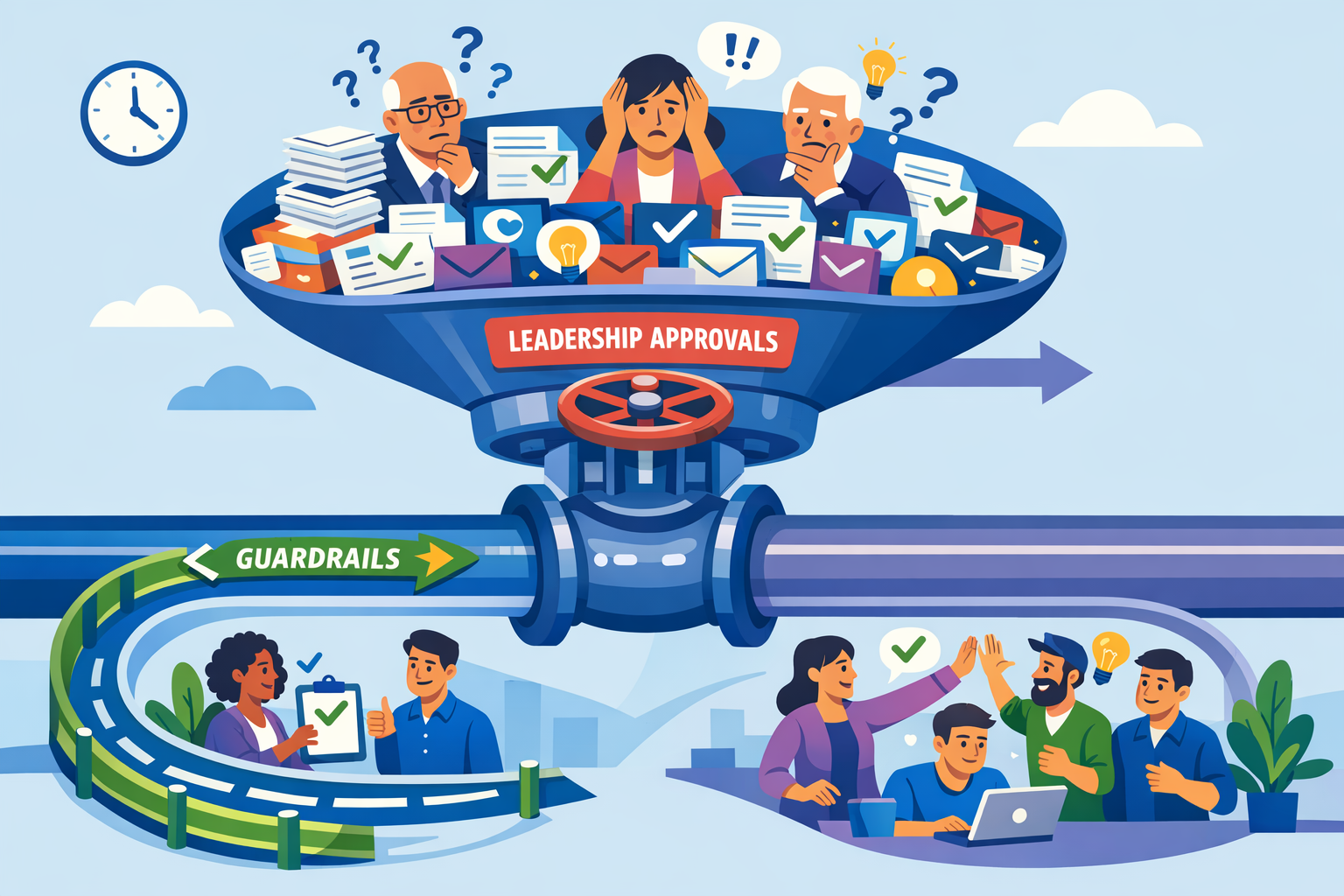
How to Stop Leadership Bottlenecks Slowing Your Growth
Growth does not usually die from lack of ambition. It dies because everything has to go through you.
If your senior leaders are drowning in approvals, your managers are waiting for direction, and decisions are stacking up like aircraft in a holding pattern, you do not have a “capacity” problem. You have a leadership bottleneck problem.
And the brutal truth is this: leadership bottlenecks are self-inflicted. They are created by unclear decision rights, weak management systems, under-developed leaders, and a culture that mistakes “being involved” for “being effective”.
This article shows you how to stop leadership bottlenecks from slowing growth, using practical fixes that work in the real world. No theory. No motivational fluff. Just the moves that unclog execution, restore pace, and make scale possible.
Leadership bottlenecks are not a workload issue
Most organisations misdiagnose the problem as overwork at the top. So they try to “help the leaders” with:
- More assistants
- More meetings
- More dashboards
- More project managers
That is like adding more buckets to a leaking roof. The issue is not that leaders have too much to do. The issue is that the organisation has trained itself to route decisions upward.
A leadership bottleneck is a structural pattern where the organisation cannot move without one or two key people making calls, signing off work, or resolving conflicts. When that happens, growth hits a ceiling.
Common signals:
- Projects stall until the founder or exec steps in
- Managers escalate decisions that should be routine
- Teams “wait for priorities” instead of owning delivery
- Leaders are in back-to-back meetings but outcomes do not improve
- Cross-team work becomes a political negotiation, not an execution system
If you recognise these, do not “work harder”. Redesign the system.
Why bottlenecks appear as you scale
In small teams, centralised leadership works. Speed comes from proximity and shared context. As headcount grows, the same approach creates drag.
Bottlenecks usually come from four root causes.
1) Decision rights are fuzzy
If nobody knows who owns a decision, everybody escalates it. The default owner becomes the most senior person available. Over time, that person becomes the organisational choke point.
2) Managers were promoted but not rebuilt
Many growing firms promote high-performing individual contributors into management, then expect them to magically lead, prioritise, coach, and coordinate. Without a system and skill upgrade, they will:
- Over-consult upwards
- Avoid committing
- Send problems to the exec team for “alignment”
3) The organisation confuses control with quality
Leaders often insert themselves because they fear standards slipping. The intent is good. The impact is lethal. You cannot scale quality through personal involvement. You scale it through clear standards, repeatable processes, and robust review mechanisms.
4) You have not separated strategy from operations
When senior leaders spend their time deciding operational details, strategy becomes an afterthought. The organisation loses direction, then generates more escalations because priorities are unclear. This creates a vicious loop.
The cost of leadership bottlenecks (it is bigger than you think)
Leadership bottlenecks feel like “slowness”. The real cost is compounding.
- Lost throughput: work waits for approvals, decisions, and conflict resolution
- Lower accountability: people learn that ownership is optional because escalation is always available
- Talent decay: high performers leave when they cannot act with autonomy
- Culture drift: politics rises because power sits with access to leadership, not clarity of responsibility
- Strategic blindness: leaders become reactive operators and stop thinking ahead
McKinsey’s work on organisational health and decision effectiveness repeatedly points to decision quality and speed as core performance differentiators. In practice, that translates to a simple observation: when decisions slow down, growth slows down.
The fix: design an organisation that does not need you
Solving bottlenecks is not about delegating harder. It is about building a system where the right decisions are made at the right level, with the right information, at the right speed.
At a big-picture level, use a simple diagnostic across PerformanceNinja’s 6Ps:
- Purpose: are priorities clear enough that teams can act without constant clarification?
- People: do managers have the capability and confidence to decide and deliver?
- Proposition: is strategy explicit, or trapped in leaders’ heads?
- Process: are there repeatable ways of working, or is everything a one-off?
- Productivity: do you have a real execution cadence, or just busy calendars?
- Potential: are you innovating deliberately, or distracting the business with random initiatives?
Now the tactical steps.
Step 1: Declare your decision inventory (yes, write it down)
You cannot fix what you cannot see. Most leadership teams have no documented view of what decisions are being escalated and why. Start with a two-week decision inventory.
For 10 working days, capture:
- The decision
- Who made it
- Who should have made it
- Why it escalated
- How long it took
- Impact of delay
Do not overcomplicate this. A shared spreadsheet is enough. The point is to expose patterns.
You will typically find that 60 to 80 percent of escalations fall into a handful of categories:
- Pricing and discounting exceptions
- Client scope and priority conflicts
- Hiring approvals
- Product or delivery trade-offs
- Cross-team resource allocation
This inventory becomes your bottleneck map.
Step 2: Define decision rights using “D-A-I”
Forget complex governance models that nobody remembers. Use a simple rule set for each recurring decision category:
- D = Decider: one person who makes the call
- A = Advisors: people who must be consulted before the call
- I = Informed: people who must be told afterwards
Then apply two constraints:
- Constraint 1: the Decider must sit as low as possible in the organisation while still having competence and context
- Constraint 2: Advisors must be limited, otherwise consultation becomes a delay mechanism
Example: discounting.
- Decider: Head of Sales
- Advisors: Finance (margin guardrails), Delivery (capacity constraints)
- Informed: CEO, Account team
Then set thresholds, so the CEO is not dragged into routine deals:
- Discount up to 10 percent: Head of Sales decides
- Discount 10 to 20 percent: Head of Sales decides with Finance sign-off
- Discount above 20 percent: CEO decides
This is how you buy back executive time without losing control.
Step 3: Replace “approval” with “guardrails”
Approvals are a tax on speed. Guardrails protect quality without forcing escalation.
Guardrails are explicit boundaries that allow teams to act independently. Typical guardrails include:
- Financial: budget limits, margin floors, delegated authority levels
- Customer: service level commitments, escalation triggers, red-line contract clauses
- Brand and quality: definition of done, review checklists, QA standards
- Risk: security and compliance non-negotiables
If a team operates inside guardrails, they do not need permission. If they want to break a guardrail, escalation is required. That is the correct use of senior attention.
Step 4: Build a real execution cadence (meetings are not a cadence)
Most leadership bottlenecks are fuelled by one thing: the organisation has no reliable rhythm for prioritising, tracking, and unblocking work. So everything becomes a meeting, and every meeting becomes a decision hunt.
A functional execution cadence has three layers.
Weekly: delivery and blockers
Purpose: keep commitments on track and remove friction fast.
- 30 to 45 minutes per team
- Review top priorities, progress, risks, and interdependencies
- End with explicit owners and deadlines
Non-negotiable rule: issues do not float. They get owned or parked with a decision deadline.
Fortnightly or monthly: cross-team alignment
Purpose: resolve dependencies and resource conflicts without dragging in the exec team.
- Representatives from key functions
- Decisions are made using D-A-I rules
- Escalations are the exception, not the norm
Quarterly: strategy and direction reset
Purpose: ensure teams are not executing the wrong work efficiently.
- Reconfirm priorities
- Kill or pause low-value initiatives
- Make resourcing decisions explicit
This cadence creates organisational reliability. Reliability reduces escalations.
Step 5: Upgrade managers from “doers” to “owners”
If your managers cannot own outcomes, leaders will keep stepping in. This is not a personality problem. It is a capability and expectation problem.
Make the shift explicit. Managers must stop being the best problem-solver in the room and start being the person who ensures problems get solved.
Install three management non-negotiables:
1) Ownership statements
For every manager, define 5 to 8 outcomes they own, written in plain language. Not tasks. Outcomes.
- “On-time delivery above 95 percent”
- “Gross margin maintained above X”
- “Customer renewal rate above Y”
If it is owned, it is decided there first.
2) Coaching rhythm
If managers are not coaching, they are not building capacity. Require:
- Weekly 1:1s with direct reports
- Monthly performance and development review conversations
- Clear feedback, early, not after damage is done
3) Decision competence
Give managers a standard decision method. For example:
- Define the decision in one sentence
- List options, including “do nothing”
- Define success and constraints
- Choose and communicate
- Review outcomes after two to four weeks
Decision skill is trainable. But only if you demand it.
Step 6: Stop letting meetings masquerade as leadership
A common bottleneck pattern is “decision by meeting”. Everybody attends. Nobody decides. The leader becomes the default judge.
Fix it with meeting rules that force clarity:
- Every meeting has a named owner
- Every meeting has a written purpose: decide, plan, solve, or inform
- Any item labelled “decide” must have a Decider named in the invite
- Pre-reads are mandatory for decision meetings
- If no decision is made, the meeting is considered a failure
Expect resistance. People are addicted to meetings because meetings feel like progress. They are not progress. Delivery is progress.
Step 7: Design escalation paths that do not involve the CEO
Escalation is not bad. Uncontrolled escalation is bad.
Define escalation paths that route problems to the right level:
- Operational blockers: escalate to the relevant functional lead within 24 hours
- Cross-functional trade-offs: escalate to a designated “integration” forum (not the exec team)
- Customer risk: escalate via a defined client health process with clear triggers
- People issues: escalate to the manager first, then HR or a people lead if unresolved
Then apply a strict rule: do not escalate without proposing at least one recommended decision. This stops leaders becoming problem dumpsters.
Step 8: Create a single source of truth for priorities
Bottlenecks explode when priorities are unclear. People escalate because they do not want to be blamed for choosing wrong.
You need a visible, maintained priority system that answers:
- What are the top priorities this quarter?
- What does “done” look like?
- Who owns each priority?
- What is not being done?
Tools do not matter. Discipline does. A shared document maintained weekly beats an expensive platform nobody trusts.
When bottlenecks are a culture problem (and they often are)
Sometimes the system is fine, but the culture punishes autonomy. Leaders say “take ownership” then undermine decisions, rewrite work, or publicly second-guess managers. That trains dependence.
If you want bottlenecks gone, you must change the leadership contract:
- Leaders stop rescuing and start coaching
- Mistakes become learning events, not blame events
- Managers are backed when they decide within guardrails
- Performance is measured by outcomes, not busyness
This is where many organisations fail. They want speed and control. You do not get both at the same level. You get speed through distributed authority and strong standards.
A brief implementation plan (30 days to visible relief)
You do not need a six-month transformation to feel impact. You need focus and follow-through.
Days 1 to 5: expose the bottleneck
- Run the decision inventory
- Identify top 10 recurring escalations
- Quantify delay cost where possible
Days 6 to 15: lock decision rights and guardrails
- Define D-A-I for the top 10 decisions
- Set thresholds and guardrails
- Publish decision rights in a place everyone can find in 30 seconds
Days 16 to 30: install the cadence and meeting rules
- Implement weekly delivery reviews per team
- Create a cross-functional alignment forum with decision authority
- Enforce meeting rules and pre-reads for decision items
By day 30, you should see fewer escalations, faster decisions, and less executive fire-fighting. If you do not, it means one of two things: decision rights are still unclear, or leaders are still behaving like the bottleneck.
The hard truth: you might be the constraint
If you are the CEO or founder, here is the uncomfortable question you should ask yourself:
Are you the bottleneck because the organisation needs you, or because you need to be needed?
Some leaders stay central because it feels safe. Because it preserves identity. Because it avoids the risk of others making imperfect decisions.
But growth demands a trade. You must give up centrality to gain scale.
The goal is not to make yourself irrelevant. The goal is to move your attention up the value chain:
- From approving to setting standards
- From solving to designing systems
- From reacting to shaping the future
That is organisational leadership. And it is the only way to stop leadership bottlenecks from slowing growth.
Next Steps
Want to learn more? Check out these articles:
How to Research a Company Before a Job Interview Properly
Month-One Wins: The Practical Playbook to Prove You Belong
First-Month Goals That Matter: Build Trust and Ship Value
To find out how PerformanceNinja could help you, book a free strategy call or take a look at our Performance Intelligence Leadership Development Programme.